


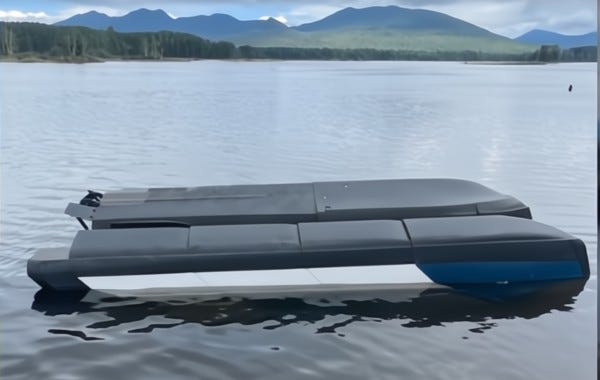
“So carelessly and negligently conducted himself as to cause the accident.”
Investigators in Maine have concluded that an “engineering design flaw” lead to the deaths of three women riding on a Sea-Doo Switch pontoon boat. The Canadian manufacturer of the jet powered craft, BRP is scrambling to correct the defect on the thousands of Switch boats already sold.
The circumstances of the accident are nearly identical to one that happened to a Clay County family in August 2024. William Grullon was slowing down his 13-foot switch near the launch ramp at the mouth of Black Creek when the boat flipped over forward suddenly.
The five adults were thrown clear, but Bianca Grullon, 16 months old at the time, was trapped underneath the overturned boats for nearly 10 minutes before being rescued by firefighters. As a result, she suffered a lifelong “catastrophic anoxic brain injury,” according to the family’s $30 million lawsuit against BRP.
The Maine case involving the 18-foot model of the Switch happened on Flagstaff Lake on August 30.
Maine Inland Fisheries & Wildlife were informed by the Coast Guard that at least 15 cases of Switch boats flipping forward have been recorded, including the Grullon accident and a child fatality in Virginia.
The conclusion that a design defect contributed to the Maine accident has not stopped BRP from deflecting blame in the case here. Lawyers for BRP told the judge that the father, who had been operating the Switch, “so carelessly and negligently conducted himself as to cause the accident.”
The Switch can travel at more than 30 miles per hour, but none of the injury or death cases involved speed—or alcohol. Weather and sea conditions were not a factor, either. The Maine operator was not charged, nor were operators in the Virginia or Clay County cases.
In each case, the Switch was going slow or decelerating when the bow went under water, and the boat flipped over forward; victims were trapped under the overturned vessel, held in by the fence assembly around the edge of the deck.
After the Florida accident in August 2024, Clay News & Views researched Switch owner accounts on Facebook describing their own close calls and hypothesized that the forward flips were caused by water in outer pontoons flowing forward during quick deceleration. Owners said they had been told that the outer pontoons allowed water to seep in to provide stability at rest and that it would exit the vessel when operated at speed.
A Sea-Doo Switch is essentially a jet-ski in the middle of a pair of outer pontoons. The center hull contains the machinery space and is designed to be watertight, at least in its aft section.
The U.S. Coast Guard, issued two safety alerts last year, concluding that water movement in the forward part of the middle hull was also to blame for destabilizing the craft as it rushed forward upon deceleration. The factory has a recall in effect to install gasketing to make the hulls watertight.
Maine wardens picked up the same middle-hull language in their October 27 report on the Flagstaff Lake accident, which referenced Coast Guard safety alerts and a study from BRP itself about a Switch tendency to ride bow-down at slow speed:
It’s known that the design of this vessel allows water from the waterbody it sits on to enter the middle pontoon (hull) until it reaches equilibrium water pressure. This force acts as a ballast for the vessel to help maintain stability at rest. Per the design, as the vessel increases speed to a “planing” speed, the water is designed to drain from the hull. At speeds prior to planing, the water is not draining and the free surface effect of the interior water is causing uneven pitch to the vessel, mixed with human weight sitting on the deck and the negative trim angle, can cause the vessel to taken on more water and capsize. It is believed that this exact scenario is what happened to this vessel