


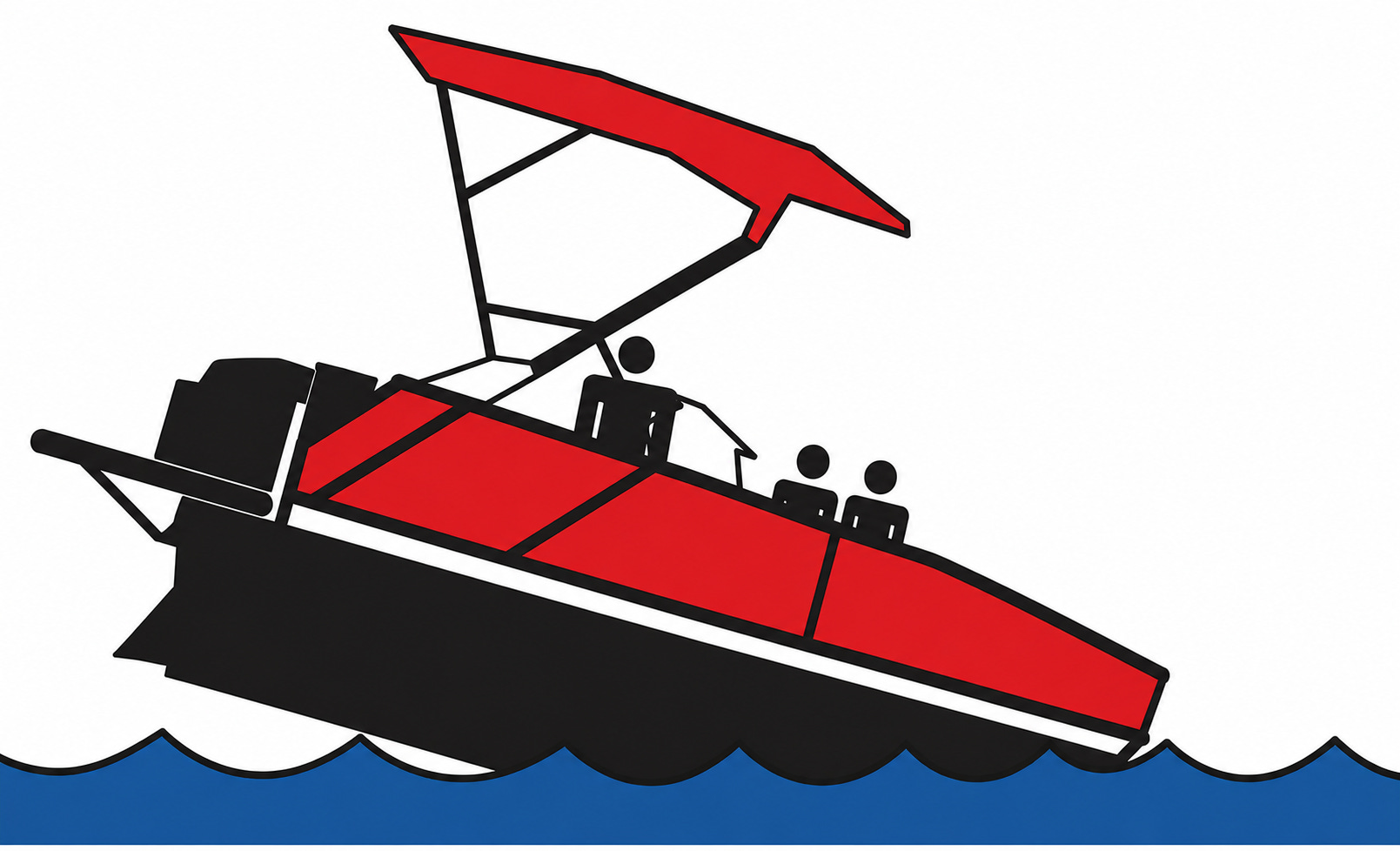
The type of Sea-Doo Switch hybrid jetski-pontoon boat that flipped over on the St. Johns River here, leaving a Florida toddler crippled for life, will soon be equipped with a sensor-driven system designed to prevent accidents like that one.
The Switch has been shown to flip over forward under the right conditions. BRP recently announced that when the vessel senses those conditions, the machine itself will take control over the throttle.
This is the second remidiation effort by manufacturer BRP. The first was a safety recall to seal the hulls from half-filling with water that might then rush forward during deceleration, helping to plunge the nose of the boat under water.
Besides the Clay County infant—her name is Vianca Grullon—four Switch passengers have died after a forward flip. In October, the U.S. Coast Guard declared that these vessels presented a “capsizing hazard.”
“These capsizings have occurred when the vessel was operated with trim by the bow and the bow ‘digging into’ the water. Weather conditions and poor seamanship do not appear to be significant contributing factors,” Coast Guard investigators wrote.

BRP is fighting a $30 million lawsuit filed by the Grullons after Vianca suffered a “castastrophic anoxic brain injury” after the family Switch flipped forward on the St. Johns River, trapping her underwater for around 10 minutes. BRP blames Vianca’s father who it says was negligent in his operation of the vessel, and that’s why the boat flipped.
On May 28, BRP announced the introduction of the Intelligent Balance Assist system in a letter to Switch owners. The Canadian company said iBA was part of a new collection of “SMART accessories that automatically respond to vehicle inputs to support the overall riding experience.”
BRP did not mention the word “capsize” in the letter, but did say:
iBA helps operators avoid bow-down operation of the watercraft by temporarily lowering the throttle, which reduces the risk of capsizing, when it detects a combination of specific factors indicating a need for the operator to rebalance and evenly distribute passengers or cargo. These factors include speed, throttle input, and negative trim caused by front overload.
Typically, operators resolve front overload by evenly redistributing passenger and/or cargo weight to rebalance the watercraft. If an operator continues accelerating without rebalancing, iBA will prompt the operator to rebalance.
Once iBA engages, full throttle capacity will resume only when the watercraft is rebalanced. Operators may need to relocate passenger and cargo weight distribution to achieve even weight distribution and balance the watercraft.
In other words, in order to avoid the conditions that lead to those fatal or near fatal flips mentioned at the beginning of the story, the machine takes control from the operator.
Control can be complicated. Switch owner Brian Garrison once described the technique that he used to avoid plunging the nose of the boat when decelerating.
Slow down evenly and gradually. Then when your wake catches up to you, just before it hits, increase gas slightly to counter the push of the wake on the back of the boat, then ease off again. repeat to keep the bow up until the wake evens out and the boat settles. Basically, stopping too fast can cause the momentum of the boat to push the nose down, if you combine that with the push that the boat’s own wake catching up to it, that also causes the nose to dip. Combine that with any waves you may hit, that could further dip the bow. Combine that with too much weight in the front, and you have a bad day.
To the largely inexperienced customer base that is drawn to the Switch’s affordable price and promise of fun on the water, the iBA may prove a godsend. All models will come standard with the technology in 2027, and BRP will retrofit earlier models free of charge. (There are four models from 13 to 21 feet LOA, powered by 130 or 170 horsepower Rotax jet drives.)
Despite the application of this largely accepted automotive-style technology to a watercraft, a vocal cadre of owners balked at the notion of ceding control of their boat to an onboard computer. The naysayers are making their voices heard—where else?—on Facebook.
“Purely a CYA by BRP. my guess is it will be a throttle tune to spread out throttle closing event preventing a more than 50 percent throttle to zero percent throttle from happening to quickly,” Devin Lott said.
“This is for the stupid and oblivious drivers,” Geoffrey Mellot wrote. “I routinely drive with the bow a little overloaded. the quick fix is to accelerate more rapidly from idle or a slow speed. There is a speed where the bow will plow down, but that’s still pretty slow, and self correcting after a time or two, if the driver is paying attention when/why water comes over the deck.”
“I’d trust a drink from Bill Cosby before I trust that system,” Steve Giacobbi said.
A lawyer for the Grullons reacted to BRP’s announcement. “This product is going down very fast,” Attorney Judd Rosen said.
The Grullon lawsuit is in it’s deposition phase as Grullon family lawyers grill BRP executives and engineers. Trial is scheduled to begin on October 5 in the Circuit Court of Duval County before Judge Katie Dearing.