


It was the first Friday of June, and “Boater Skip Day” had drawn thousands of open-boat partygoers to a sandbar off Bayard Point in the St. Johns River. They anchored. They rafted vessels together. All day long, they pounded down cans of Michelob Ultra and gawd-awful booze spritzers so favored by Millennials.
So, by late-afternoon—Yeti coolers depleted—a certain percentage of happy skippers drunk-drove their center-consoles and pontoon boats back to base. As always for big events, the river cops were out in force to deter bad behavior, but this year was different.
This was the first Boater Skip Day since a new Florida law went into effect preventing state and local police from boarding civilian boats for “random safety inspections,” a pretext in which a whiff of regurgitated Ultra begets a field sobriety test.
Not anymore, probable cause only, according to the Boater Freedom Act of 2025. An operator would have to be seen actually engaging in bonehead behavior to get arrested.
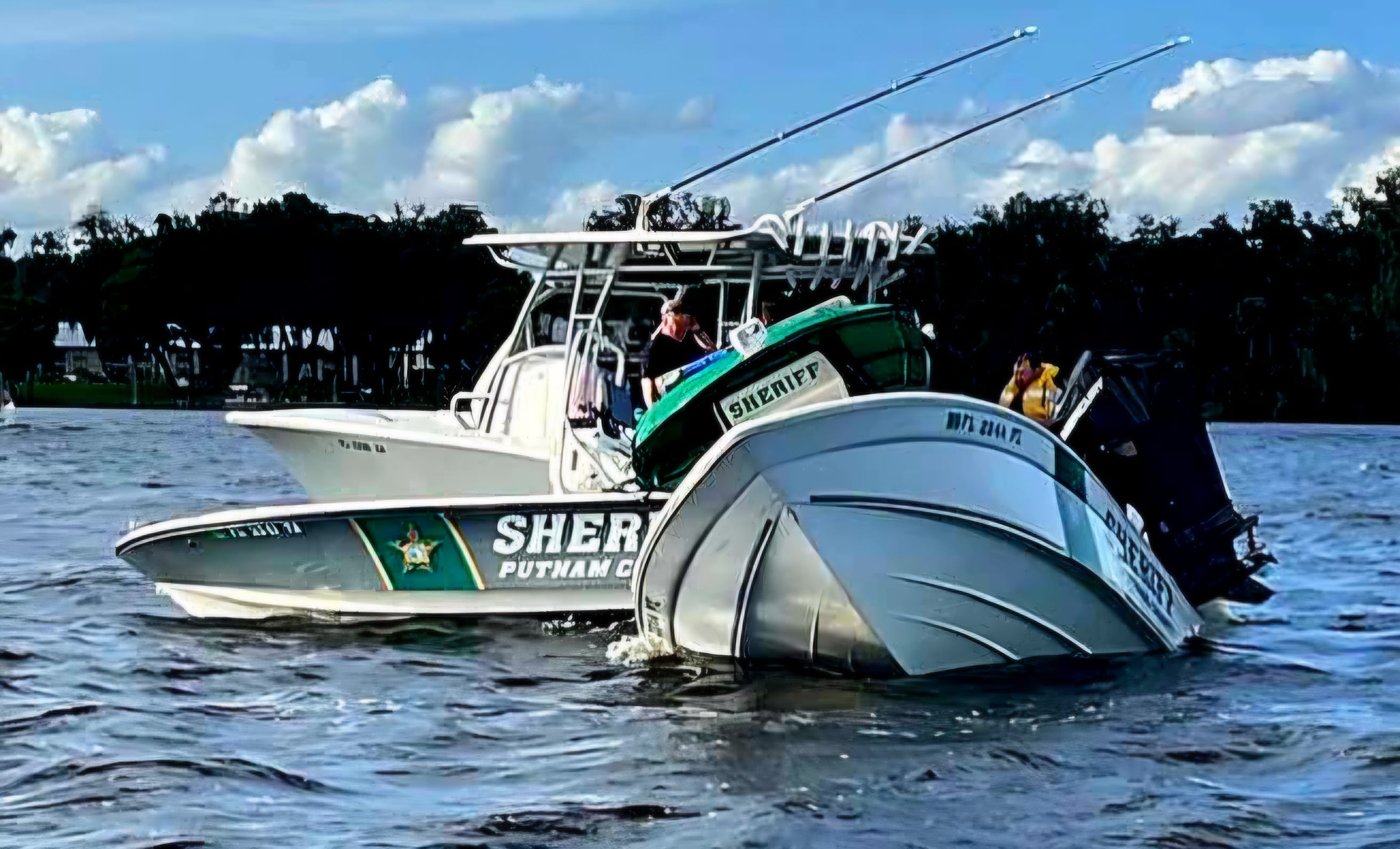
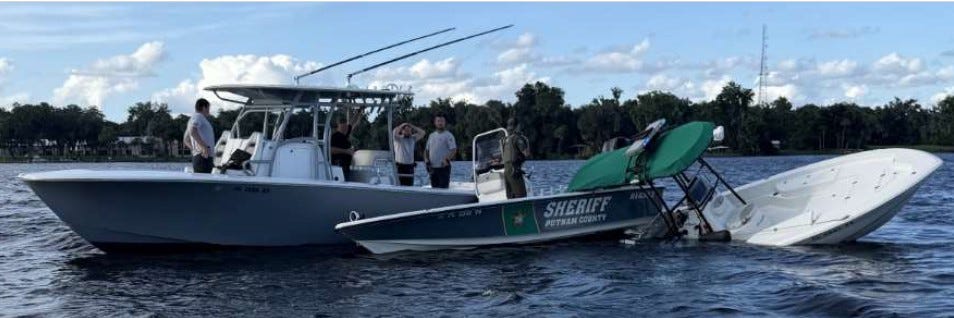
Remarkably, however, there was only one major bonehead event in the aftermath of Skip Day this year. Ironically, the crash involved two of the most certifiably sober boats in the crowd. Two Putnam County Sheriff’s Department patrol boats collided, after one had thrown its operator into the river and then ran in circles like a scalded dog until it hit the other.
This is the part that’s not amusing: None of the four officers involved in the crash was badly hurt, but reading the after-action report makes it clear that people could have been killed. Preliminary estimates priced the amount to repair damage to the patrol boats at $55,000.
The accident happened during a “training exercise,” according to the Fish & Wildlife officer who investigated:
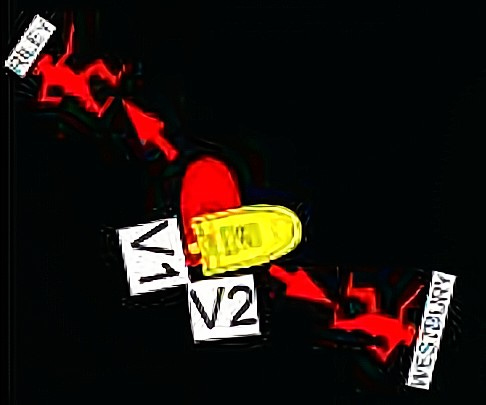
While returning to Palatka from patroling and boating safety enforcement, the deputies began conducting training exercises involving tactical vessel approaches and wake crossings. During these maneuvers, both vessels were heading north on the river, on plane, at an unknown speed. V2 was lead vessel and V1 was following behind on the starboard side. V1 crossed the wake of V2 to approach the port side. While crossing, V1 overcorrected the steering which ejected the occupant. Deputy Riley was not wearing a vessel kill switch when he was ejected. V1 began spinning under power in a clockwise direction. V2 pulled Deputy Riley from the water.
(Kill switches were in the news recently. One of them played a part in the unsolved case of the wife who disappeared during a dinghy ride in the Bahamas. On April 4, Lynette Hooker supposedly fell overboard, and her body was never found. Her husband Brian said he couldn’t save her because the boat’s outboard motor stopped running.
(The suggestion is that Lynette, not Brian, was the person connected to the motor’s kill switch by a lanyard. By going overboard, she shut down the motor.)
In Florida, it is a violation to operate a jetski without attaching the kill-switch lanyard. However, marine police have been known to lecture civilian operators that this is also a “best practice” when underway in any outboard watercraft.
‘Bullet Boat’
Vessel 1, as the FWC officer calls it, was being operated by Deputy John Riley (experience: 10 to 100 hours). The failure to attach the kill-switch lanyard to himself is an omission right out of Water Cop 101 and the root cause of everything that followed. In the parlance of marine law enforcement, V1 had become the “bullet boat,” but, unlike a bullet, runaways inevitably adopt a circular path. In this case, the boat circled clockwise.
According to the Fish & Wildlife report, released yesterday, the Putnam deputies tried two by-the-book tactics to rein in the runaway, as it circled at 21 to 40 mph (emphasis added):
Due to the possible dangers to the public with the unmanned vessel, attempts were made to shoulder the vessel with V2 to gain control. The deputies were unsuccessful because of the rotation speed of V1. A good Samaritan vessel brought PCSO Deputy Matthew Westbury to the scene and he boarded V2. Deputy Westbury attempted to use a rope to prop-foul V1 to disable the engine. While doing so, the rope entangled the engine of V2 disabling it. V2 became inoperable and began drifting.
A Recent Coast Guard ‘Shouldering’ Success in Maryland
The Putnam deputies’ second idea—they train for this—was to toss a length of rope in the path of the bullet boat and hope for a prop-wrap. They got a prop-wrap alright but on the wrong boat, which now turned Vessel 2 into an immobile “target boat.”
V2 drifted into the path of V1, and V1 struck V2 on the port side near the stern causing it to ramp over and become lodged on top of V2. Deputy Westbury and Deputy Riley jumped from V2 upon impact. Deputy Pleiman ducked between the console and the seat. Deputy Mullins lost her footing and hit the side of her head on the port side of the vessel, causing a laceration to her left ear.
Second Unplanned Swim
The technical term for one boat running up onto another is “ramping,” and, according to one retired marine patrol officer, it is very often a cause of death or severe injuries. Two of the four deputies on Vessel 2 avoided injury by jumping into the water.
Deputy John Riley was cited under the Florida statute covering Reckless or Careless Operation of a Vessel for “operating Vessel 1 at an unsafe speed for the maneuvers he was attempting, which caused him to be ejected.” This is a non-criminal violation, usually resulting in a $500 fine for a first offense..
In Florida, reckless operation can also be a misdemeanor or a felony, with jail time attached as well as fines. Elevated charges can happen if the consequences of this bad behavior results in accident, injury or death.
And while that may seem to apply in this case—with the subsequent injury accident—Fish & Wildlife apparently judged that Riley’s ejection and the subsequent vessel collision were discrete events. That is, somehow separate. The actual crash, according to the report, happened in the course of a legitimate law enforcement mission:
Law enforcement vessels may deviate from the navigational rules when such diversion is necessary to the performance of their duties and when such deviation may be safely accomplished. The collision of the vessels occurred while deputies were within the scope of their duties to stop the unmanned vessel from causing danger to the public.
The boss of the four deputies is Putnam County Sheriff Homer “Gator” DeLoach, who was asked whether there would be any in-house disciplinary action because of the cascading foul-ups of June 5. DeLoach did not reply to the email.
DeLoach might be wise to consider some modern-day folk wisdom that goes like this, “Falling down drunk is to be expected. If you are falling down sober, however, you just might have a problem.”
Great article as always. Superb journalism at this site.