


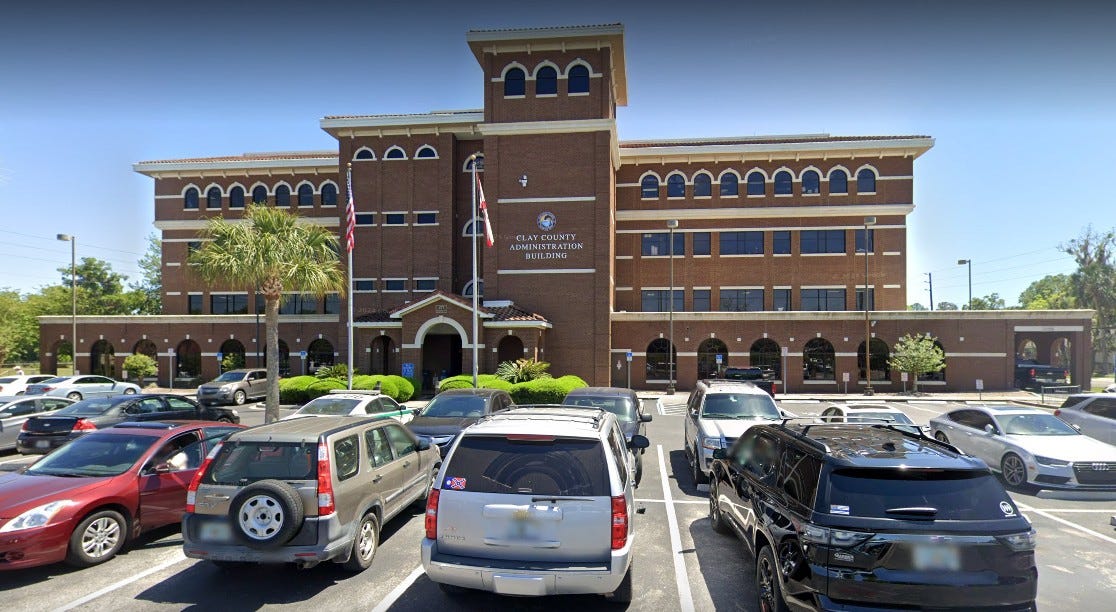
In a lively session marked by calls for transparency, fiscal responsibility, and voter education, the Clay County Charter Review Commission (CRC) met on January 12, 2026, to discuss potential revisions to the county charter.
The meeting, held at the Board of County Commissioners chambers and chaired by Courtney Connor, drew particular attention to the long-standing issue of county commissioner salaries, which have remained frozen at approximately $37,000 annually since 2008—a figure set through a ballot initiative amid past political controversies.
The discussion centered on aligning commissioner pay with Florida Statutes Chapter 145, which provides a uniform formula for compensation based on county population and annual inflation adjustments. Despite wanting to align with the statute, several charter review commission members admitted they did not know what it says.
According to the latest calculations from the Florida Office of Economic and Demographic Research (EDR) for Fiscal Year 2025-26, the full statutory salary for a Clay County commissioner—without charter limitations—would be around $100,000, reflecting the county’s population of approximately 240,000 and certified adjustment factors.
Chair Courtney Connor recommended dropping the topic entirely, citing no complaints from commissioners, the focus on public service over paychecks, and vocal public resistance on social media. She warned against turning the role into “just another job” and emphasized the need to avoid fiscal irresponsibility in the current economic climate.
Members debated the merits of a full alignment versus more modest increases, emphasizing that commissioners have never publicly complained about their pay and view the role as one of public service rather than a paycheck.

Rhonda Jett, Clay Republican Party Chairwoman and CCSO employee, argued that the current salary fails to account for inflation (equivalent to about $59,000 in today’s dollars) and the growing demands of the position in a county that has quadrupled in population over the last 18 years.
The only problem with Jett’s assertion is that it simply isn’t true. Clay County has a population of approximately 240,000. In 2008, the population was around 185,000. While that is an increase, the population has not even doubled, much less quadrupled.
Critics, including Chair Connor, cautioned against pursuing raises amid fiscal constraints and community backlash, suggesting the focus remain on service without risking perceptions of “pulling a fast one” on voters.
Other critics, like Matthew Mitchell, called out the lack of transparency in vague statute references without hard dollar figures, labeling it a “scare tactic.” Commission member Steve Andersen countered that educating the public isn’t the CRC’s job.
However, despite strong public opposition on social media and past voter rejections (twice defeated by margins of 60-40 and 70-30), the CRC opted for a “compromise”.
The commission voted to advance revised ballot language proposing that commissioner salaries be set at 70% of the state statutory amount, which would equate to approximately $70,000 annually based on current EDR figures—an increase of about $33,000 from the existing $37,000. This would amount to doubling the commissioner’s current salary.
Public comment was limited, with one resident, Helena Cormier, endorsing fair pay to attract quality leaders amid county expansion.
The vote on the salary proposal passed 11-4. Tim Nguyen, Matthew Mitchell, Susan Callahan, and Courtney Connor all voted no.
The CRC reconvenes next month to refine the language and address remaining questions.
So are these positions full time jobs? Or are they performed while members have main professional careers elsewhere?
If there is an increase in pay, may I recommend increasing teachers' pay by same percentage rate?