


First of two stories about the travails of Clay Fire & Rescue.
There’s a saying about first responders: When chaos breaks out, and others are running from danger, they run toward it.
True enough, but their story is more complicated. In their private lives, many carry the weight of what they’ve seen—the kind of things that show up in sleepless nights and strained marriages—lingering in the quiet corners that they never share. Because of these frailties, some hesitate to call them heroes, but what they do on shift, day after day, is nothing short of heroic.
Clay County has no shortage of heroes. This story is about those in the Clay County Fire Rescue—the people who have pulled strangers from burning homes and wrecked cars, restarted silent hearts and witnessed first breaths and final moments. Yet many are forced to do their jobs in toxic environments with yesterday’s resources and tomorrow’s empty promises.
Unfolding Story
By the mid 1980s, none could deny that Clay’s growing population needed full-time firefighters rather than part-time volunteers. When the county transitioned to the paid fire department, they patched and added on to the already old and faulty structures to prepare for the in-house crews.
Today, with developers throwing up houses faster than Home Depot can restock lumber, Clay County’s population has soared at a rate that’s hard not to notice. According to the U.S. Census, the county’s population has climbed from 140,814 in 2000 to 244,812 in 2025—with projections that it could reach 280,000 within the next few years.
Despite the county’s booming growth and the fact that calls have increased almost 70 percent in the last 10 years—from 19,000 to 32,000—no additional fire stations have been built. Station 1, on Brannan Mill Boulevard, scheduled to be fully operational in early fall, will be the county’s first to be newly added in 25 years.
Several have been relocated to new buildings because of deterioration and Station 22 on Pine Avenue in Fleming Island will move to its new station on CR 220 sometimes this year. But many stations are the same used by volunteers 40 years ago.
Air They Breathe
According to reports and interviews, many county fire stations have repeatedly reported serious mold and air issues since at least 2001—the alarming kind that triggers headaches, eye issues, breathing problems, cancers, other serious long‑term health risks and death.
It appears the county is attempting to cover their budget shortfall—and maybe finance someone’s oceanfront property—with their exorbitant costs to provide public records. So, despite multiple stations reporting mold and air issues, CN&V narrowed its request to all mold reports for five stations: 13, 15, 17, 18 and 23.
The county provided five mold inspections done by three Jacksonville-based environmental companies between 2020 and 2025.
To help decipher all the technical mold reports, CN&V sought the assistance of Frank Ricketts. He has 40-years of experience and is presently a consulting expert in all kinds of issues involving air quality and building solutions, including molds.
Independent of the county, CN&V was able to obtain official reports from 2002 through 2003, which appeared to be the county’s first effort to document serious mold issues in the firehouses.
As far back as 2001, fire and rescuers at station 15 in Lake Asbury said they were working through headaches and other serious symptoms when they reported them to management. Crews said the administration appeared to be shuffling excuses from one desk to another.
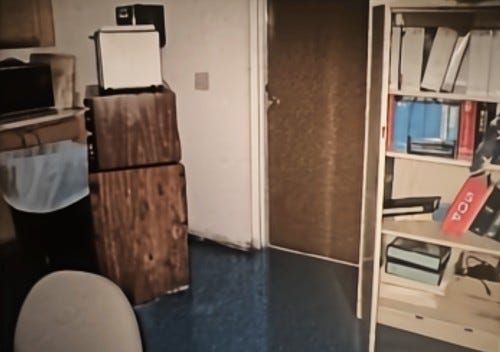
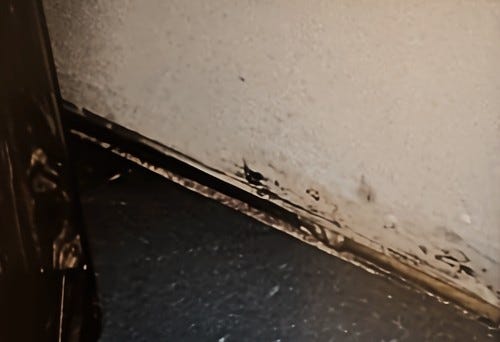
Finally, the 2002 reports show the county authorized SkyeTec Indoor Environmental Solutions to conduct several visual inspections of the station. With only look-sees, things were bad.
SkyeTec recommended more extensive testing. The recommendation was passed up the chain and approved.
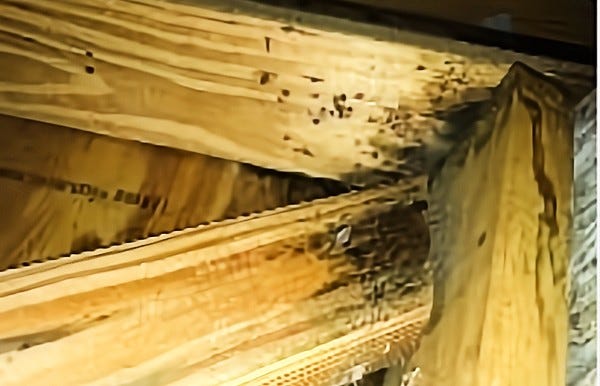
Environmental inspectors found dangerous mold throughout the station—in the attic, ceilings, walls, hallways, breakroom and even the bunkrooms where crews slept between calls. Photos documented mold on walls, ceilings, baseboards and HVAC vents. SkyeTec also documented rodent activity in the attic and reported that unsealed light fixtures could be allowing dangerous viruses carried by the rats to circulate through the air to crews.
The company recommended a full remediation, which typically means cleaning up the mess, fixing what caused it and rebuilding structures to make things right again.
According to the reports, it appeared Station 15 didn’t need a remediation back in 2002—it need a bulldozer, a prayer, and a fresh start.
Ricketts pointed out that rats and mold don’t always come as pairs, but they often live in the same neighborhood. Rodents are attracted to wet, contaminated wood and are a sign that lots of mold is present. He said rats worsen indoor air quality when they chew up insulation, contaminate HVAC ducts and spread droppings, urine, and dander around a building.
The environmental company advised that crews should be moved out of the building while walls, ceilings, roof flashings, and HVAC systems be removed and replaced. For the remediation, SkyeTec advised the county to hire a company experienced in mold abatement and listed strict protocols which must be put in place and followed faithfully during the process. They also issued a chilling warning:
Any remediation plan attempt that does not include long-term plans to maintain systems and prevent recurrence is short-sighted and destined to fail. There is no one-time, complete cure to microbial contamination within structures.
Crews said they were moved out of the building and on site into Conex Boxes, which are large, steel shipping containers. Reports show Capt. David Motes was put in charge of the project and SEDA Construction began plans for remediation in January 2003.
Obviously, those in charge didn’t heed SkyeTec’s warning. A preliminary air assessment from Professional Industrial Hygiene Services (PIHSS) dated August 19, 2003, showed rescuers were back in the building and having more health issues. Insect and rodent droppings, moisture, and mold were still present.
On August 25, 2003, Motes sent out a memo to all stations, which contained a health survey “questionnaire” from PIHSS. He said the questionnaire was available to anyone who would like to provide “information or concerns related to the alleged environmental issues at Station 15.”
Some walls and ceiling had spots that looked like chia-pets. For months the station had resembled demo-day on HGTV’s Fixer Upper, and crews from 15 had been and were still coughing like coal miners.
However, former county employees, along with fire and rescuers throughout the county, said Motes’ memo set the standard in the county, then and now. All reports of mold are to be referred to as “allegations” or everything’s fine—if you squint hard enough.
There was more bad news at 15. In September 2003, a diesel emissions test from PIHS showed carbon monoxide and a slew of other harmful gases were seeping into the station house from the truck bay. Recommendations were suggested, but still, firefighters said that 15 remained a “sick station.” They said that when issues were reported in later years, the county ordered “in-house” inspections and “sent somebody out to spray bleach on ceilings and walls.”
Recent Reports
All five reports from 2020 to 2025, done by the three Jacksonville environmental firms, showed the county authorized “Limited Testing.”
Frank had concerns about the type of testing that was done in the county fire stations. He shared that mold and air testing is expensive, and full remediation is astronomical. As a result of the cost, Frank said public and private entities often opt for the limited bargain-basement tests, which cannot locate all the problems. It does, however, avoid the high costs of remediation and construction.
The first four limited tests were ordered after health complaints from fire house crews.
October 12, 2020- Universal Engineering Sciences, Stations: 13-Clay Hill, 15-Lake Asbury, 17-Peoria Street in Orange Park, 23-Keystone Heights.
August 18, 2021-GLE Associates, Inc.- Station 18-Blanding Blvd. in Orange Park
November 8, 2022-Universal Engineering Sciences, Station 15-Lake Asbury
December 6, 2024-GLE Associates, Inc.-Station 23-Keystone Heights
Even with the limited testing, all the stations in the first four assessment had bad report cards. Issues noted in the reports were elevated total mold spores and other biological contaminants, fungal growth, mold-impacted building materials, visible water staining, HVAC issues, roof/flashing leaks, lack of insulation and improper ventilation in attic spaces. Rodent droppings were found, indicating the rats had a long term lease.
The 2022 report on station 15 noted that walls and ceiling were removed after the 2020 assessment, but the 2022 testing still showed harmful mold, water staining and damage in the station and building materials.
Remediation was recommended in all four assessments, but no reports of it being done were included in the records release.
Although crews said they reported headaches and breathing issues after staying overnight at the Communications Center, no reasons for the testing were mentioned in the fifth report.
But on Sept.10, 2025, Stations 13, 15, 22 and the Communication Center were assessed, again by limited assessment. This report initially listed, “No amplified mold of concern in air detected” for all the three stations. But deeper in the report, it describes mold in the HVAC closet at station 13 and “localized visible mold on the Bunk Room air supply vent in the Comm Center.”
There were numerous remediations suggestions in the 2025 report, as well as a “post-remediation assessment.” But again, no remediation reports were included.
All three environmental companies notably listed warnings in all five reports, stating limited assessments were remarkably unreliable. They wrote that the partial testing authorized by the county imposed “time, financial and physical constraints” and therefore their tests had “shortcomings in accurate testing.” The partial air testing the county authorized, wrote one company, is a short snapshot in time, which is effected by things like airflow, outside and inside humidity, HVAC cycling and activities inside the stations and truck bays.
They also warned the restricted assessments can typically miss mold inside closets, behind walls, behind ceilings, under floors and in crawl spaces and “does not claim to identify all potential hazards and/or contaminants that may be present.”
Tails From the Firehouse
A double-classified, not-so-secret, secret has been circulating around the county lately, as well as in firehouses in Jacksonville and those north and south of Clay. It offers a vivid snapshot of the condition of some of the county’s firehouses. The exact timeline is unclear, but multiple people have confirmed it as fact.
Rescuers at station 15 were gathered round the table for supper, when suddenly, a big chunk of ceiling crashed down onto the table. Rats began showering down like rain over all surfaces and a few of the slower reacting crew. Before the shocked squad could break into a full run, a large cat—which has presently grown in the telling to the size of a mountain lion—leapt down on to the table into a full hissing pursuit of the rats.
The scared squeakers were manically scurrying for their lives to hide beneath furniture, nooks, crannies, closets, clothing and immobile body parts throughout the whole building and anything that provided cover from the fierce feline.
Real Life
Television dramas like Chicago Fire and Nashville 911 paint a glamorous picture of fire-rescue life—ample personnel who spend shifts lifting weights in fancy recreation areas, cooking gourmet meals in chef-style kitchens and watching sports on tv until a catastrophic disaster occurs—always in broad daylight—and as the crews heads out with the latest and greatest equipment.
CN&V visited some of the fire station in the county—with no notice.
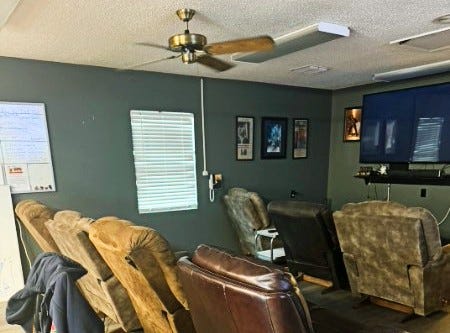
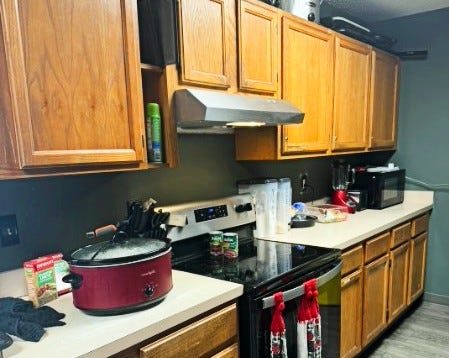
The only workout equipment in sight was a couple of treadmills wedged into corners. The kitchens were basic—Formica counters with a stove, microwave and refrigerator. It appeared the closest thing to a gourmet experience in those kitchens were most likely wieners and a can of chili. There were televisions, but they sat silent as crews came and went on calls, washed trucks and gear in freezing weather, cleaned stations and wondering why CN&V was there.
All the stations were neat and clean but had only the essentials. Some of the furnishings looked like they had been acquired at curb alerts just before trash day. And some stations were…well…dumps.
Station 15 was the worst of the ones visited. Ceilings had been patched too many times, and after a few minutes in the station, the air felt thick with an unmistakable moldy smell. Even someone who has gotten good at looking the other way, should be able to tell that station 15 has problems.
Crews from other stations recently said they try to avoid staying overnight at 15 when they are called for extra-shifts there because they “always leave with a headache.”
The County’s Side
In early November 2025, CN&V asked to meet with County Manager Howard Wanamaker, Fire Chief Lorin Mock and Acting Fire Chief David Motes. The meeting was finally arranged for January 15, but the only faces at the sit-down was Chief Mock and the county’s Director of Communications, Laura Christmas.
At 70, Mock is a tall, gray-haired man with a polished grandfatherly ease—faintly reminiscent of the late country singer Porter Wagoner—but with a little less poof to his hair. He was smartly dressed with a uniform shirt so crisply starched, it might stand on its own.
Mock was well aware of and confirmed the ratscapade at station 15. “We went in and closed off areas that were assessable to it.” he said.
When questioned about the recent years of mold, Mock offered a philosophical reflection.
“The average age of the stations, is 40 years. It was occurring before I arrived (in 2009) and we have dealt with it on multiple occasions.” Mock said. “There are older volunteer stations that, frankly, probably never should have ever had career quarters attached to them, but the only way the county could do that was to build them in that way.”
He said the county did regular in-house inspections, and the last report in the fall showed 13, 15 and 22 “had passing grades.” Insiders said this is not accurate.
Station 17, Mock said, was still “a bit of struggle, but has major work going on.” When CN&V visited 17, mid-day during the week, there was no work being done.
He said he suspected the county would have to “readdress” the mold in the stations “over and over again” until all of them are replaced.
And when will that happen?
In 2024, County Commissioners approved a $65 million bond for a public-safety package for Clay County Fire Rescue. Funding included new equipment barns at every station—spaces firefighters need to clean and store gear contaminated with toxins during emergency calls. The package also promised new and replacement fire stations, new equipment and vehicles, a fire‑training burn building and a replacement for the public‑safety radio tower.
Christmas pointed to a section of the county website, Expanding Public Safety: Preparing for the Future, which outlines the bond projects. While $65 million sounds substantial, the county’s own figures show that roughly 85% of the money has already been spent or committed. Inside the county, some say that with most of the money already spoken for—and project estimates rising—the ambitious list of “TBD” (To Be Determined) projects is either wishful thinking or deliberately misleading.
Breakdown of expenditures and allocations:
• $12,673,772 – Replacement of Station 20 (Completed)
• $11,840,483 – Construction new Station 1(In progress
• $12,175,750 – Construction of replacement for Station 22 (In progress)
• $15,327,157 – Estimated cost for future replacement of Station 15 (Awaiting FDOT approval to bid)
• $ 2,620,009 – Estimated cost for replacement of the public‑safety radio tower.
Total spent/allocated: $54,303,256
None of the gear barns have been built. The assumption is that new or replacement stations will include them, but no plans have been released for barns at existing stations. For now, the gear hangs in the truck bays at the old stations creating another safety risk for crews.
The training‑burn building—expected to consume the remaining funds and then some—still has no cost estimate. The replacement of Station 13, one of the district’s older buildings with documented mold, remains without a price tag or timeline.
Stations 17, 18, and 23 also suffer from long‑standing mold and air‑quality with reports of illnesses.
At Station 23, the problems run deeper: despite multiple remediation attempts, the building still carries enough unresolved issues to merit a demolition.
During one remediation, crews say, foam sprayed into the attic buried fire‑suppression sprinkler heads, leaving the fire station without functional fire protection for seven months—after county and fire administrators had been informed.
Stations 17, 18, and 23 are not scheduled for replacement.
Insiders say people deciding when, how much and which firehouse get remediations, have no experience with mold remediation construction.
Because some fire house crews still have complaints of mold and health issues, CN&V asked if true testing, not limited, was done and mold and air issues were found, could the county move crews immediately from the sick buildings into nice trailer homes on site.
“Mold has been addressed with how we do it.” Mock answered—twice. That answer left a lot of wiggle room.
He then went on to say. “Since 2020, crews have been temporarily moved out of stations…and into Conex Boxes on site.”
This appears to be a “yes” to moving them out, but a “no” to nice trailers.

Next in Part 2: If Part 1 was smoke, the next installment will be fire. Topics include: Chief Mock’s alleged retreat from Fire-Rescue, concerns about lack of safety in the county and a myriad of issues revealed by mental‑health surveys that rattled the ranks and left more than a few folks shaking their heads.
Part 2 will also look at the county’s latest attempt to shine things up on its Facebook page—and maybe even a new website and videos—both cheerfully insisting that “everything’s fine at Clay County Fire Rescue,” despite plenty of evidence that it’s not.
I have been fortunate enough to have retired from both Orange Park fire department and Clay county. I have been asked to talk to the new firefighters for Clay county to review our history. As much as this story is true there is so much more. The county has always offered empty promises in the past. I stood up in front of the commission a few times in my life to go through some of the history and seemed to hit mostly deaf ears. The county has always looked for the least expensive way to fix things at the advice of council. Overall the original employees endured a lot, the current employees get the benefits. I believe these are growing pains for the county.
Maybe while discussing tripling county commission salaries, a new requirement should be added. Each commissioner should be required to spend 3-24 hour shifts in fire stations in their respective district per month.