


The data provided in this article is from the presentation deck supplied to the School Board by Enterprise Fleet Management. The full presentation can be found here.
A recent fleet analysis presented by Enterprise Fleet Management (EFM) to the School District of Clay County highlights significant issues with the district's non-bus fleet, dubbed the “White Fleet.”
The presentation at the School Board’s January 27th workshop meeting highlighted an aging, oversized fleet with potential risks to safety, operational costs, and overall efficiency. A modernization strategy through leasing and surplus sales was proposed to mitigate the risks.
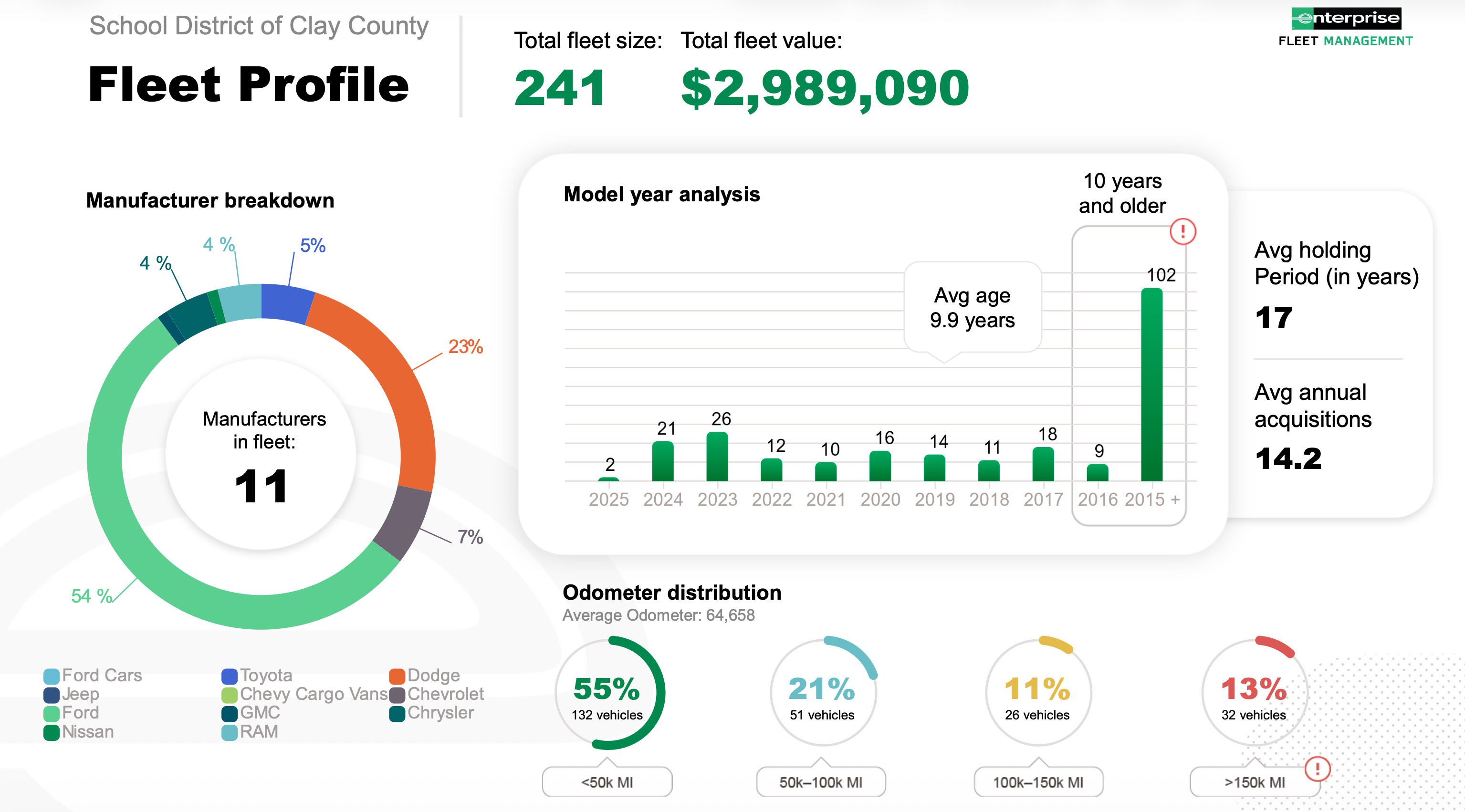
The district's white fleet consists of 241 vehicles, with an estimated total value of $2,989,090. According to the presentation’s estimates, the white fleet’s size should be reduced by approximately 90 vehicles.
The fleet's vehicles are 9.9 years old on average, but 43% (104) are at least 10 years old. Odometer readings average 64,658 miles, with a distribution spanning low (less than 50,000 miles) to high (more than 150,000 miles), indicating varied usage across departments.
Per the presentation, newer cars in the fleet are sitting unused to the point that their batteries are dying, and tires are deflating. Meanwhile, older vehicles with fewer safety features are in regular use.
Compared to neighboring districts, Clay County's 252-vehicle fleet is mid-sized. Smaller than Sarasota's 341 but larger than St. Johns County's 128. Notably, Sarasota's larger fleet supports additional functions, such as an in-house police department and a technical college, which Clay lacks.
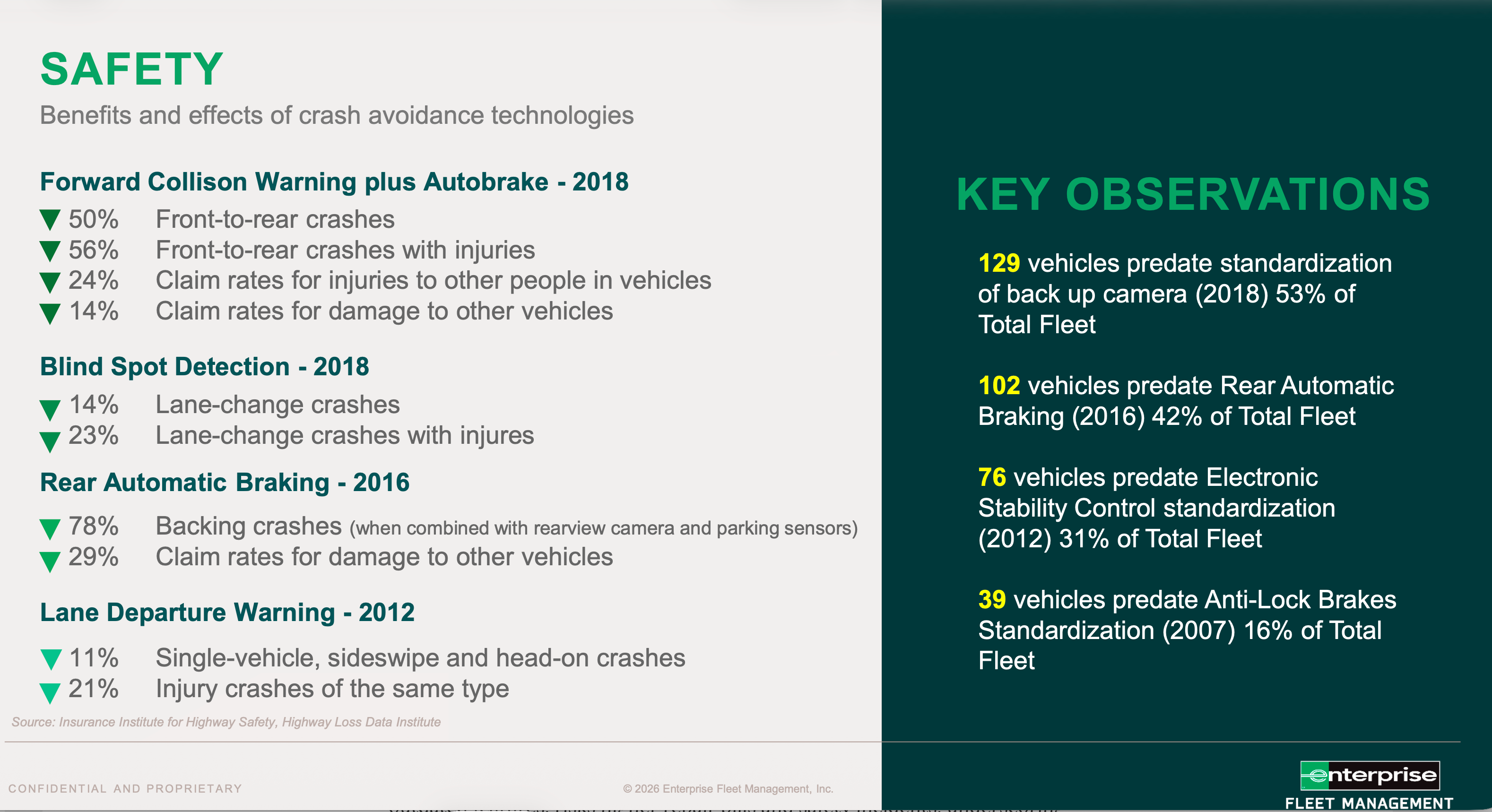
A critical aspect of the report focuses on safety deficiencies, revealing that a substantial portion of the fleet lacks modern crash avoidance technologies. Drawing on data from the Insurance Institute for Highway Safety (IIHS), the analysis notes benefits of newer model vehicles, such as a 78% reduction in backing crashes with rear automatic braking and a 50% drop in front-to-rear crashes with forward-collision warning systems.
However, 53% (129 vehicles) predate backup camera standardization, 42% (102) lack rear automatic braking, 31% (76) lack electronic stability control, and 16% (39) predate anti-lock brakes. These gaps expose the district to higher accident risks, insurance claims, and operational disruptions.
When measured against Florida's school fleet best practices, as outlined by the Florida Department of Education (FDOE), these shortcomings are pronounced. Best practices emphasize equipping vehicles with up-to-date safety features to comply with Federal Motor Vehicle Safety Standards and reduce liabilities.
Clay County's current approach, with vehicles accumulating high mileage and outdated features, risks higher repair bills and safety incidents, underscoring a need for more aggressive modernization.
The report projects that maintaining the status quo could lead to higher expenses, as older units increase operating costs.
Overall, the $2.99 million valuation reflects a significant investment, but deferred replacements may have increased indirect costs, such as maintenance and fuel. Automotive technology has advanced significantly over the last ten years, and the rise of AI has created opportunities to manage large fleets more effectively—opportunities the district appears to have underutilized, given the fleet's aging profile.
EFM recommends a strategic overhaul: retain 100 vehicles from model years 2018-2025, acquire 50 new 2026-model leases, and eliminate 141 older units through surplus sales over time.
This would leverage an estimated $884,477.50 in equity to offset leasing costs of $613,840.80 annually (including maintenance), resulting in a net positive cash flow by fiscal year 2027.