


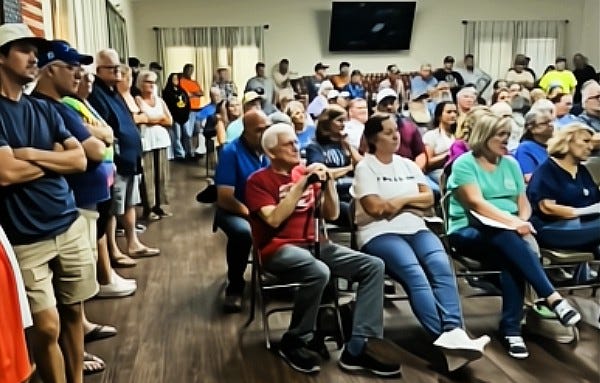
The Middleburg Civic Center was a fire marshal’s nightmare—had there been one at last night’s meeting. Well over one hundred residents filled the chairs and stood elbow-to-elbow along the sides of the room to make a historical decision.
That decision?
To fire the entire Clay County Board of County Commissioners, who had recently slapped them with hefty new taxes under the guise of “stormwater drainage improvement fees.”
The Meeting
Keystone Heights’ resident Charles Hodges, a county dock builder and the unofficial general leading the charge against the fees, opened the meeting.
There was no agenda. But had there been one, the first item, after the praying and pledging, might have been to warm up the tar and begin the pre-plucking of the chicken feathers.
But despite the tension in the room, the crowd consisted mostly of folks who had done their homework and came armed with research, facts, and plenty of well-thought-out arguments to stop the large taxes.
A committee was established to begin the next step in the recall process under Florida law, which is to initiate petitions naming the officials to be recalled and the specific charges against them.
If the required threshold of valid signatures for each commissioner is verified by the supervisor of elections, recall elections will be scheduled.
Florida law says the recall charges are limited to one or more of the following:
Misfeasance (improper performance)
Neglect of duty
Drunkenness
Incompetence
Permanent inability to perform official duties
Commission of a felony
There was, at first, whispered support for District 4 Commissioner Betsy Condon who, along with District 2 Commissioner Alexandra Compere, had voted against the fee and traditionally voted in accordance with the wishes of the people.
But as the debate continued, it appeared folks wanted a clean slate and were willing to throw Condon out with the people on the commission that she sat amongst.
Robert Meadows, a retired navy pilot and engineer in the county, appeared well-versed in all aspects of Clay’s business. He said the county’s unjustified and unfair levy of the stormwater taxes appeared illegal, at best.
Meadows noted that research showed stormwater fees could only be levied on parcels of land that gained a “benefit” from drainage work. He said the benefit was tied to the property, not the individual property owner.
Commissioners have maintained that even though most properties throughout the county would not have any drainage work done on their land, the owners still had to pay the fees as they would “derive a benefit.”
The benefit, the county said, was property owners would, in some way, come in contact with properties which had drainage improvements and that therefore constituted a benefit to the property owner.
Meadows also said the consultants’ report showed for stormwater work to be in compliance, the county would be required to hire a Stormwater Manager, a Stormwater Geographic Information System (GIS ) Analyst, and a Storm Drain Inspector. The report showed these three people would cost the county around $3 million dollars a year.
The common thread among those attending the meeting was they all believed the fees were being imposed to help dig the county out of the financial hole created by the very people now asking the residents to pay for the shovel.
Bad Decisions, Broken Promises and Failures by the Commission
Many of those who attended the meeting characterized the stormwater fees as just the latest affront and began expounding on a long and growing list of years of grievances.
The County’s audit, which is required by the state and routinely done by outside auditors, Meadows noted, showed the county had failed to follow procedures and was “out of compliance” with some state statutes.
It appeared, from the related incidents, that getting a face-to-face with the county manager or some department heads was tougher than getting an audience with the Pope—and with less miracles.
Yet, Meadows reminded the taxpayers that the county manager and department heads’ salaries were some of the highest in the state—larger than that of the governor and with astounding benefits—although many appeared to be just seat warmers with underlings tasked to do the county’s work.
Residents complained that road construction was haphazard and years behind schedule, which caused delays, frustration, and gridlock for people trying to get to work, get to school, get home, and get on with their lives.
The taxpayers spoke of how commissioners had allowed developers to build massive developments in the county and provided “loopholes” for them to forgo proper infrastructure, which threatened water sources, the electric grids, and moved tax burdens to citizens.
Attendees grieved the fact that the commission had voted last week, on a 3-2 vote, to reinstitute taxes on county services which had previously been reduced for disabled veterans.
The list of offenses grew longer and hotter than this year’s Florida Summer.
“I’ve seen this before,” said Garreth Cumber, who moved from New York over a decade ago. “This is the way it starts—first it’s the stormwater, then meters on the well, then sewer taxes on septic systems, then before you know it, you’re paying $14,000 in taxes on a small home you’ve already paid off. We have to stop it now.”
Residents said the commission’s blatant failures and disregard for the pocketbooks of the taxpayers created the foundation for the recall.
“If you do a bad job,” Hodges said, “you need to go and you sure don’t deserve a raise.”
Citizens’ Future Plans
After looking at different departments in the county, some residents—experienced in budgets—said it appears Clay County does not have a budget problem, but a spending problem. So, aside from the recall, a separate group of committed residents are also planning to review the bulging budgets of the different departments in the county and determine where cuts can be made to save residents from paying the stormwater fees and for the county’s extravagant spending.
There’s plans for more stormwater meetings, more research and, it appears, more surprises in store for the commission—“Hold my beer” somebody against the back wall summed up the pending plans.
If the Clay County Commission thinks the stormwater tax is one-and-done, they may want to reconsider. The fat lady hasn’t sung yet…she’s just warming up, and judging by last night’s crowd—this show may run for a while.
County Commission Enacts Stormwater Tax, Reduces Veteran Exemption For Garbage

The Board of County Commissioners voted Tuesday to enact a newly proposed stormwater fee. Hundreds of Clay County citizens filled the meeting room, an overflow room, the lobby of the building, and much of the parking lot to speak against the new tax.
I’ll sign a petition
They all need to go. And we all need to refuse to pay these BS fees. Anyone they try to take a home from, we all show up and dare them to try.