


Since 2023, Clay County has entered into at least six separate contracts with Flock Safety, the Atlanta-based surveillance technology company.
Combined, these contracts commit local government to roughly $1.76 million in spending, with an estimated $1.56 million already paid as of this writing.
This is the first comprehensive public accounting of everything Clay County has purchased from Flock Safety, who signed for it, and what it would take to walk away.
Part 2 of this series takes a closer look at the surveillance network's AI-powered capabilities, including the county’s largest and least-understood purchase: the Wing Gateway/FlockOS Elite system.
Six Contracts, Two Different Government Entities
A key finding threading through these records: not all of these contracts were signed the same way. The Board of County Commissioners executed three through County Manager Howard Wanamaker. Three were executed directly by the Clay County Sheriff’s Office, without a BOCC vote.
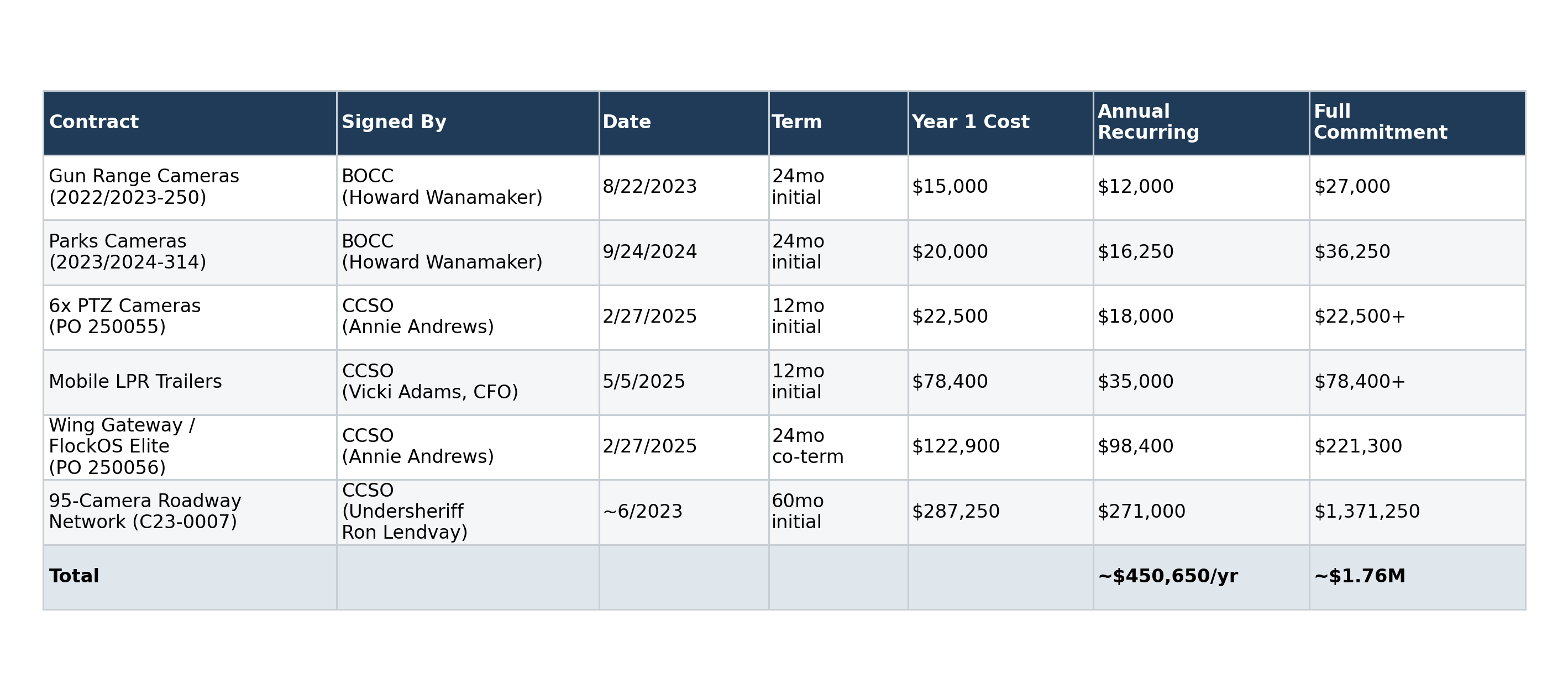
The 95-camera roadway network accounts for roughly 78% of all committed spending and carries by far the longest lock-in period of any contract: a full five years, versus one or two years for everything else.
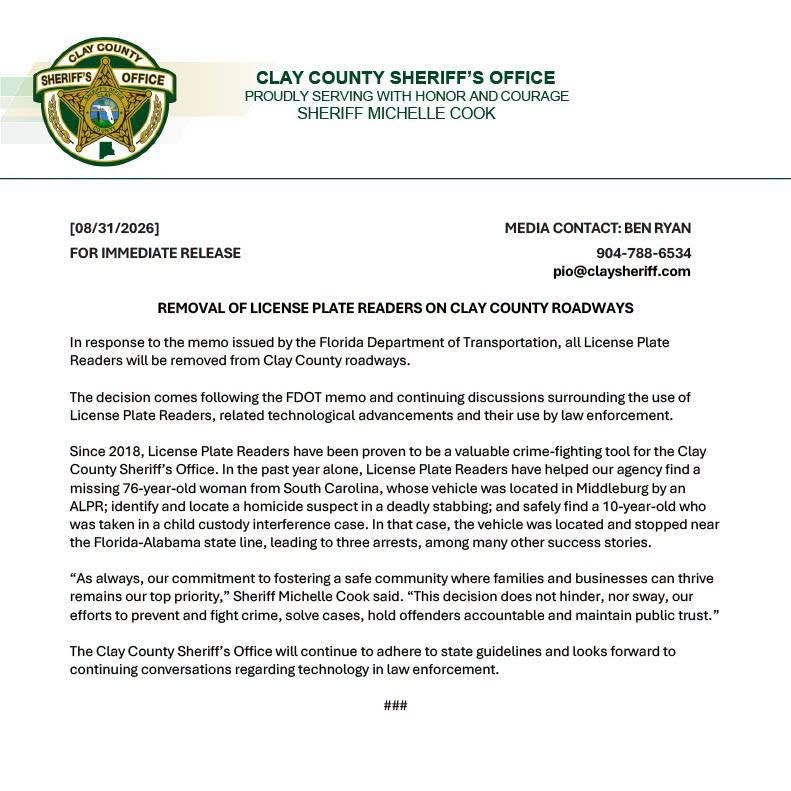
The 95 roadside cameras are the devices now partially affected by FDOT’s August 31 memo.
What’s in Each Contract
Gun Range Cameras (2022/2023-250): Four Condor PTZ (pan-tilt-zoom) cameras with LTE cellular service, installed at what county records describe as a gun range.
These cameras are tied into the FlockOS “Community” package, which allows CCSO to view privately shared Flock devices within the county but does not include the broader state or nationwide license-plate search network.
Park Cameras (2023/2024-314): Five solar-powered, LTE-streamed, non-PTZ Condor fixed cameras with 30 days of on-device storage. These cameras are installed at:
Moody Avenue Park (1)
Ronnie Van Zant Park (2)
The Regional Sports Complex (2)
The park cameras feed into the FlockOS “Essentials,” which includes State Network and Nationwide Network license plate lookup. Plates captured at these parks are searchable against a nationwide database, not just kept local.
PTZ Cameras (PO 250055): Six more Condor PTZ cameras with LTE service, plus a FreeForm add-on, an AI-powered natural-language search tool across the department’s LPR images and video footage. The contract does not specify installation locations.
Mobile LPR Trailers: Two LPR Trailer Bundles (three LPR cameras total) mounted on Wanco Flock Ready Trailers, plus a Mobile Security Trailer package.
The mobile security trailer is a self-contained unit that contains:
Two PTZ cameras
One 360-degree multisensor camera
A blue deterrence light
An audio talk-down speaker
All of this is mounted on a solar- and battery-powered trailer equipped with a radar speed sign.
Unlike every other Flock product in these contracts, these units are mobile—deployable anywhere in the county on short notice, with no built-in fixed-location transparency.
Wing Gateway/FlockOS Elite (PO 250056): A 104-device system integrating existing third-party camera feeds county-wide, paired with Flock’s top-tier software subscription. This allows Sheriff Cook to integrate up to 1,500 cameras into the surveillance network, even if they aren’t made by Flock. (Covered in full detail in Part 2 of this series.)
95-Camera Roadway Network (C23-0007): Ninety-five Flock Safety Falcon® cameras. Falcons are Flock’s flagship “infrastructure-free” fixed license plate reader. This reader uses Vehicle Fingerprint technology to log not just plates but also vehicle make, color, type, and identifying features such as bumper stickers and roof racks. This is the network referenced in CCSO’s recent removal announcement following the FDOT memo.
Notably, this contract also includes a $142,500 add-on for extended data retention, up to one full year, rather than the 30-day retention period stated elsewhere in Flock’s own paperwork and referenced in CCSO’s public messaging, plus a $25,000 “Advanced Search” AI query tool.
What The Contracts Say About Early Termination
For residents wondering whether a future commission or sheriff could simply cancel these programs, the contracts offer a limited answer—and it isn’t “yes, easily.”
The 95-camera network’s master agreement (C23-0007) — by far the largest and longest contract — spells out only three ways out:
Non-renewal notice before the end of the current term. But the initial term here is 60 months, so this route isn’t available until 2028 at the earliest.
Termination for material breach — available to either party, but only after a 30-day notice period during which the breaching party can “cure” the breach and keep the contract alive.
Non-appropriation of funds — if Clay County government fails to budget the money to continue the contract, CCSO can terminate with 30 days’ written notice. This is the only genuine early exit, and it requires an actual funding gap, not simply a policy decision to discontinue the program.
Notably absent from this contract: any general “termination for convenience” clause that would let the county simply choose to walk away for policy reasons—over privacy concerns, cost, or public pressure—without breaching, waiting out the term, or engineering a budget shortfall.
The BOCC-signed contracts (Gun Range, Parks) are governed by Clay County’s own Standard Addendum, which overrides Flock’s standard auto-renewal language: those contracts do not renew automatically and require a new written agreement between the parties to continue past their initial term.
That addendum also caps the county’s payment obligation at whatever is appropriated in a given fiscal year. A narrower protection than an outright right to cancel, but still a meaningfully different structure than the CCSO-signed agreements.
The CCSO-signed contracts (the PTZ cameras, mobile trailers, and Wing Gateway/Elite) appear to follow the master agreement’s standard auto-renewal terms, continuing indefinitely unless either party gives 30 days’ non-renewal notice before the end of the current term.
Summary
Taken together, these six contracts show a Clay County Sheriff’s Office spending pattern that is larger, longer-term, and more independent of the county’s elected commissioners than previously documented publicly.
The largest and longest single commitment, a 5-year, $1.37 million agreement with no convenience exit, was signed by the Sheriff’s Office, not the Board of County Commissioners, with no input from the public.
Part 2 of this series examines what all of this money actually bought: the equipment, the software, and a system capable of pulling in more than 1,500 camera streams from across the county.
Well, as the sheriff of another FL county said, that while he realizes that they’ve been utilized, along with good police work, to help solve a few crimes, we need to avoid becoming a surveiled population. Another way of looking at the power of the cameras is that we would have no freedom if we end up with a nefarious regime running the country as a police state. Don’t think that could never happen here.
Sad to say but all involved in this debacle across the state need to be dismissed.