


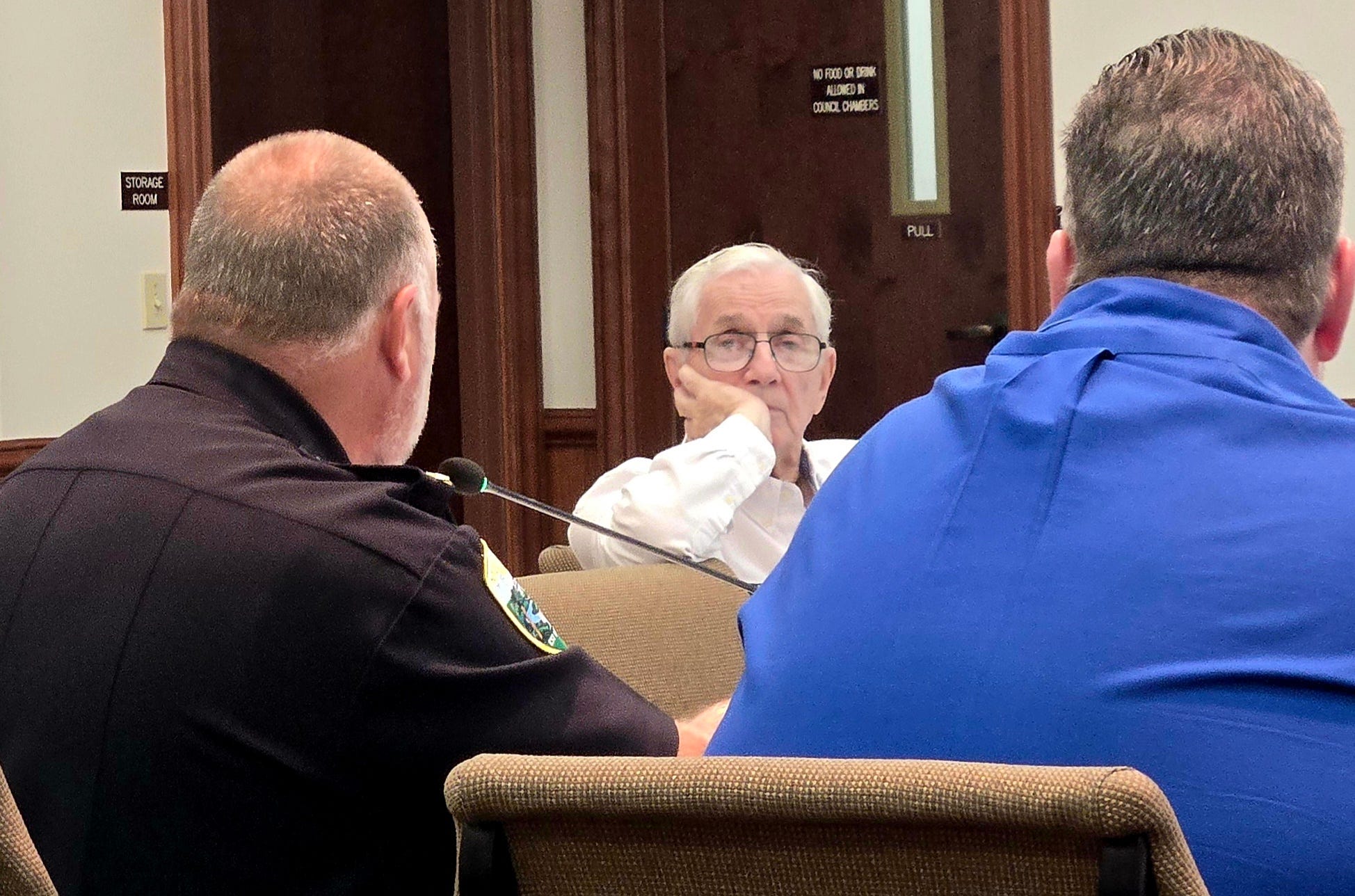
For a couple hours yesterday morning, one of the safest places in Northeast Florida may well have been council chambers at City Hall, Green Cove Springs. There were at least six uniformed police officers—a couple in full battle rattle. There were some more of them in plainclothes, and there was Chief Shawn Hines, the star of the show.
Ever since Amendment 3 was approved for the ballot there’s been a buzzing in the bonnets of Green Cove folks—not quite a 911 emergency, just a low grade angst. The November 3 referendum question, if passed, would slash the municipal side of the property tax bill for most Florida homeowners.
Described as a “commuter county,” Clay County can expect to lose as much as 30 percent of its revenue, and for tiny Green Cove it could be worse. “If the proposed property tax referendum passes, the estimated financial impact to the City would be approximately $1 million in Fiscal Year 2027-28 and $1.6 million in FY 2028-29,” Acting City Manager Mike Null told Clay News & Views.
For context, the city’s proposed operating budget for the coming year is $11.3 million. For even more context, the city’s police department budget accounts for more than $5.6 million of that, more than half.
Ostensibly, Chief Hines was on hand to explain and defend his 2027-28 budget to the council, but the possibility of Amendment 3 passing hung over the proceedings like the smell of rain on asphalt.
When Hines got wind that councilors and ordinary citizens were having serious conversations about maybe having to ditch the police in favor of a cheaper deal from the Sheriff’s Department—and then Sheriff Michelle Cook offered to oblige with a quote—the chief embarked on a lobbying campaign.
Hines visited every single councilor individually since Florida Sunshine law prohibits them from gathering as a group to discuss city business in any informal setting. His demeanor was described as “upset and hurt,” as if the very act of discussing going over to the county would make the possibility more likely.
It’s abundantly clear from interviews and what councilors said at the meeting yesterday that all of them are pleased with Green Cove police as an institution, but that was no reason, Mayor Darren Stutts said, not to have conversations now, even if the potential impacts are a full budget cycle in the future:
We don’t know what’s going to happen with that vote. So we’ll see what happens in November. It will be more next year’s budget. But I know it has gone through the community. I’ve got calls from citizens about it. I’ve got calls from lots of people about it, reporters asking about it, wanting to know what we’re going to do.
So, it’s hard just not to say anything. And citizens, you know, they’re concerned—both sides. Some don’t want to get rid of it (the police department). Some of them, you know, encourage us to do just that. We have to look at both sides of it. But as a whole, I firmly believe that none of us want to do that. That would be our last resort with no other options on the table.
Privately at least, some councilors admit that they can see no other viable options.
Amendment 3 would increase homestead exemptions for primary residences to $150,000 in 2027 and $250,000 in 2028. After that, increases in the exemption would be tied to the Consumer Price Index, and assessment increases on other types of property would be limited to 5 percent a year.
If the referendum passes, economists predict that statewide property tax revenues will plummet by around $5 billion in its first year and as much as $11.8 billion per year after five years.
You can bet that Green Cove is not alone in its dilemma. All over Florida, municipalities with small departments—often defined as those with fewer than 50 officers—have to be asking the same questions.
Hines started his presentation by noting that polls showed just 61 percent support for the amendment, which is a fragile lead in vote that requires 60 percent approval to pass.
The past few weeks have seen a host of organizations come out against Amendment 3, making essentially two arguments:
Such drastic cuts will degrade and disrupt public services, and
By shifting funding decisions to the state, Tallahassee will usurp decision-making powers that were traditionally vested in local governing bodies.
Besides the Democratic Party, amendment opponents include the Florida State Fraternal Order of Police, which issued a statement Friday saying:
We oppose the current Amendment 3 because it creates far too much uncertainty about how local governments would continue to fund law enforcement, fire rescue, emergency medical services, and other critical public safety functions. Public safety should never become collateral damage with uncertain fiscal consequences.”
The uncertainty comes from the fact that, although public safety coverage cannot be eliminated altogether because of Amendment 3 cuts, the measure does not prevent decision-makers from shopping for a better deal to maintain that coverage.
Ostensibly, Hines’ plea to the City Council was to fend off any elimination of positions from the 2026-27 budget. Hines described his 28-officer department as being stretched thin. At the same time, his message was about the high quality of local police work, effectively laying out what was at stake in November.
As it happens, Hines is a decent public speaker. He talked about crime rates, the proportion of crimes solved, and the sheer volume of calls that were getting answered and the department’s four-minute-53-seconds response time, which compared favorably to that of the county or even Orange Park.
There were 5,820 traffic stops in Green Cove over the past year, Hines said, only 39 percent of which resulted in a written citation. He did not say it, though you could imagine him doing so, that most of those were out-of-towners anyway.
Hines talked about organizational culture. He made it clear that all his patrol officers, none of whom have more than two years of experience here, are expected to be nice to people.
One of the factors that makes the idea of having the Sheriff’s Department take over responsibility for Green Cove attractive is that the current sheriff is very popular and seems competent. She has a slick social media operation burnishing that image on a daily basis. She just had a house built in the city.
Based on her predecessor alone, though, no one can predict whether her replacement will be anywhere near as good. In fact, hardly anyone alive today remembers that Green Cove Spring established its own police department to escape from under the yoke of a sheriff who was both a bully and a criminal racketeer.
His name was J.P. Hall, and it took a group of hardened veterans coming back after World War II to stand up to Hall, and wrest control over law enforcement within city limits from him.
Despite the opposition, despite the potential chaos and loss of local control, there’s a real possibility the amendment may pass. If Clay County is any gauge, Floridians do not trust their governments to spend wisely, and they will be reminded of that mistrust at the worst possible time.
Tax bills will be mailed out by county tax collectors to arrive by November 1—two days before the November election. Collection begins immediately.
A silver lining could be the cessation of road projects. If developers can not show off a development in dire need of wider roads, perhaps it will slow growth a bit. Too much traffic already.
Unfortunately one of many services to get the axe.