

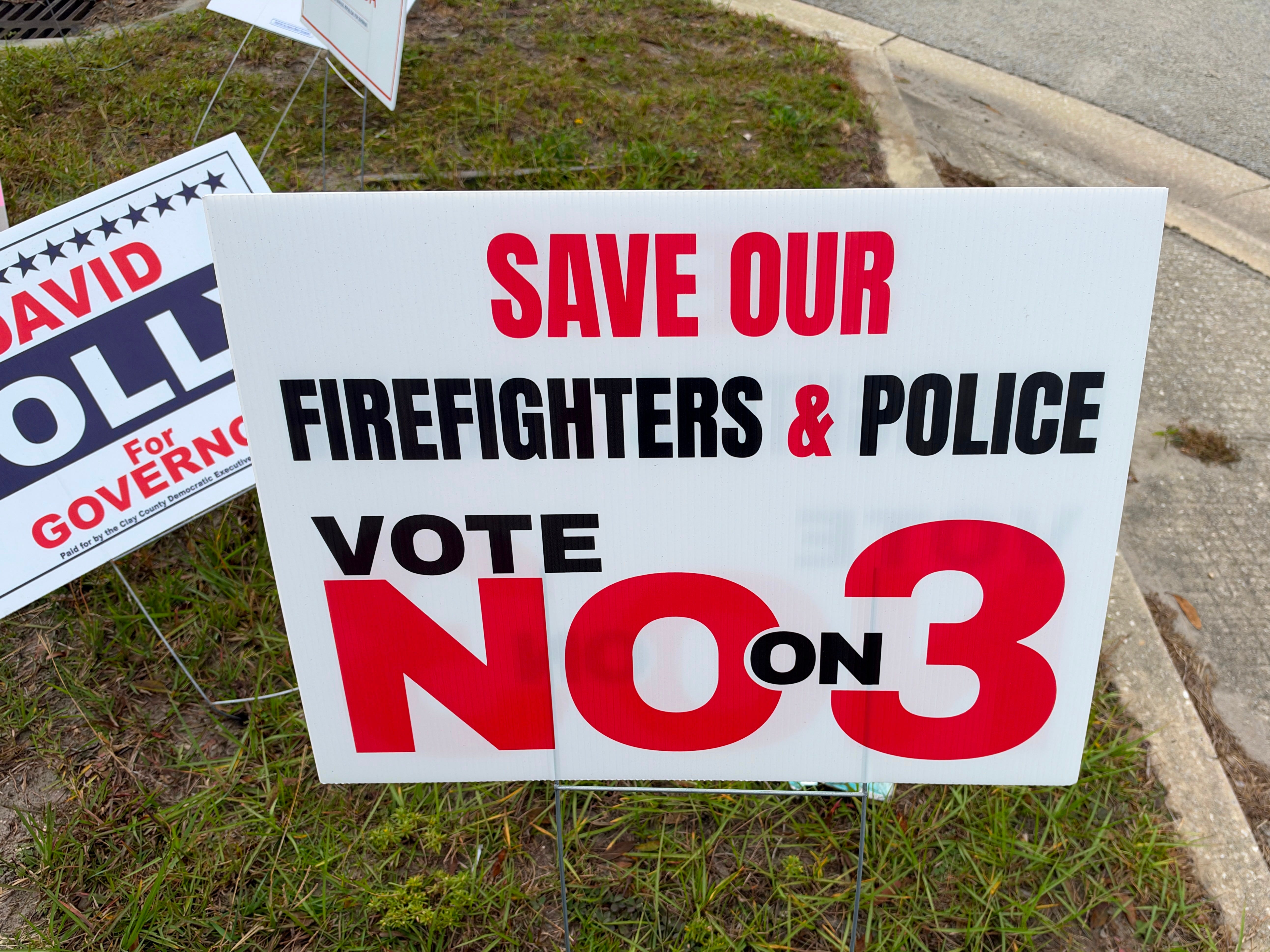
Yard signs urging Clay County voters to reject Amendment 3 are missing information required by Florida law.
The signs read “Save Our Firefighters & Police” above “Vote No On 3.” They have appeared at early voting sites in Clay County. None of the signs CN&V examined carry a “paid political advertisement” notice. None list the name or address of the person who paid for them.
Multiple sources have alleged to CN&V that the Clay County Firefighters Union paid for the signs in part. The union contributed money to a Sheriff’s Office employee who then allegedly purchased and placed the signs throughout the county this week.
CN&V contacted Clay County Firefighter Union President Jasen Hernandez about the allegations, but did not receive a response.
Sheriff Michelle Cook has recently campaigned against Amendment Three, appearing at local meetings, on podcasts, and in press conferences with Democrat and Jacksonville Mayor Donna Deegan.
What The Law Requires
Florida law treats a paid sign supporting or opposing a ballot issue as a political advertisement. Under Section 106.143 of the Florida Statutes, these signs must be clearly marked “paid political advertisement” or “pd. pol. adv.” They must also state the name and address of the person or group that paid for them.
The disclaimer must be “prominent.” The state Division of Elections has said that means it must be immediately noticeable and conspicuous.
CN&V called the Clay County Supervisor of Elections office on its public line for election questions. The staff member who answered said the signs do not meet state requirements and signs like these must disclose that they are paid advertisements and must identify who paid for them.
Willful violations of the disclaimer law can bring civil penalties. Complaints are handled by the Florida Elections Commission.
A Political Committee Question
The funding arrangement raises a second question. Under Florida law, a political committee includes two or more individuals, or a group or organization, that accepts contributions or makes more than $500 in expenditures in a calendar year to support or oppose a ballot issue.
Groups that cross that line must register before spending money. Committees working on a statewide issue like Amendment 3 register with the state Division of Elections.
Registered committees must report every contribution and expenditure.Those reports are public. They let voters see who is paying for political messages.
CN&V has not determined how much money was spent on the signs, and who may have contributed funds other than the alleged donation from the Clay Firefighters Union.
Given the amount of signs at the early polling locations and along roadways in the county, it is likely that whomever purchases the signs spent more than the threshold needed to follow state election laws.
What The Sign Says Versus What The Amendment Says
The sign suggests that passing Amendment 3 would put firefighters and police at risk.
Amendment 3 would raise the homestead exemption on taxes for non-school property. The exemption would rise to $150,000 in 2027 and $250,000 in 2028. After that, it would adjust for inflation.
The amendment would also lower the annual cap on assessment increases for non-homestead property from 10% to 5%. The larger exemption would not affect school taxes.
The amendment also limits how local governments can spend property tax money. The ballot summary says it “requires counties and municipalities to use property taxes solely for public safety, education and schools,” followed by other uses.
Those include roads and infrastructure, environmental resources, debt payments, employee pensions, and general government operations.
Public safety is the first use listed. The amendment does not eliminate police or fire departments. The amendment also does not set a minimum funding level for public safety.
State economists estimate local governments would lose about $13.7 billion in revenue over the first two years. Opponents, including sheriffs and firefighter unions across Florida, argue that loss would force cuts to public safety.
Supporters disagree. The Florida Realtors, which backs the measure, says “Florida can prioritize public safety and provide property-tax relief.” Supporters of the amendment have pointed to instances across Florida where local and county governments have spent taxpayer dollars on non-essentials with little to no public oversight.
Debate On The Merits
Amendment 3 raises real questions. How much revenue will Clay County lose? Which services will be cut, and which taxes or fees might rise to cover the gap? How much relief will homeowners actually see? Voters deserve clear answers before they decide.
The “Save Our Firefighters & Police” signs answer none of those questions. They offer a slogan that suggests public safety itself is on the ballot. In CN&V‘s view, that is an appeal to emotion. It replaces a debate over the amendment’s costs and benefits.
Voters also have a right to know who is paying for a political message. Florida law requires that information be on every paid political sign.
At this point I have tuned all of these people out. I no longer answer my phone and any email I get related to anything political is deleted unread. Nice way to waste people's money.