


Clay News & Views presents this op-ed from Tanya Kacsan. Tanya is a former History and Civics teacher with a master’s degree in Education. She is currently the chairwoman of the Clay County Chapter of Moms For Liberty.
At the January 27, 2026, Clay County School Board workshop, Superintendent David Broskie presented what he described as a “Financial Renaissance” for Clay County District Schools. This plan was framed around three pillars:
Pillar I: Decreasing expenses
Pillar II: Increasing revenue
Pillar III: An enrollment campaign
While all three deserve scrutiny, this article focuses squarely on Pillar II: Increasing Revenue, because what was presented should deeply concern Clay County taxpayers, parents, and educators alike.
As part of this so-called Financial Renaissance, Superintendent Broskie proposed adding employee compensation to the existing additional one Mill of ad valorem millage tax. A millage (or millage rate) is the tax rate used to calculate property taxes, expressed as the amount of tax owed per $1,000 of a property’s assessed value (one mill equals $1 in taxes per $1,000).
This tax was originally sold to voters as a school safety and security measure with limited flexibility to cover operational expenses.
That distinction matters.
While the original ballot language allowed for some operational expenses, the One Mill was not sold to voters as a general-purpose funding source for employee compensation. It was supported because it was tied to one overriding concern: ensuring the physical safety of children in Clay County schools.
Below is what was put before Clay County Voters in 2022
Ballot Title: Continue Additional One Mill Ad Valorem Tax for District and Charter School Security and Expenses
Ballot Summary:
Shall an additional one (1) mill of ad valorem millage tax, proportionately shared between charter and non-charter Clay District public schools based upon each charter school’s proportionate share of the district’s total unweighted full-time equivalent student enrollment, be approved to fund safety and security for district public school students and staff, and to provide operating expenses of the district, beginning July 1, 2023, and ending on June 30, 2027?
Instructions to voters: ____Yes _____ No
Let’s be honest about what voters were told—and what they expected.
This millage was initially sold to voters as a way to meet new security requirements from the State of Florida following the Parkland school shooting in 2018. Several current Clay County School Board members ran for office, explicitly promising that this tax would ensure the presence of sworn law-enforcement officers in our schools. Not just guardians. Not internal district policing experiments. Law enforcement.
Those promises were made in direct response to the widely acknowledged failure of the Clay County School District Police Department.
Voters were not looking for theories or budget flexibility. They were demanding trained deputies on campus—and they were told that the One Mill would provide exactly that.
Now, Broskie is proposing to fundamentally change that promise.
During the workshop, Broskie said, “For about a year and a half this has been on my mind,” before laying out a rushed timeline that would require new ballot language to be finalized by the March workshop meeting.
If this proposal has been under consideration for more than a year, taxpayers should reasonably ask why there is suddenly no time for meaningful public discussion.
Broskie also said, “We have reached the point in the evolution of where we are that I’ve made the judgment that this is the proper path for our district.” That statement makes it clear the decision has already been made internally, and now taxpayers are being asked to accept it under pressure.
Inappropriate
Perhaps the most disturbing moment of the workshop came when Broskie openly warned that without the One Mill, the contract with the Clay County Sheriff’s Office “would have to be restructured or eliminated.”
That statement cannot be ignored.
By proposing to add compensation to the Safety and Security One Mill and then warning that reduced law-enforcement presence would follow if voters oppose the change, the district is effectively holding the safety of children hostage to force approval of a compensation plan. That is not transparency. That is emotional coercion.
Taxpayers should never be put in a position where voting “no” feels like voting against their children’s safety.
Serious Questions
The presentation materials themselves raise additional red flags. Mr. Broskie’s presentation showed that the current one Mill, funding explicitly supports deputies from the Clay County Sheriff’s Office, Green Cove Springs Police Department, and Orange Park Police Department. In the slides presented for the proposed 2026 renewal, those specific law enforcement agencies were removed entirely.
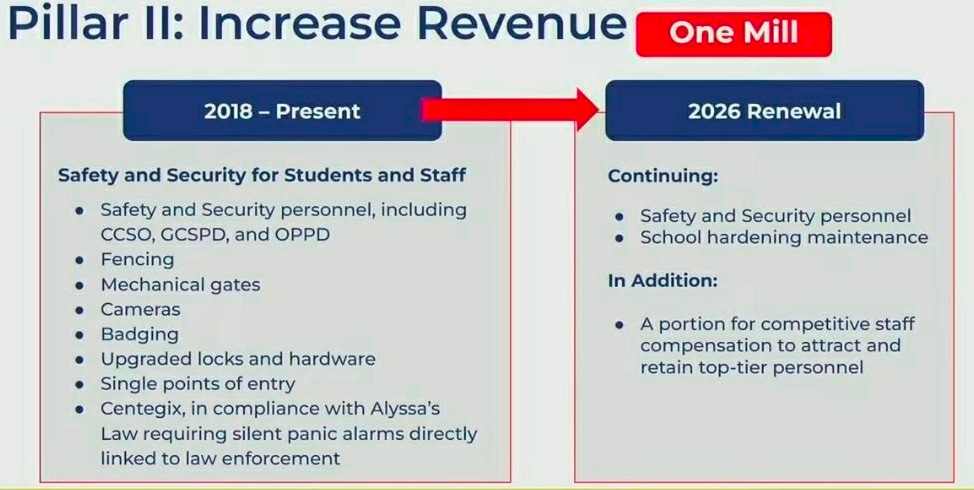
That omission leads to an unavoidable question:
Is the School District preparing ballot language that would allow the Safety and Security One Mill to be used without guaranteeing the presence of law-enforcement officers in our schools?
If so, that represents a profound breach of voter trust—and taxpayers deserve to know before any language ever reaches the ballot.
Fiscal Recklessness
Adding compensation to the Safety and Security One Mill also raises serious fiscal concerns.
If the district intends to use this millage for salary increases, it would be tying permanent, long-term financial obligations to a temporary funding source that must be renewed every four years. That is fiscally irresponsible by any standard. What happens if the millage fails in a future election? Are salaries reduced? Positions eliminated? Teachers deserve stability—not uncertainty tied to election cycles.
If the plan is instead to offer bonuses, that creates another problem entirely. Bonuses are typically taxed at a flat federal rate of 22 percent, meaning educators take home significantly less than advertised, while the government receives a larger share.
Surprising? No, of course, the government will take all they can while selling it as a benefit to teachers. That is neither a serious nor a sustainable compensation strategy.
Transparency and Real Choice
Combining school safety and employee compensation into a single ballot measure is unfair, misleading, and unnecessary. It denies taxpayers the ability to evaluate each issue independently and forces them into an all-or-nothing decision.
The responsible path forward is obvious: Separate the issues.
Put school safety and security funding on a single ballot question and list the law enforcement agencies that will be contracted to police our schools. Put employee compensation on another. Allow voters to make informed decisions without fear, pressure, or manipulation.
Clay County taxpayers are not uninformed, unreasonable, or incapable of understanding complex issues. What they will not tolerate and should not tolerate is being rushed, coerced, or misled.
Adding compensation to the Safety and Security one Mill—while threatening reduced school safety if voters disagree—is unacceptable. Our children’s safety should never be used as leverage, and taxpayers deserve far better than what was presented as a “Financial Renaissance.”
I reached out to the Clay County School Board and Broskie seeking clarification. Not a single School Board member responded by the time this article was written. Broskie’s reply, however, only reinforced the concerns raised here.
What came back were the familiar non-answers that signaled a decision had already been made, and a public process had been reduced to a formality. Taxpayers are expected to accept this change quietly and vote “yes” for the safety of children, of course.
Citing examples from St. Johns and Duval counties and leaning on technical interpretations of “operating expenses” does nothing to address the core issue: voter intent.
At no point was there a firm commitment to guaranteeing sworn law enforcement in our schools, nor any acknowledgment that bundling safety and compensation strips voters of a fair choice.
Broskie did not explain whether this funding would mean permanent salary increases or one-time, highly taxed bonuses, leaving voters and Clay County School District employees deliberately uninformed.
Clay County deserves better than borrowed justifications and rushed decisions. There is nothing innovative or responsible about coercing voters into a “yes” vote by emotionally manipulating them and bundling the physical safety of children with employee compensation—those are separate issues, and treating them as one is fundamentally dishonest.