

The author is a veteran investigative journalist who produces the Substack newsletter Seeking Rents, covering Florida politics and policies. This story was first published on June 14, 2026 and is reprinted here with permission.
FIRST OF THREE STORIES
By JASON GARCIA
Cities, counties and towns across Florida could lose close to a quarter of their annual property tax collections, if voters approve a state-backed ballot measure this fall that would cut and cap local property taxes.
That’s according to a new analysis by the state’s Revenue Estimating Conference—also known as the REC—a panel of nonpartisan economists tasked with forecasting the financial impacts of proposed legislation.
It’s the first full analysis of the seismic property tax plan that Gov. Ron DeSantis and Florida’s Republican-controlled Legislature rushed to pass during a 28-hour special session earlier this month.
The proposed constitutional amendment—which will only take effect if at least 60 percent of Florida voters support it in a statewide referendum in November—was conceived so quickly and with so little input from anyone outside the inner circles of Tallahassee leadership that even legislators who voted for the plan gave contradictory explanations of how it would actually work.

The REC analysis—which, to be very clear, should have been done before state lawmakers voted on this—found that the proposal would quickly lop off more than $8 billion a year in funding for local governments by supersizing a tax break for primary homeowners.
That provision, which would be phased in over two years, would generally increase the state’s homestead tax exemption from $50,000 to $250,000 — meaning, for example, that the owner of a $750,000 home would pay taxes to their local city or county government as if their home were worth only $500,000.
But the local revenue losses would widen rapidly from there—thanks largely to a second tax break that would suppress the annual tax bills for all other property owners, too.
That piece of the package would further restrict the year-to-year growth in tax assessments on all non-homestead property—everything from a New York couple’s vacation condo in Miami Beach to the Walt Disney Co.’s Magic Kingdom theme park.
Florida already caps increases to the annual tax assessments on non-homestead property at no more than 10 percent a year, the result of Big Business-backed constitutional amendments that passed in 2008 and 2018.
This new proposal would lower that ceiling even further so that the assessed value of non-homestead property could climb by no more than 5 percent a year—no matter how much the actual market value of the property rises.

In fact, one of the most striking findings from the REC’s analysis is just how quickly that tighter tax cap would compound, as the gap between what a piece of non-homestead property is worth and what it is taxed at steadily widens over time.
Local government revenue losses just from the non-homestead tax cap would swell more than six-fold over the first five years it is in effect — from around $350 million to more than $2.2 billion. And the tax differentials would keep on stacking up over time.
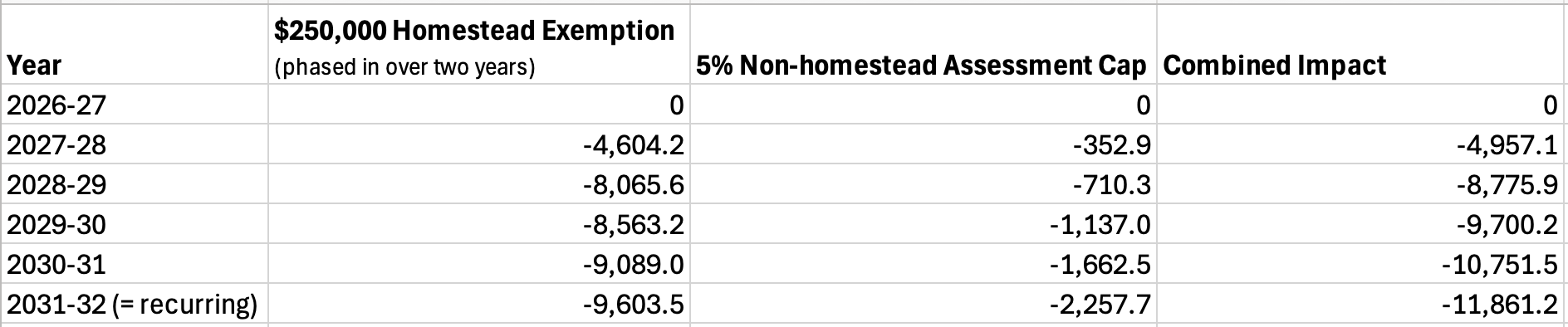
Altogether, the REC estimates that the combined package—the $250,000 homestead exemption plus the 5 percent annual non-homestead assessment cap—would wipe out nearly $12 billion in annual funding for local governments by the 2031-32 fiscal year.
And that does not include other not-yet-calculable impacts from the proposed constitutional amendment, which would, among other things, make it possible to continue increasing the homestead exemption — all the way up to 100 percent — without another statewide referendum.
For perspective: $12 billion would be somewhere in the ballpark of 24 percent of total local government property tax collections, based on the REC’s property tax growth forecasts and a bit of back-of-the-napkin math by Seeking Rents.
That’s an almost-unfathomable hit to local governments that pay for police, fire, parks, roads, sidewalks, stormwater drains, sewage plants, libraries, animal shelters, trash collection, summer camps and so much more.

Cities, counties and towns would have to make that money up somehow—through some inevitable combination of cutting public services, raising property tax rates, and charging new taxes and fees.
To understand how painful that process would be: Recall that the Florida House of Representatives last year proposed cutting the statewide sales tax from 6 percent to 5.25 percent. That three-quarters-of-a-point cut to sales tax would have reduced the state’s general revenue — the flexible pot of money that legislators are free to spend however they want — by about 10 percent.
And the Florida Legislature absolutely fell apart over it.
What was supposed to be a 60-day session dragged for more than 100 days as House and Senate leaders in Tallahassee proved utterly incapable of completing a state budget with that big a hole in the middle of it. They clashed over what existing programs to slash and which new projects to leave unfunded—and ultimately abandoned the sales tax cut entirely. The Florida Capitol has been basically dysfunctional for two years now, in large part because of the animosity that developed during that budget fight.
In other words, Republican legislators in Tallahassee could not handle even a 10 percent cut to their general revenue.
But, of course, they have no problems tossing an even bigger budget grenade into the laps of local governments.
PART TWO

PART THREE

Local governments (counties) have a spending problem, not a revenue problem, in my opinion. Time to get serious about budget cuts. The answer is not squeezing hard working residents for more and more each year. For example, see the recent Clay News & Views stories on how we were essentially paying a duplicitous salary to a second and unneeded comptroller ("The local 'comptroller story' covered by Clay News & Views centers on the resignation of the County Commission Auditor, Heather Boucher, following a controversial attempt to secure a $44,000 pay raise"). That was great reporting and I submit we need more of that type of reporting, tighter spending control, and less emphasis on generating more and more revenue.
Good article… however, our government is out of control; and they are spending like drunken sailors. They need some training wheels…this bill will help to keep them accountable.