

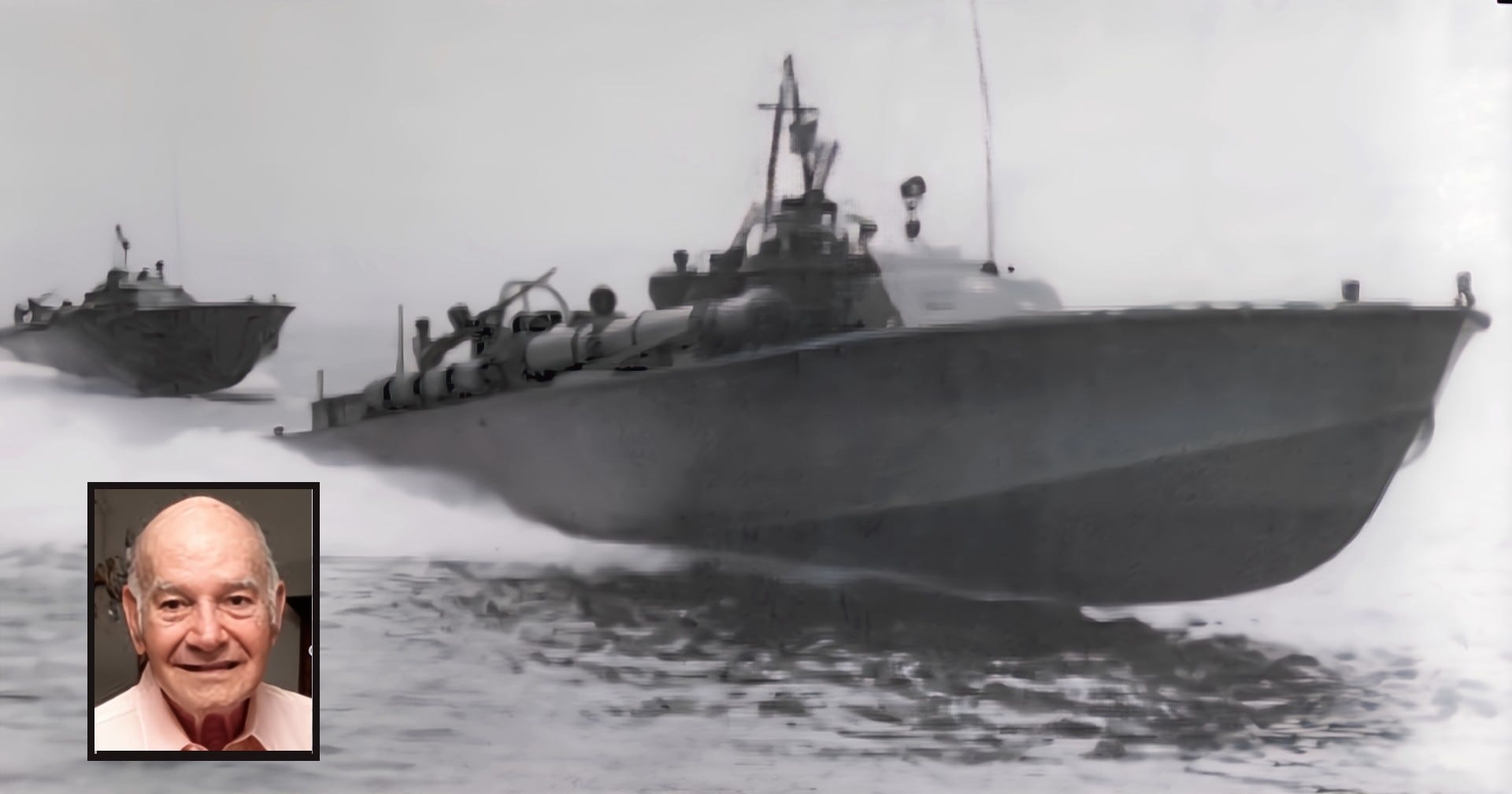
By HISTORICAL ARCHIVES CENTER STAFF
Gerard Zinser lived quietly in Orange Park for the last few years of his well-lived life before he passed away in 2001. Zinser was a member of the “Greatest Generation”, having served his country as U.S. Navy sailor for 20 years and then afterwards in civil service as a postman, mostly in Winterhaven, Florida.
When Gerard died, he was the last of the crew members of John F. Kennedy’s PT 109.
Military service was a calling for the Zinser Family. His grandfather Louis served in the Army. Louis and his brothers-in-arms were stationed about fifty miles away when George Custer met his fate at the hands of the Sioux warriors at the Battle of Little Bighorn. Gerard’s father, William, served, as did his uncles, Emil and Louis, and his brother Paul, who served in the Army during World War II. Their patriotism ran deep.
So, in 1937, Gerard enlisted in the U.S. Navy. Just a few years later, he was assigned to torpedo patrol boats in the Pacific theatre. It was there, in the Solomon Islands, that the most defining moment of his young life unfolded. He was assigned to PT 109, led by the future president of the United States, John F. Kennedy.
Zinser was the only career Navy man on the boat. On average, they were all young men, patriotic and hell bent on taking out Japanese ships. PT 109 was small and swift. She darted out at night, carrying her full load of torpedoes, searching for anything floating that was Japanese.
PT 109 refers to USS PT-109, a Patrol Torpedo boat during World War II, where “PT” stands for Patrol Torpedo, and “109” is its specific hull number.
It was in the wee hours of August 2, 1943. PT 109 and her crew were patrolling the Blackett Straits, near the island of Kolombangara. Unbeknownst to them, the Japanese destroyer Amagiri spotted PT 109 about a thousand yards away. Instead of opening fire on the smaller boat, as the Japanese did not want to give away their location, the destroyer picked up speed, her screws thrusting the beast of a ship forward at 30 knots. It was a pitch-black night as the bow of the destroyer aimed for PT 109.
At about 200 yards out, Lieutenant Kennedy spotted the Amagiri. He ordered his boat to turn starboard ready to fire torpedoes. PT 109 wasn’t fast enough in her turn, and the bow of the destroyer sliced her in half. The Amagiri kept on going. The damage to the destroyer was slight, as PT 109 was made mostly of plywood.
Crew members were thrown in the water. Zinser himself remembered waking up in the water, surrounded by burning gasoline and hearing cries of pain echoing through the air. Zinser had burns, but they were not as bad as another sailor who suffered third degree burns all over his arms and face. Amagiri’s bow was bowed in, and her screws were slightly bent, but she still made 24 knots on the way to Rabaul. Over the next few days, Lt. Kennedy led his ragtag group of castaways to safety. Gerard earned a Purple Heart.
The story of how Kennedy swam from one island to another, floated a wounded sailor on a plank, and towed him to safety lives on today as a true profile in courage. Hollywood chimed in with the movie PT 109 starring Cliff Robertson and Robert Culp. Zinser was an extra in the movie, and he himself was portrayed by William Douglas. Ironically, the movie was released the same year that President Kennedy was assassinated.
After Navy retirement, Gerard became a postal worker in Winterhaven. He, his wife Edna, and his eight children moved to Florida in the early 1960s when there was still lots of “old Florida” charm. He moved into a new subdivision where most of the neighbors had newly arrived from the Midwest, all eager to live in the Florida sunshine.
After the war, PT 109 lived on in Zinser’s life. The survivors kept in touch with each other and with Kennedy. When Kennedy ran for office, his former shipmates wanted to help with his campaign. Some couldn’t because of the Hatch Act, and those men were disappointed.
However, all the survivors, except one who died in a car crash, participated in the inauguration parade. They rode on a life-size replica of PT 109. When President Kennedy came to Florida to campaign for Senator George Smathers, he meet up with Zinser and his other shipmates. Gerard approached the President, shook his hand, and said, “Zinser, Gerard E., motor machinist mate first class, reporting for duty. PT 109”. The President and Zinser got to spend a few moments with each other before handlers pulled the President away.
Zinser was devastated when he learned of Kennedy’s assassination. Quoted by the author of the book PT 109 by Robert J. Donavan: “I cried like a baby all day when I heard he’d died. You can’t know how special he was to all of us. I felt that day like I’d lost the best friend of my life. That’s what John Kennedy meant to me.”
In his final years, Alzheimer’s stole Gerard’s memory in general but the memory of President Kennedy and the ordeal the crew of PT 109 was one that never faded.
