


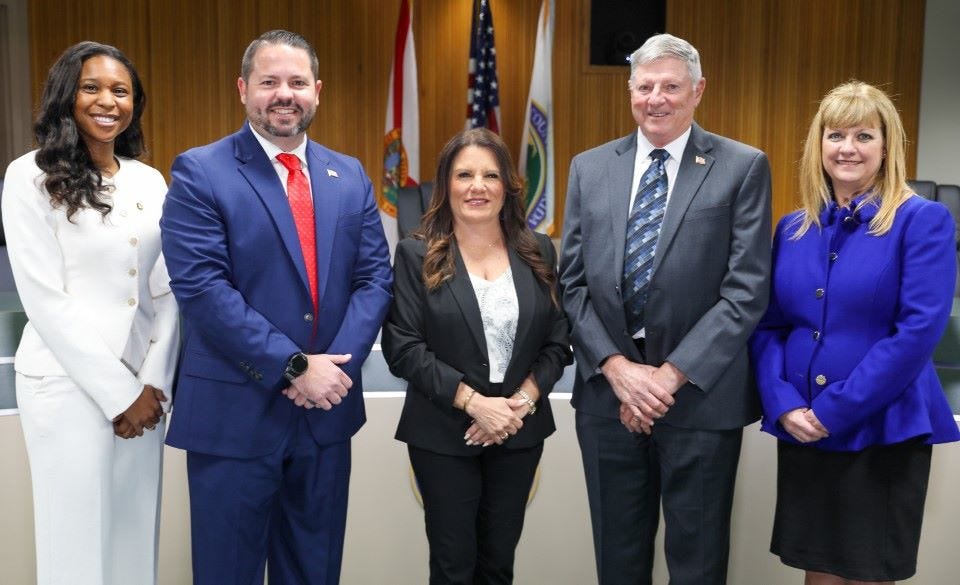
Dozens of Clay County residents packed the Board of County Commissioners (BOCC) chambers Monday night, delivering an overwhelming message to their elected officials: keep data centers out of Clay County.
The June 9th meeting drew one of its largest crowds in recent memory as the board held the first of two required public hearings on a proposed 12-month moratorium that would halt any applications for data center facilities in unincorporated Clay County while staff studies potential impacts. A final vote is scheduled for the June 23rd meeting.
No application for a data center is currently before the county, and commissioners acknowledged that no developer has approached the county with such a proposal. The moratorium was initiated preemptively, driven in part by what one commissioner called a glaring gap in the county’s land development code, which currently has no regulatory framework for data centers.
“Our land development code is completely silent on this,” said Commissioner Betsy Condon, who originally proposed the moratorium. “We’re trying to address some of those things before they become issues.”
A Room Full of Opposition
Speaker after speaker approached the podium to urge the board to pass — and in some cases extend or make permanent — restrictions on data centers. Concerns centered on three main issues: water, electricity, and the character of Clay County itself.
Bruce Reynolds, a retired environmental protection specialist from Green Cove Springs, offered some of the most detailed testimony of the night. Clay County, he said, currently uses roughly 30 million gallons of water per day, and a single data center can consume anywhere from 500,000 to 5 million gallons per day — with large AI training hubs drawing even more. He pointed to a $20.5 million class action settlement reached in March against Amazon Data Services over alleged nitrate groundwater contamination in Georgia as a warning sign.
“It is a real challenge to try to distinguish between what is supported by engineering and environmental science, and what is primarily marketing messaging — science versus sales pitch,” Reynolds said. “To me, a moratorium makes great sense.”
Valeria Weaver, a Green Cove Springs mother who said she took paid time off to attend the meeting, drew some of the night’s largest applause, which the chair had to repeatedly remind the audience was against meeting rules.
“I stand politically conservative Republican, and I say that not to bring politics into this,” Weaver said, “but there’s a lot of people here and we might vote differently, we might believe different things, but there’s a lot of us that stand on the same ground when it comes to this topic.”
She also noted that Jackson County commissioners had voted that very day to permanently ban AI data centers. “If they can do it, you guys can do it,” she said. “Stand for us. We’re all neighbors.”
Nicole Eaton of Orange Park urged the board to use the moratorium period to write permanent regulations “so protective that data centers look elsewhere,” citing Florida Senate Bill 44 — recently signed by Gov. DeSantis — as a law affirming that local governments retain full authority over zoning and land use decisions related to data centers.
One resident offered a pointed challenge to the board on the question of priorities during drought season: “Data centers pull the most water on hot summer days during seasonal droughts when the aquifer drops in July,” she said. “Who gets priority? The servers or the people?”
Not everyone was opposed. Marcia Garcia of Green Cove Springs made a case for keeping the door open. “I think it’s important to resist the temptation to oppose data centers just because it has become fashionable in the last few months to oppose them,” she said. She argued that the moratorium should be modified to allow applications to be submitted and reviewed, so the county could learn which types of facilities might actually seek to locate there.
Bruce Jackson, a Jacksonville-based data center industry veteran who said he has been attending Nassau County’s parallel workshops on the issue, pushed back on what he called outdated assumptions about water use. Modern AI-oriented data centers, he argued, use closed-loop cooling systems similar to a car radiator — dramatically more efficient than the older evaporative cooling systems most critics were referencing.
He also cited Loudoun County, Virginia, which collected $749 million from data centers last year, 45 percent of its entire general revenue fund.
Commissioners Split
The board, which will cast a binding vote on June 23rd, offered a preview of where members stand — and the picture is not unanimous.
Commissioner John Sgromolo came down firmly on the side of skepticism. Citing Clay County voters’ overwhelming passage of a conservation tax amendment—“at over 70%, which in an election is wild” — he said the public’s environmental values were already well established. He asked the county attorney to research whether a full ban on data centers, similar to what Jackson County passed, would be legally permissible in Florida.
“Just because you can doesn’t mean you should,” he said. “In terms of the juice not being worth the squeeze — in my opinion, with these data centers, it’s just not. There are way too many unknowns.”
Betsy Condon, the commissioner who introduced the moratorium, also signaled her support, describing water as her primary concern and noting that she lives in the recharge area of the Florida aquifer. She said she had been following Nassau County’s data center workshops closely and emphasized that a city in Mesa, Arizona, that had eagerly welcomed a data center, “said if they had it to do over again, they would never do it.”
Curiously, BOCC Chair Kristen Burke offered no comments or opinions on data centers during the meeting.
The most vocal dissent came from Commissioner Alexandra Compere, who argued the board could not afford to take a year off from the conversation, given Clay County’s financial position.
“We quite literally do not have 12 months,” she said, citing a $50 million budget deficit the board had discussed in a morning workshop. She pointed to rising unemployment in Clay County, now over 4% and climbing, and argued that the tax revenues generated by data centers in comparable counties in Virginia and Georgia were too significant to dismiss. Loudoun County, Virginia, she noted, collected $900 million from data centers last year — nearly matching its entire operating budget.
Compere also claimed that Clay County already has at least one data center within its borders, though she did not identify it, arguing it would be misleading for the board to treat data centers as entirely foreign to the county. Clay News & Views was not able to find any evidence of a data center currently operating in the county.
“There are good data centers and bad data centers,” she said. “And frankly, 12 months in this industry — asking for 12 months before changes that can help the infrastructure of a county — we don’t have 12 months.”
She stopped short of saying she would vote against the moratorium, and invited residents who wanted to change her mind to contact her directly.
Jim Renninger took a more pragmatic middle position, framing the issue in terms of national security and technological inevitability. “AI is going to rule the world for the future,” he said. “You’re going to use a data center — it just may be in China. Do you want your data stored in a Chinese storage facility?” He said the board was “taking a measured approach.”
Renninger also did not mince words when the topic of kickbacks came up, after one resident alleged online that commissioners were being paid off. “If you were to accuse me of taking kickbacks, I want to refer you to Sheriff Cook,” he said flatly. “That’s illegal, and I resent that wholeheartedly. I’ve spent my life representing the public.”
The board will hold the second and final public hearing on the moratorium ordinance at its June 23rd meeting, where a vote is expected. If approved, the moratorium would freeze all data center applications for one year while county staff develops regulatory standards and brings recommendations back to the board.
We don't need a data center in Clay county
The out of control growth has pushed available water, electricity and roads past their capacity to handle the load. Why add to that situation by adding load? Robbing Peter to pay Paul has never worked.