


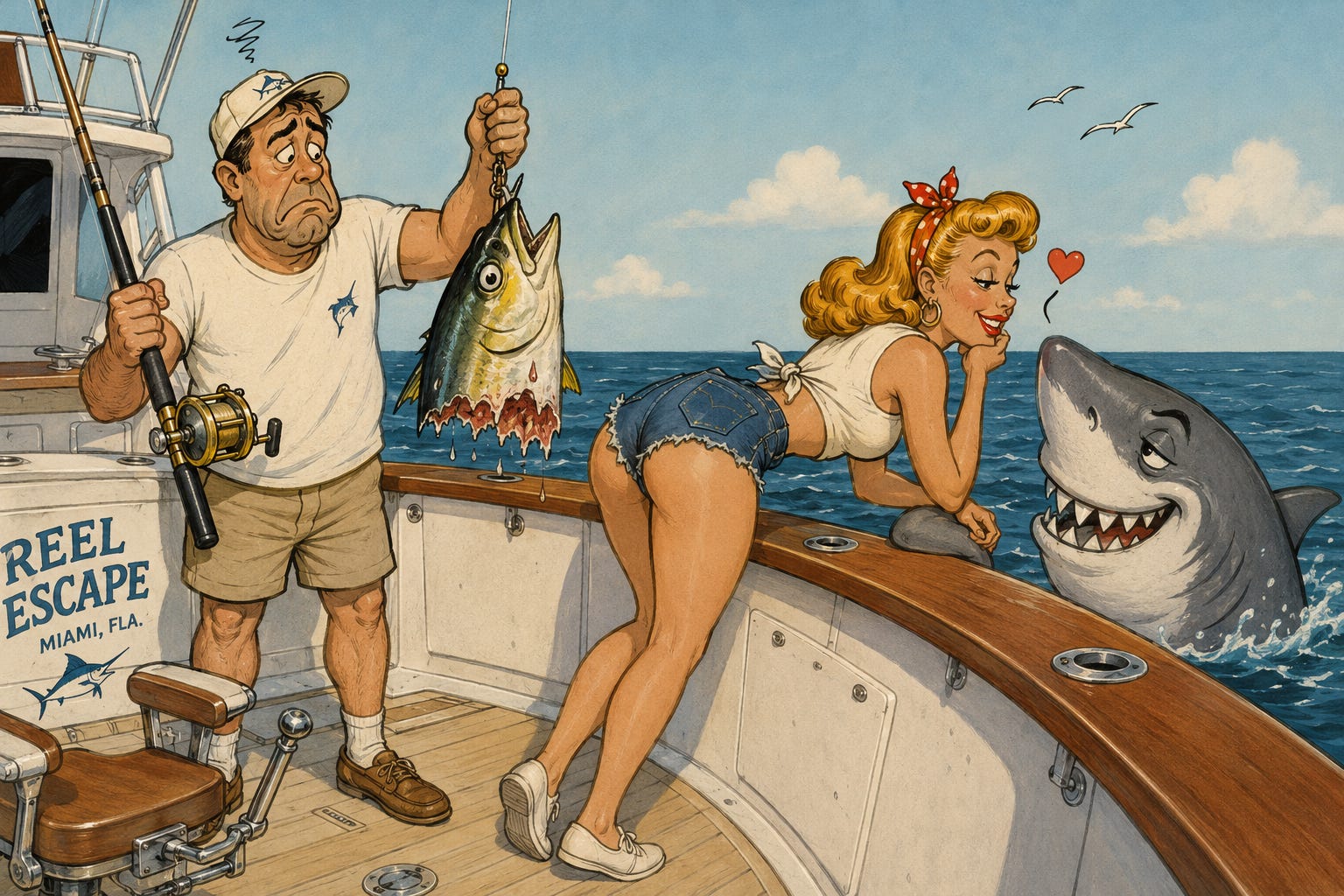
The line is taut. Then, suddenly it’s not.
Florida’s saltwater fishermen are frustrated. Despite deploying hundreds of thousands of dollars in motors, molded fiberglass, fuel, rods, reels and YETI coolers, this benighted cohort is being outwitted by creatures with brains the size of a walnut.
Sharks are eating their lunch…literally. Dinner, too. Pretty soon these brash bulls will be (flirting with) their wives.
How it happens: Having hooked a fish, the angler begins the process of reeling in his catch. He is fighting the fish, and the fish is fighting back. The line is taut. Then, suddenly it’s not. Reeling becomes easy-peasy, and the reason why is that a shark has bitten off as much of the aft portion of the fish as it could.
Tailess, the fish has lost all purchase, and, besides, it’s dead.
This is not a new phenomenon. What is new: The frequency. Sharks are back, baybee! They’re practicing a little angler depredation in the morning, then nipping New Smyrna Beach-goers in the afternoon.
This state of affairs has caused great sadness among fishermen. The collective gnashing of teeth was evident on Facebook. These poor guys are hurting.
“Yeah, nothing like blowing $500 in fuel catching a s***load of fish and losing them to sharks. Definitely sucks,” Philip Punch wrote.
“Absolutely the worst,” Thomas Botwinski lamented. “I lost six consecutive nice yellowtail hookups last trip.”
“This is the worse it has ever been in 50 years of fishing. EVERYWHERE, the sharks are trained now to run to boats for an easy meal, and, to the point, it’s impossible to fish,” sniffled Bob Hubbard.
Referred to collectively as “The Taxman,” the culprits are usually bull sharks or sandbar sharks (with hammerheads pitching in against the tarpon-catching crowd). A 2022 survey found that 77 percent of recreational anglers and charter guides had experienced shark depredation.
The cull-the-herd proponents want to eliminate the problem by either “harvesting” more sharks and grilling the steaks out of them or via 12-gauge deer slugs. (Alas, they complain, sandbar sharks are a federally protected species.)
Here’s some pertinent scientific-sounding talk:
Bull sharks are highly adaptable predators that use sounds, vibrations and electrical signals to track struggling or injured prey. Reeling in a hooked fish mimics an easy meal, conditioning bull sharks to associate fishing boats and struggling fish with a quick feeding opportunity.
Yeah, I don’t think anyone has proven that a bull shark needs the presence of a boat to find his next meal, but here, enjoy some more science gobbledegook, this time sneering at the “fishers” (not fishermen, not anymore), whose identities are apparently being threatened:
Underlying and deeply rooted conflicts around poor perceptions of management legitimacy and threatened fisher identities add complexity to the fisher–shark conflict, and call for broader interventions beyond these visible effects.
Enter U.S. Senator Rick Scott of Florida. In July 2025, Scott and Senator Brian Schatz of Hawaii introduced the SHARKED Act, which would establish a task force to solve the depradation problem. The bill has passed the House and now awaits a final floor vote in the U.S. Senate.
The bill’s announcement noted the fisherman frustration, federal regulators’ lack of empathy and a most sincere concern about the possible harm that could come to the feasting shark population. Quoth the press release (emphasis added):
Hooked fish being landed by anglers or commercial fishermen creates an unnatural and easy meal for sharks and exposes them to potentially harmful fishing gear. As the rate of shark depredation has increased, fishermen have become increasingly frustrated by the issue and a continued lack of response from the fisheries management community.
Maybe, the fisheries management community is unsympathetic because overall shark populations continue to be way down from historical norms, and even though there may be a comeback in places such as Florida, it’s only a partial comeback. Plus, complaining about sharks doing shark things is a bit like calling the police because some goshdarn woodpecker won’t let you sleep late on Sunday morning.
Meanwhile, the sportsmen are lashing out, directing their frustration against the ecotourism activity of “shark diving.” This somewhat silly passtime (think bungee-jumping) supports it’s own little Florida industry. In response, two Florida congressmen introduced the Florida Safe Seas Act, which is also pending in the Senate.
This legislation would outlaw feeding sharks in federal waters off Florida, feeding being a necessary precursor to attracting sharks to a central location where they can be observed by divers paying $250 each for the experience. Florida has already outlawed the practice in state waters.
Again, the theory (which is treated as fact) is that chumming for Jaws by a handful of small operators is somehow teaching these beasts to associate boats with food on a species-wide level. Yet another one big maybe.
The only real hope is that the Task Force might come up with some tech solution that allows boaters to somehow jam a shark’s onboard fish-detection sensors. Either that, or maybe we just fall back on the solution du jour for a whole host of today’s thorny issues—drones. There must be a way to use drones here, no?
Otherwise, maybe we do nothing. After all, we are talking about an expensive hobby, not some existential threat. You can keep fishing on nature’s terms or take up golf. (Your wife isn’t really hooking up with Bill the Bull, is she?)
What was it that one unsympathetic commenter said, responding to that Facebook conversation about shark predation?
“Unless you have grown gills and fins, you’re the problem not the sharks. Almost no one gets attacked by a shark sitting in the bar or at the mall, and I’ve never had one steal fish from me at Publix,” Tony Spagna said.