


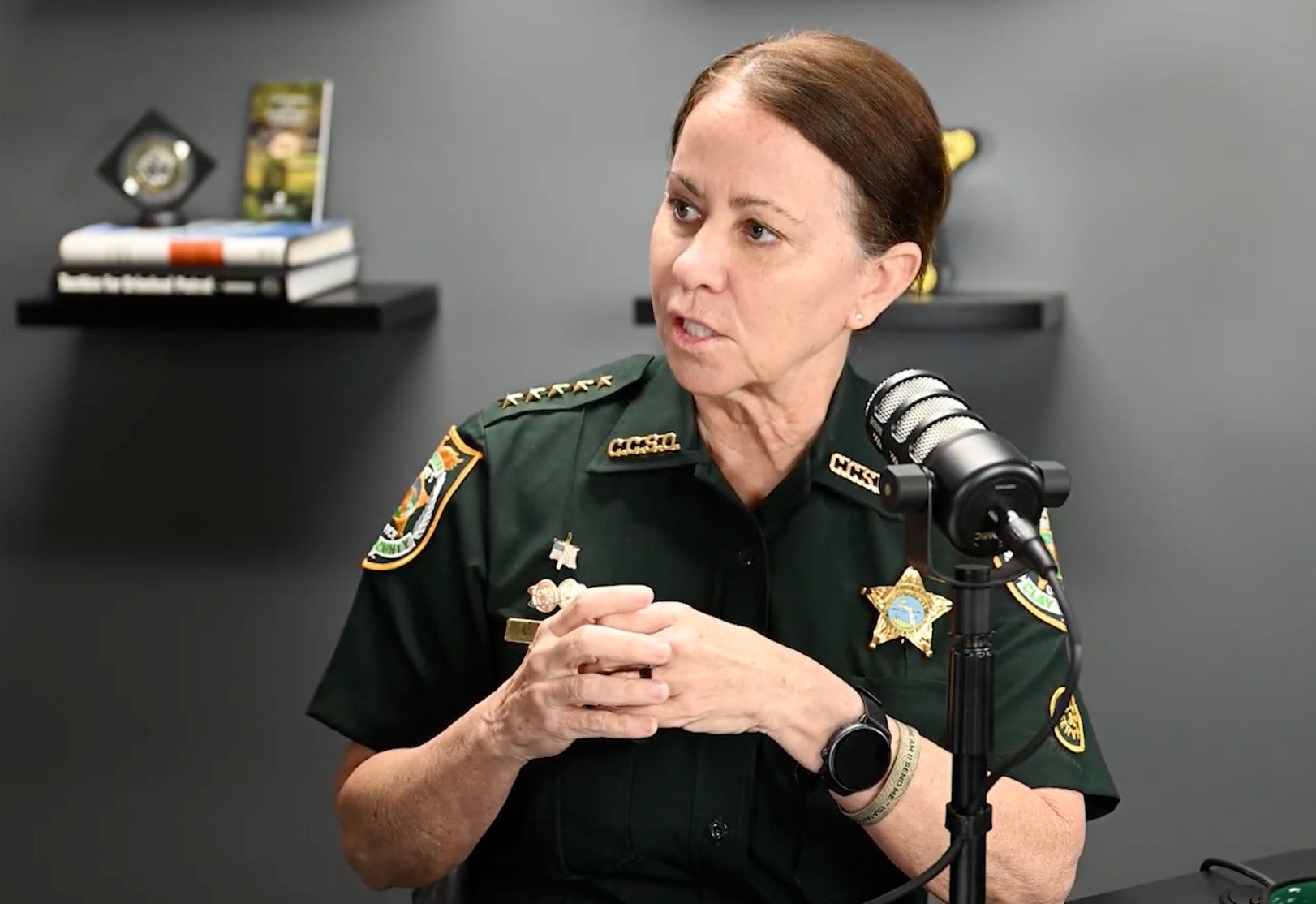
Clay County Sheriff Michelle Cook says Amendment 3 would force her to lay off hundreds of employees. She says her agency is so lean that nearly every dollar is already spoken for.
Cook made those claims on Florida Unwired, a podcast produced by the News Service of Florida. She spoke with senior reporter Ana Goni-Lessan about the proposed constitutional amendment on the November ballot.
It would raise the homestead exemption from $50,000 to $150,000 in 2027 and to $250,000 in 2028. School taxes are carved out.
Sheriff Cook has campaigned against the amendment for most of September, starting with local meetings in Clay County and an appearance in a commercial made by the Florida Sheriff’s Association.
CN&V reviewed seven years of county budget documents, CCSO’s own published budgets, its 2025 annual report and the agency’s technology contracts. Several of Cook’s key figures hold up. Others conflict with her agency’s own records.
What Cook Said
Cook told the podcast that a $50 million loss in county property tax revenue would cut her budget by about $35 million. She said that would mean laying off about a third of her workforce, or 250 to 300 people.
She said all of Clay County’s property tax revenue goes to law enforcement and fire services. She said the county has no other money to cover the loss.
Cook also described her budget as almost entirely fixed. She said about $1 million of her $120 million budget is discretionary. She said 82% of her budget pays for people. She listed salaries, benefits, insurance, and FICA as costs she has “zero control over.”
Cook also embraced the phrase "defund the police." The host introduced the term and asked whether Amendment 3 would effectively defund law enforcement. Cook agreed. "This is defunding the police," she said.
She said cutting her funding without a plan to keep her employees amounts to defunding. She later said that passing the amendment would mean "turning our backs on those who need us the most."
The Claims That Hold Up
Several of Cook’s numbers match the records.
Her budget figure is accurate. The county’s tentative budget for fiscal year 2026-27 sets spending in the two sheriff’s funds at $120.9 million.
Her personnel figure is accurate. Personnel costs make up 81.8% of that spending. The share has stayed near 80% throughout her time in office.
Her funding figure is accurate. Cook said about 95% of her budget comes from property taxes. Property taxes make up about 97% of the revenue in the sheriff’s funds for 2026-27.
Her claim about property taxes is largely accurate for the new budget year. That is a recent change.
A Budget Restructured in the Amendment 3 Year
In the 2026-27 tentative budget, the county moved Fire Rescue out of the General Fund. It created a new Fire-EMS Countywide fund with $38.2 million in property tax revenue.
At the same time, the General Fund’s property tax revenue dropped to zero. It was $55.2 million the year before. Property tax flowing into the sheriff’s countywide fund rose from $56 million to $78.8 million. That is a 41% increase in one year.
The result is a budget where county property tax goes almost entirely to law enforcement and fire. That structure is new. It takes effect in the same year Amendment 3 is on the ballot.
There are possible exceptions. The 2025-26 county levy included a voter-approved conservation lands tax and a small tax for unincorporated services. CN&V could not confirm whether those continue in 2026-27.
Cook’s claim that the county has no other money is harder to support. The General Fund still holds about $87.8 million in revenue from other sources, including sales tax and state revenue sharing. Whether to move any of it to public safety would be up to the County Commission.
Budget Nearly Doubles
Cook took office in January 2021. She inherited a $62.8 million budget. The 2026-27 tentative budget is $120.9 million.
That is an increase of $58.1 million, or 92%. The budget grew every year of her tenure. It never decreased.
Here is spending in the sheriff’s funds by year, using each year’s adopted budget:
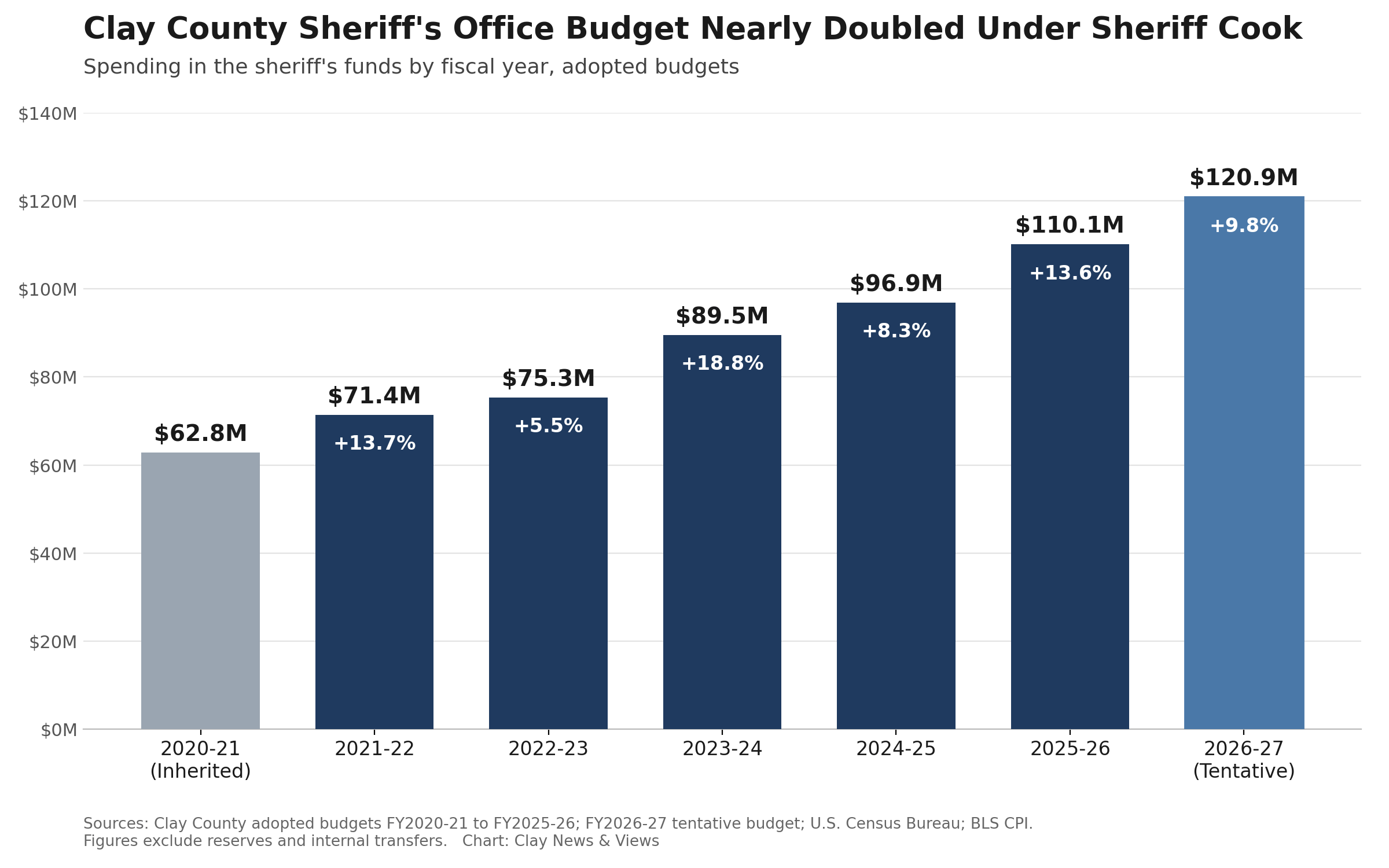
Since 2020-21, the Sheriff’s Office has nearly doubled.
Over roughly the same period, Clay County’s population grew about 9.8%. The Census counted 218,245 residents in 2020 and estimated 239,593 in 2025. Inflation from September 2020 to September 2025 was between 25% and 26%.
Personnel spending grew faster than the budget overall. It rose from $50.6 million to $98.8 million, a 95% increase.
Cook says she inherited a badly understaffed agency. She told the podcast her goal was to bring staffing up to the state average of deputies per 1,000 residents and keep pace with growth.
Her 2025 annual report lists 930 agency positions and 175 new hires. On the podcast, she said the agency has just over 900 employees.
The Clay County Board of County Commissioners approved every one of these budgets.
‘Zero Control’ and the Agency’s Own Budget
Cook said she has no control over salaries, benefits, insurance, and similar costs.
Some of those costs are set elsewhere. The Legislature sets Florida Retirement System contribution rates. FICA is federal. Health insurance premiums follow the market. In the 2025-26 budget, law enforcement benefits rose $2.2 million, or 33%.
Courthouse staffing also grew to cover two new courtrooms, which the courts decided to open.
But CCSO’s own budget documents describe other personnel growth as the result of agency decisions.
The approved 2025-26 budget explains the rise in law enforcement personnel costs. It cites CCSO’s career compensation plan, a new specialty pay program, and added staffing to improve the deputy-to-citizen ratio.
Cook’s own message in the 2025 annual report says the agency increased personnel and resources during the year to better respond to calls for service.
The sheriff decides how many people to hire and how to pay them. The cost of each employee is partly outside her control. The number of employees is not.
A Closer Look at Spending
Cook said about $1 million of her budget is discretionary. Her office’s technology contracts tell a different story.
In January 2025, Cook signed a 10-year agreement with Axon Enterprise worth $12 million. That averages about $1.2 million a year. The deal covers Tasers, body cameras, in-car cameras, drones, and the Fusus surveillance platform.
CCSO also holds multiple contracts with Flock Safety for license plate cameras and related systems. Together, they commit the agency to roughly $869,000 a year.
One five-year contract for 95 roadway cameras includes an optional upgrade to store license plate data for a full year. That upgrade alone costs $142,500.
Combined, these contracts cost about $2.1 million a year. That is about twice what Cook described as discretionary.
CCSO’s 2025 annual report lists software licensing and support as the agency’s largest non-personnel expense, at $2.65 million. The report does not say how much of that goes to Axon and Flock.
The report also says the body camera program began in 2023 after Cook identified the cameras as an industry standard. CCSO is adding them in phases. Fifty deputies received cameras in 2025. Another 100 units are planned for 2026 and 100 more for 2027.
Non-personnel spending has also grown quickly. Operating and capital costs in the sheriff’s funds rose from $18.1 million in 2024-25 to $22.2 million in 2025-26. That is a 22% increase in one year. CCSO’s budget attributes part of it to the body camera rollout and IT licensing.
Once signed, multi-year contracts can be difficult to cancel. The roadway camera agreement has no clause allowing CCSO to end it early for convenience. But the sheriff’s office decided to sign each contract.
Other Claims Checked Against the Annual Report
Cook told the podcast her agency handles about 275,000 calls for service a year. The 2025 annual report lists 264,346.
She said CCSO receives more than 5,000 calls to 911 each month. The report lists 76,764 for the year, or about 6,400 a month.
She said the jail holds about 440 inmates on an average day. The report lists an average daily population of 392 for 2025.
Cook also warned that with fewer deputies, residents with non-emergency calls would wait much longer. The annual report gives a baseline. In 2025, average response time was 9 minutes and 14 seconds for priority calls and 13 minutes and 37 seconds for non-priority calls. The report says both improved from 2024.
Budgets Posted Online
Cook told the podcast that CCSO posts its budgets on its website so anyone can review them.
CCSO’s budget page includes the proposed and approved budgets for 2025-26. For 2026-27, it lists only the School Resource Officer budgets. As of Oct. 2, the agency’s itemized 2026-27 budget does not appear on the CCSO website or the county’s website. The new fiscal year began Oct. 1.
The only public version of the 2026-27 sheriff’s budget is the county’s fund-level total. It does not show how the money is divided among salaries, equipment, contracts, and other costs.
What Comes Next
Voters will decide the fate of Amendment 3 on Nov. 3.
Cook's choice of words matters as that vote approaches. “Defund the police” is one of the most emotionally charged phrases in American politics. Using it to describe a property tax measure invites voters to react with fear rather than weigh the numbers.
Cook’s own records show her budget nearly doubled in six years. Her layoff scenario assumes her agency would absorb $35 million of a $50 million loss. It also assumes the County Commission would not use other revenue to soften the cut.
Cook said on the podcast that she supports tax reform but wants a plan that protects public safety funding. She said she would press the state’s tax commission to take up the issue if the amendment fails.
