


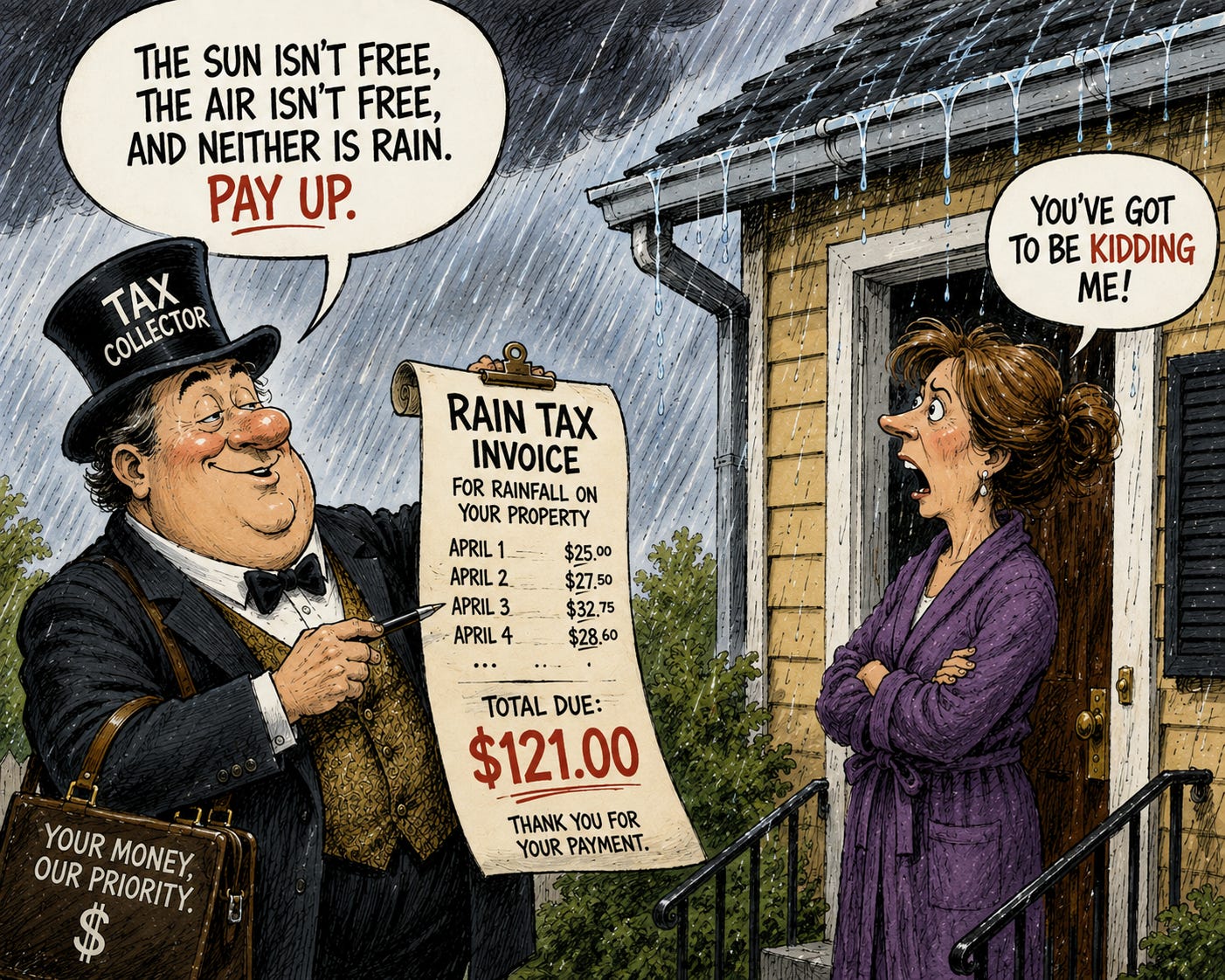
It appears the folks we’ve hired to run the county store are telling us the cash register is empty. Now, they want us to refill it—or else.
Several weeks ago, homeowners received The Letter from the county. The missive said that come November, the county plans to make us pay taxes on rain.
They’re calling it “stormwater fees,” which will be levied on homeowners and businesses in “unincorporated areas “ of Clay. The correspondence said the money is to fix stormwater drainage issues around the county—but even if you live on a sand hill with no drainage problem, you still have to pay it. And there’s only a guesstimate of what the fees will be, but the message suggests they will continue to rise.
The county says they need $9 million a year for the foreseeable future— meaning long after many of us are dead.
The charge will appear on our tax bill, but the county is not calling it a “tax.” This is an important distinction, because residents get to vote on taxes, they don’t on fees.
The letter was clearly written by a lawyer(s), as parts of it were so confusing, residents needed a lawyer to explain the legalese. But there was an unmistakable threat that needed no explaining: Don’t pay the fee, the county will take your home.
Threat Behind The Threat
Clay County has an embarrassing and well-documented history of overspending: two sheriffs, a clerk of court, a county manager, the tax collector and more county commissioners that we can count.
Consequently, lots of residents believe the stormwater fee is not only a plan to raise a chunk of money for the county to spend on whatever they want, but also to intimidate county residents into voting against Amendment 3—which will allow money to flow away from the county and back to homeowners. This may be the real reason some officials want us to believe if Amendment 3 passes the county will be in a fiscal hole.
Clay News and Views previously covered Amendment 3, but here’s a recap.
It is on the November ballot and gives homeowners a much-needed break from ever-growing property taxes. The amendment increases the homestead exemption from $50,000 to $150,000 in 2027, then sets the exemption at $250,000 in 2028.
Before The Letter was sent, officials bragged in the media and on the county website that they operated a “lean budget.”
Apparently, “lean” has a flexible definition, because a few weeks later they dropped a bomb which some believe was yet another attempt to stop Amendment 3: “Oh, by the way, we’re $35 million in debt.”
Squeezing Residents
The stormwater fee is worrisome and contentious for taxpayers all around the county. Nevertheless, county employees said some commissioners and administrators pushing for the fees came up with their own humorous little ditty that boils the debate down to a simple refrain: “The juice is worth the squeeze.”
The squeezers, however, may not find it so funny when they discover county homeowners are harder to squeeze than they thought.
With little notice, about 200 people showed up last Friday on a miserably hot summer night for a meeting at the Middleburg Civic Center concerning the new fee. There were different faces and diverse backgrounds, but one common thread stitched them together throughout the room in a tight weave—anger. And they plan to show up en masse to fight the fee's passage, as Clay Citizens did six years ago.
In 2019, the then-Board of County Commissioners (BCC) contemplated a fix for drainage issues in the county. After listening to a large group of county citizens’ pleas to squash the stormwater fees, the BCC decided against the charges. They promised to find other “options” to fund drainage.
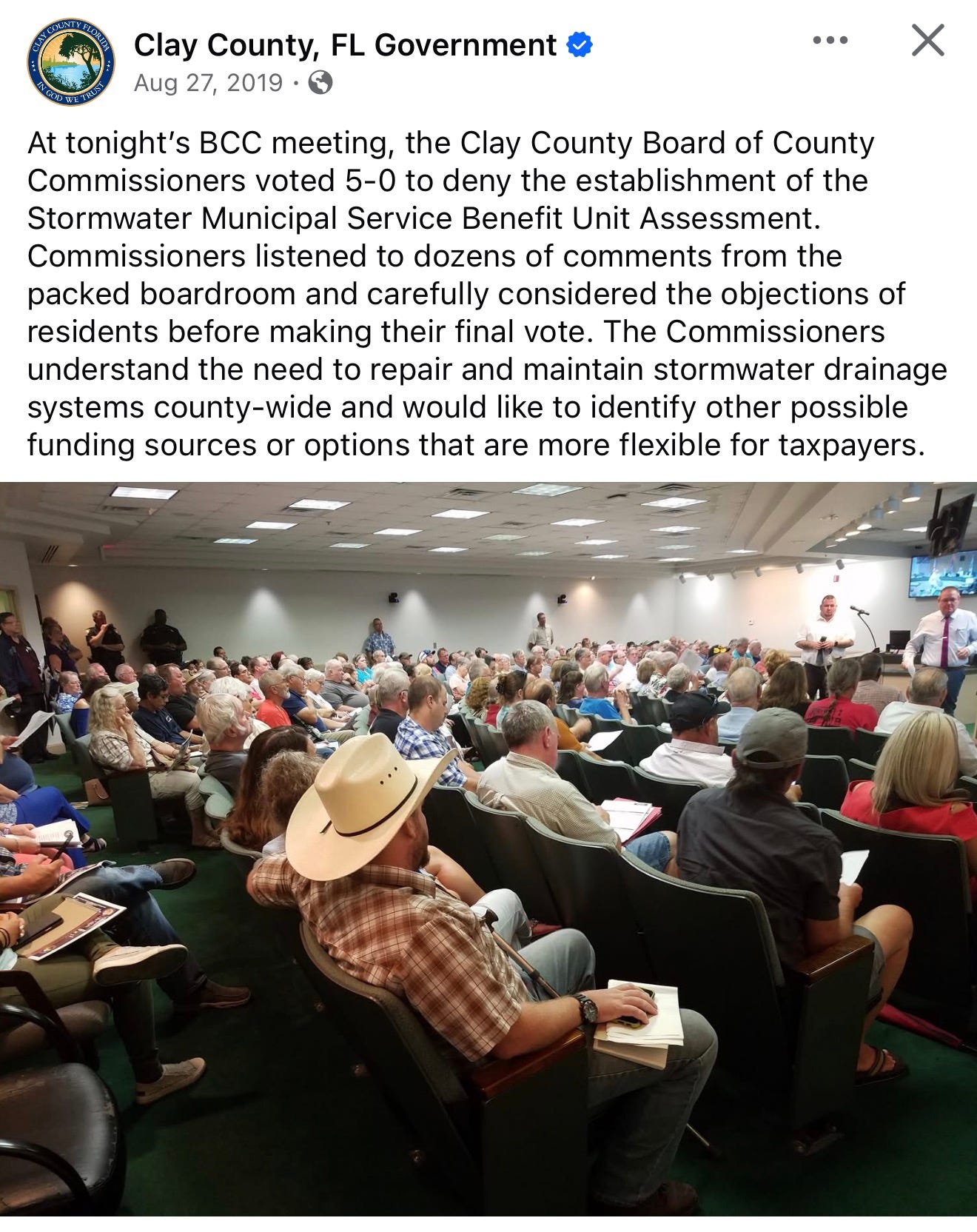
The present BCC is apparently sending those “options” down the storm drain. On Tuesday at 4 p.m., the Board of County Commissioners will vote on the stormwater fee.
Spoiler Alert
Seems the stormwater vote has already been decided. Commissioner Condon will vote “no.” Commissioners Burke, Renninger and Sgromolo will vote “yes” and Commissioner Compere is on the fence.
Insiders said commissioners and county administrators in favor of the fee would not have put the issue on the agenda for a final vote unless they already knew they had the votes to pass it.
There is a small wrinkle, however, in the alleged preplanned vote at next Tuesday’s meeting. Condon acted within the Sunshine Law because she publicly assured her constituents she is against the fee. However, if other commissioners discussed the issue with each other or passed information with surrogates before the meeting, the vote could be squashed and the commissioners charged with breaking Florida’s Sunshine Law. But proving it may be difficult.
Spoiler Alert: The Sequel
It appears the show will go on regardless of possible violations.
So sources say to bring your pillows as the plan for the meeting is that the commission will roll out a lineup of “experts.” They’re planning mind-numbing displays and speeches to either put residents to sleep or convince them to “trust us,” shut up, and pay the fee—because apparently, they want residents to think the county is on the verge of becoming a swamp.
Folks in the know said commissioners and surrogates are planning to tell residents that they, and their Department of Government Efficiency (DODE), have worked tirelessly to cut costs and find other monies for stormwater repairs, but to no avail. Presenters plan to pat themselves on the back because of specific cuts they made in the budget—in particular with how the county has not replaced 50 people who retired or left. If they follow their preplanned script—that raises a rather awkward question—why were 50 dispensable people even on the payroll in the first place?
Those privy to the rehearsals for the county’s meetings said presenters have yet another plan. The will attempt to convince attendees that the county cannot takes funds from other parts of the budget, because they must spend massive amounts on public safety needs which have increased dramatically due to the county’s massive growth spurt.
Anyone who has spent time driving around our area is already well-aware that the county has allowed builders and developers to stuff homes into our county like Vienna Sausages in a can. But odds are, the money spent by the county on infrastructure for developers will most likely not be mentioned.
A former commissioner told CN&V that infrastructure was not built by the county in the early 90’s. He said Clay, like many other counties, required developers to build infrastructure before development could take place. This kept county expenses and millage rates low. However, the commissioner said, influential developers helped to facilitate a deal for the county to buy Clay Utilities. Afterward, requirements for infrastructure were “magically removed.”
Facts and Friction
To ensure that folks are armed with accurate information before the meeting, here’s a few facts.
Mr. Google says in 2024, the typical millage rate recorded for counties with populations between 225,000 and 674,999 was 5.4838. Clay County’s population is about 240,000, and our millage rate is 5.5471. If added together, the average millage rate of all counties, large and small, across the state is 6.5308.
Experts in government finances told CN&V they believed the county’s advertised millage rate was misleading. The published millage is only the “countywide services” portion of the county's tax revenue, they said, not the “actual revenue” received.
Those knowledgeable said in FY 2025-26, Clay County added a 0.2 mill “conservation land” tax and other taxes called Municipal Service Taxing Units (MSTUs). This puts the total of our real millage at 8.8010.
This means the county is getting more spending money than they’re saying.
The same experts say renters will also be affected by the stormwater fees. Rent, already high in the county, will be rising as landlords pass the fees on to their renters. Those in apartments will certainly be affected, as fees will be charged based on the size of roofs, driveways, and parking lots. This will also be a large hit for businesses.
Dear Commissioners: Let Us Help
Given the county’s misadventures with taxpayer monies in the past, some residents have an idea they plan to run by the commission on Tuesday night. They want to form a committee of knowledgeable people in the county, chosen by residents not the commission, to come together to review the budget to see where the money is being spent and where cuts can possibly be made. The’d also like the commission to hold off on the vote while they form the committee.
Nevertheless, CN&V has complete confidence that commissioners will agree to the taxpayers’ requests—when Hell freezes over.
Worried and Wondering
The county’s stormwater plan has no exceptions for hardship cases.
As the stormwater issue plays out, CN&V continues to talk with homeowners from different corners of the county. They were initially thrilled at the possibility of getting a break on their burdensome homeowner taxes if Amendment 3 passed. One resident said she had planned to get back on her blood pressure medication. But even with the passage, she said, the new fee will now make it impossible for her to afford the meds.
Others are worried that a demand for more county money, especially the large and growing fee proposed for stormwater, could cause them to lose the homes they’ve spent a lifetime struggling to keep. For these residents, another bill to pay could be the final straw that breaks them.
It will be interesting to see if the county’s presentation will be modified, since enlightened readers have already had a look behind the curtain.
Even more interesting— Amendment 3 is not the only decision facing Clay’s voters in November. Also on the ballot is an amendment to give Clay County Commissioners a raise.
CN&V is going to go out on a limb to make a prediction. Come November, commissioners will discover the only thing Clay’s voters are interested in raising—is their eyebrows.
Hopefully, we'll have a chance, at some point, to vote these commissioner clowns out of office. The only thing they appear to be good at is finding creative ways to bilk residents out of their hard-earned money.
https://taxfoundation.org/blog/how-money-used-federal-and-state-cases-distinguishing-taxes-and-fees/