

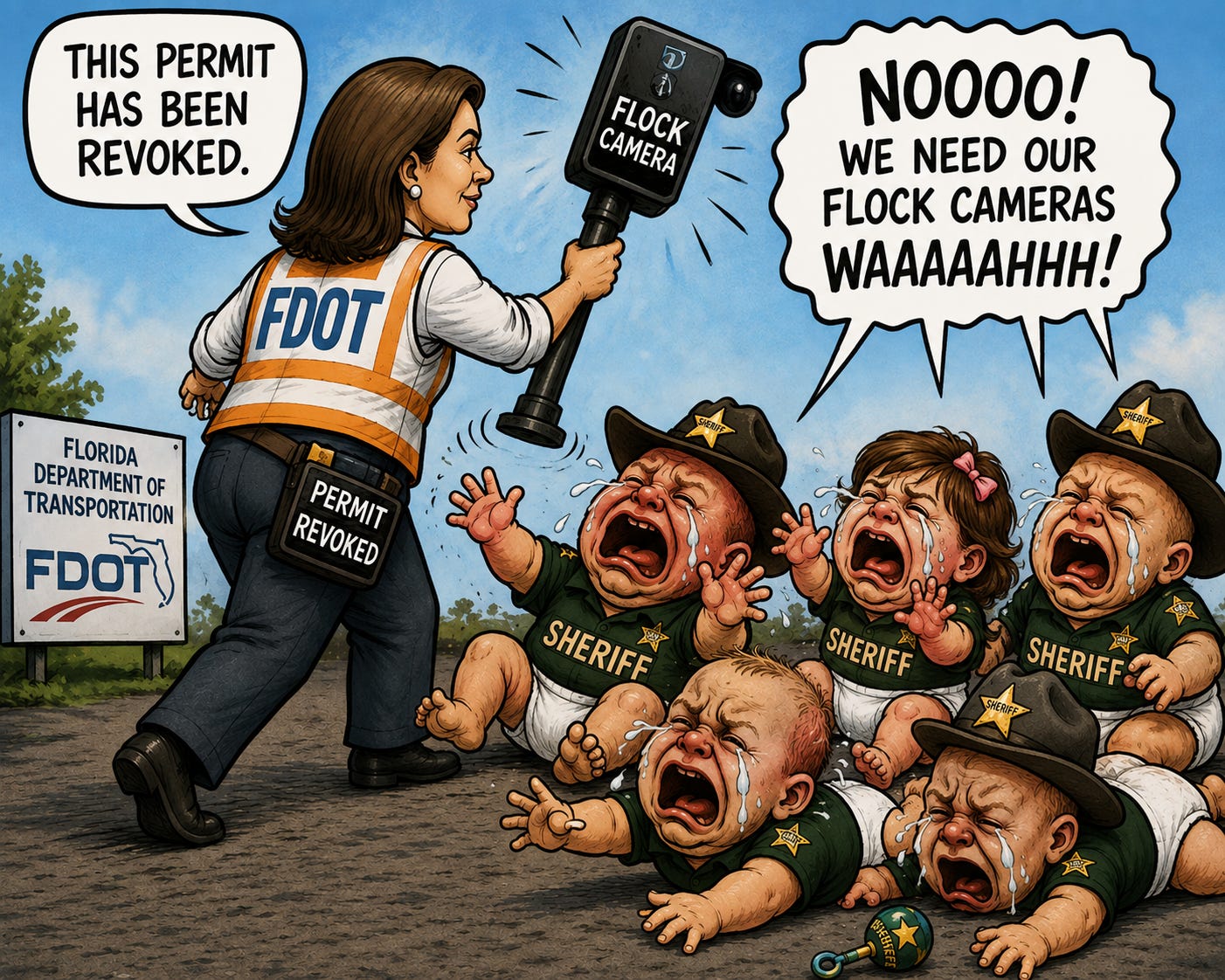
Clay County Sheriff’s Office announced Sunday it will remove license plate reader cameras “from Clay County roadways,” a decision the agency says was forced by a new memo from the Florida Department of Transportation.
But a close read of the state’s order raises questions the Sheriff’s Office has not yet answered — including whether the mandate actually covers most of the cameras Clay County has installed, and whether the public will ever see where those cameras are.
What The FDOT Memo Actually Says
FDOT’s Engineering and Operations Memorandum No. 26-01, dated August 31, 2026, revokes “General Use Permits” that allow local law enforcement agencies to place automated license plate readers (LPRs) in the right-of-way of roads on the State Highway System.
Citing its authority under Florida Statute 316.0777, the department states that a permit holder, meaning the local agency, in this case CCSO, has 30 days to remove any LPR devices placed in that right-of-way, or FDOT will remove them itself. The memo also permanently ends FDOT’s issuance of new LPR placement permits going forward.
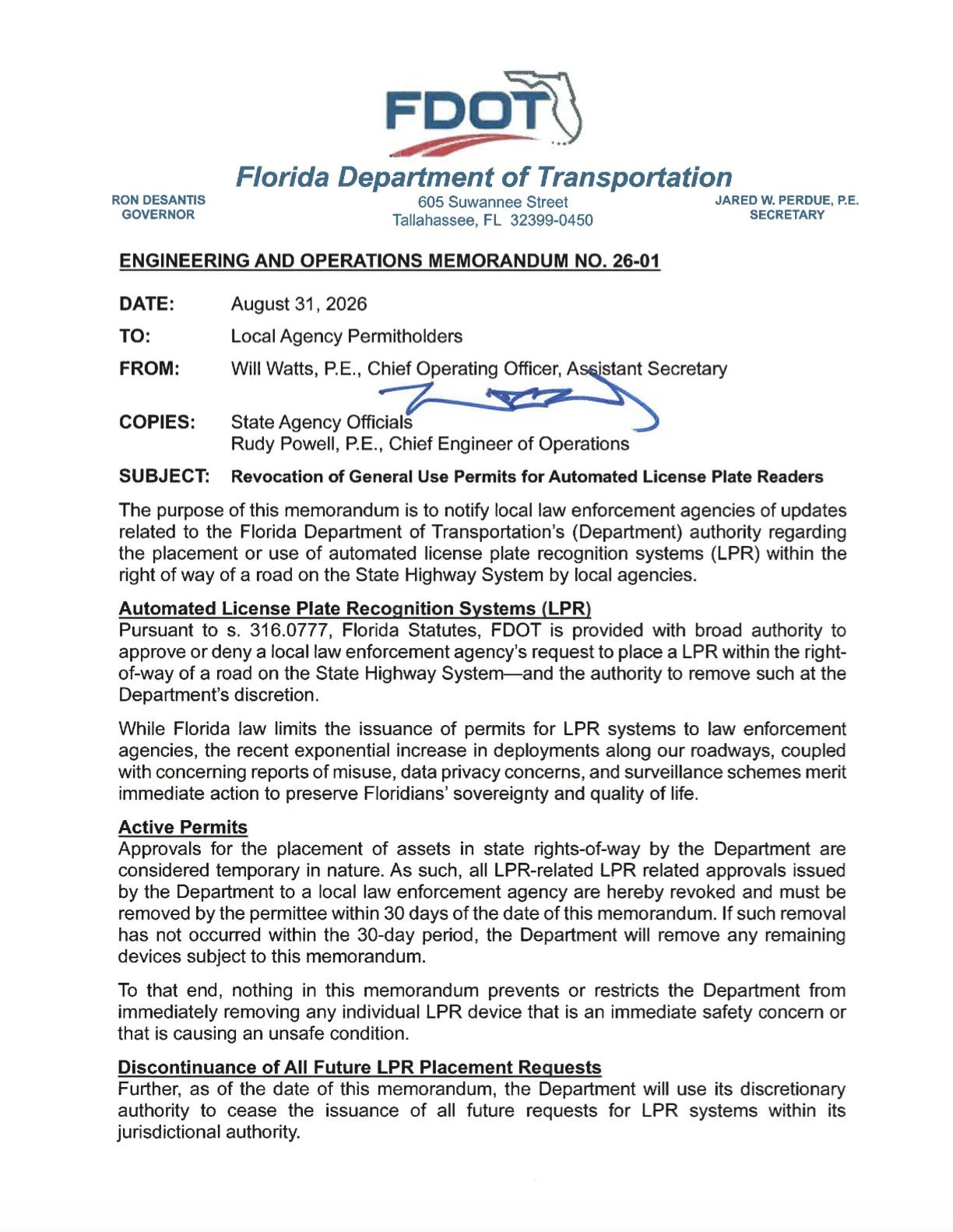
Critically, the memo cites “concerning reports of misuse, data privacy concerns, and surveillance schemes” as the reason for the order—language that goes well beyond a routine permitting technicality and signals the state sees this as a policy response to the ongoing, and increasingly national, backlash against ALPR networks like Flock Safety’s.
But the memo’s authority is narrow by design. FDOT’s right-of-way jurisdiction covers only the State Highway System — interstates, U.S. highways, and state roads. It does not extend to county roads, city streets, or private property, all of which remain entirely outside FDOT’s control.
What CCSO’s Announcement Says — And Doesn’t
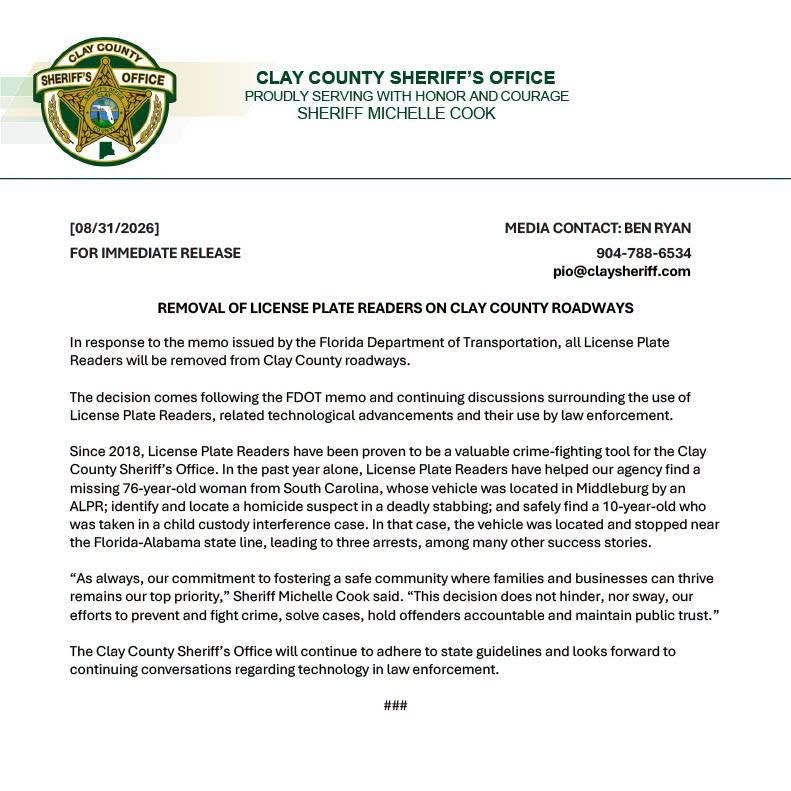
Sheriff Michelle Cook’s press release states plainly that “all License Plate Readers will be removed from Clay County roadways” in response to the FDOT memo. That is broader language than the memo itself requires. FDOT ordered the removal of LPRs from state highway right-of-way—not from every road in Clay County.
That gap is critical because it is not clear how many of CCSO’s cameras are actually in FDOT’s jurisdiction versus on county-controlled roads, where the state memo has no legal force at all.
CCSO holds a Flock Safety contract covering at least 95 cameras placed at locations across roadways throughout Clay County. The Sheriff’s Office has never released documentation identifying the specific locations of those cameras.
Neither the public nor, as far as records show, CN&V can independently verify how many of the 95 sit on state right-of-way subject to the FDOT order, and how many sit on county roads, which the memo doesn’t address.
That leaves several open questions:
Is CCSO removing all 95 roadway cameras, or only the subset actually on state right-of-way? The wording of the press release suggests the former, but the FDOT memo only requires the latter.
If CCSO is removing cameras beyond what FDOT required, is that a voluntary policy decision—and if so, why wasn’t it framed that way?
What happens to the parks and gun-range cameras? Those cameras, documented in separate Flock Safety contracts (2023/2024-314 for parks, 2022/2023-250 for the gun range), are not on state highway right-of-way and would not appear to be covered by the FDOT memo at all. CCSO’s release does not mention them.
Will the locations of the removed—or remaining—cameras be disclosed? Without a public accounting of where the 95 roadway cameras are, there is no way to confirm compliance with the FDOT order, let alone evaluate what surveillance capability the county retains once the 30-day removal window closes.
Accountability Matters
CCSO’s release leans heavily on ALPR success stories—a missing 76-year-old woman located in Middleburg, a homicide suspect identified, a child safely recovered near the Florida-Alabama line—to frame the removal as a loss for public safety rather than a response to any wrongdoing on the department’s part. Sheriff Cook said the decision “does not hinder, nor sway” the office’s ability to fight crime.
That framing sidesteps the more specific accountability question this outlet has been pursuing: Not whether ALPR technology has value, but where, specifically, it has been deployed, under what policy, and with what oversight —questions that remain unanswered for a 95-camera network whose map the public has never been shown.
I love it! Thank you Clay New & Views for the awesome information.
So, it's been 8 days since this article, maybe a little longer since the order. What is CCSO's official stand on this? Do they care about the public backlash on surveillance? Are they taking all the cameras down? I'll be watching the ones I know about, I guess the end of September may be telling whether this sheriff is concerned about people's liberties.