

By SANDRA HARTLEY
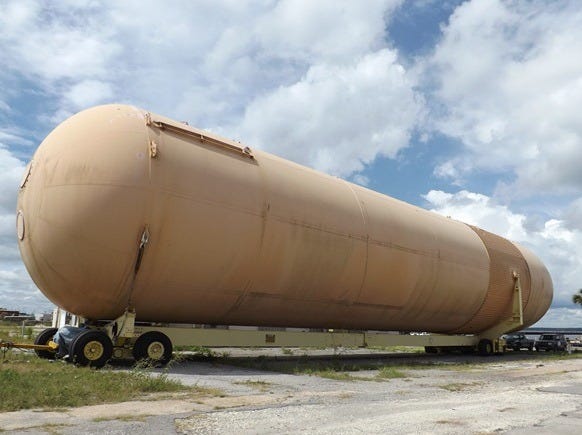
Have you ever driven past the Clay County Port/Reynolds Industrial Park and wondered about the huge orange tank parked there? It is not just a tank; it has a story that reaches the stars. Landing in Clay County is an interesting tale. What is it, what is its purpose, and why is it in Green Cove Springs?
This tank, known as the external tank, was crucial to the Space Shuttle’s journey, providing the fuel to reach orbit. The tank’s distinctive orange color comes from the spray-on foam insulation. Initially, the tanks were painted white, but NASA soon realized that skipping the 600-pound paint job improved performance and allowed extra payload (people and cargo).
A space shuttle has three main parts: the orbiter, the solid rocket boosters, and the external fuel tank.
The orbiter looks like an airplane. It is where the astronauts live and work. It is a vehicle that orbits the Earth. It could carry up to eight astronauts and up to 50,000 pounds (25 tons) of payload into low Earth orbit. When the mission was complete, the orbiter would re-enter the Earth’s atmosphere and land like a glider.
The solid rocket boosters (engines) were the first to help launch a human-powered vehicle into space. They are attached to the sides of the external fuel tank. Once the boosters provide the necessary thrust at liftoff and during the first two minutes of flight, each burns out. Then, they drop into the Atlantic Ocean, where they are recovered, checked, refurbished and reused.
Never in Space
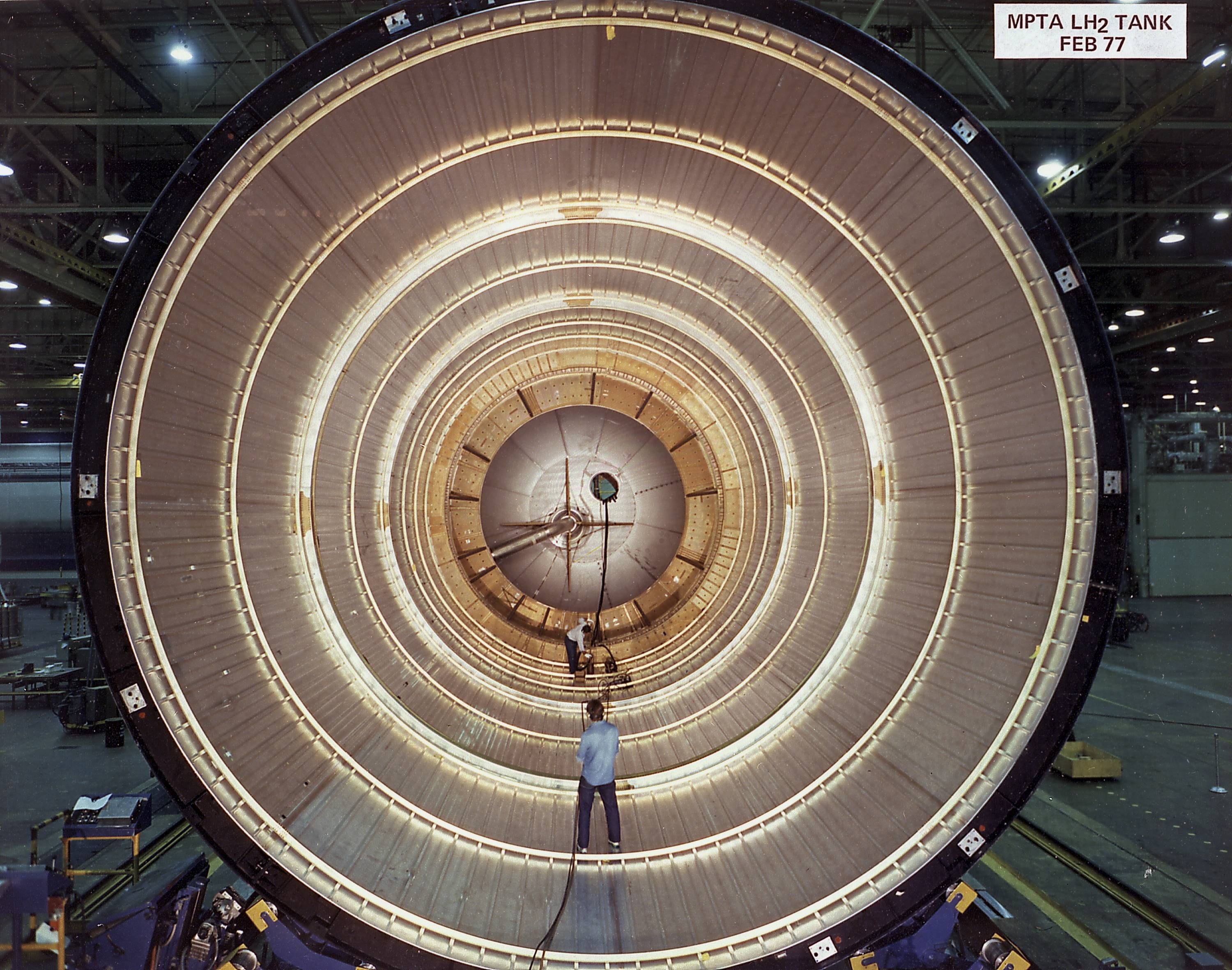
The orange external tank carries fuel for the shuttle’s boosters. It is considered the backbone of the assembly. “Big Orange” stands 15 stories tall and can hold 535,000 gallons of liquid hydrogen and oxygen, which the main boosters use during the orbiter’s lift-off and ascent. After booster burnout, it is jettisoned into the Earth’s atmosphere. Unlike the boosters, the tanks were not originally designed to be reusable. They broke apart before impact and fell into the Indian or Pacific Oceans, away from shipping lanes, never to be recovered.
So, now a mystery unfolds. How did a single external fuel tank end up intact in Green Cove Springs, Florida?
The answer is that the orange external fuel tank you see never went into space. Despite its appearance and the common myth that it was an external tank meant for space launch, this tank has always remained on the ground. It has become a symbol of engineering experiments and a reminder of the challenges in connecting Earth to the stars.
Between 1977 and 1980, the orange structural test article (STA) in Green Cove Springs was used to evaluate the strength of an external fuel tank’s payload and other structural components at NASA’s Marshall Space Flight Center in Huntsville, Alabama. Big Orange played a crucial role in the testing process to ensure the safety and dependability of those venturing into space.
After its brief service period, it was displayed at NASA’s Marshall Space Flight Center in Alabama. In 1987, it was moved to the Stennis Space Center in Mississippi for public viewing for ten years. In 1997, the fuel tank was transferred to the Kennedy Space Center in Cape Canaveral on Merritt Island, Florida, again for display.
Gift From NASA
When the Space Shuttle Program ended in 2011, NASA removed unnecessary space shuttle artifacts to create space for the exhibit of the newly retired shuttle, Atlantis. The Space Shuttle’s external fuel tank, one of the largest artifacts, was donated to the Wings of Dreams Aviation Museum in Keystone Heights, Florida. The museum was intended to be the tank’s permanent home.
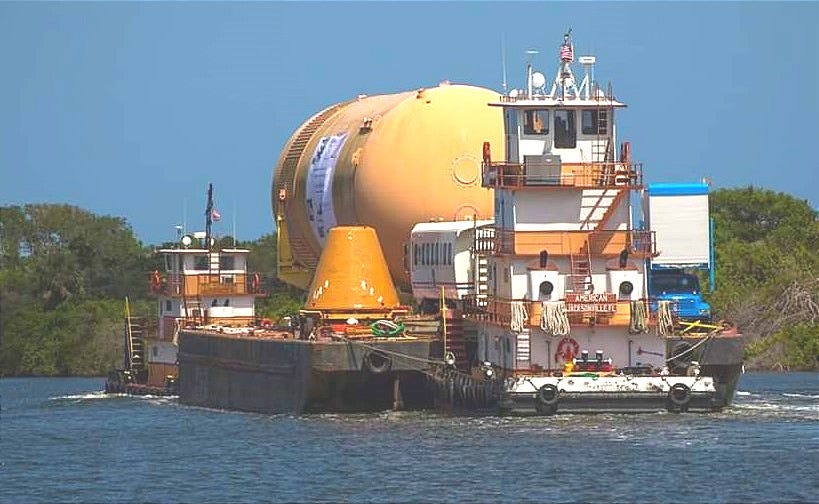
On April 24, 2013, the 154-foot-long external tank, one of the shuttle program’s original test articles, left its journey from Kennedy Space Center. The Big Orange traveled by barge along the Intracoastal Waterway, down the St. Johns River to the Green Cove Springs port.
Pushing and pulling the massive tank through the waterways between Kennedy Space Center and Green Cove Springs was an impressive sight. Volunteers used a 200-foot barge, two tugboats, and multiple cranes to complete the task. Once the tank was docked, unloaded, and on its way to the museum, Robert Oehl, a former museum executive director, said it would have been the largest land transport of an aviation artifact since Howard Hughes moved the wooden seaplane known as the “H-4 Hercules” or the “Spruce Goose.” Unfortunately, the tank never reached the Wings of Dreams Aviation Museum. As a result, it was never able to claim the Spruce Goose’s title.
Transporting the tank over land to the museum might have seemed simple, but that simplicity quickly vanished. Due to its size, NASA’s generous gift turned into a logistical challenge that couldn’t be solved.
Unexpected Challenges
The expenses of moving the tank from Green Cove Springs to Keystone Heights became overwhelming. Utility lines, streetlights, signs, and trees along the route would have needed to be taken down. Depending on the route, the distance ranged from 25 to 30 miles, mostly through rural areas.
Besides the technical requirements during transport, police escorts would have been necessary to close roads for hours. It was clear that the tank was too tall and too wide to be moved to its intended destination. The cost of transporting the fuel tank from the port to the aviation facility became an unexpected and crippling financial burden.
Today, the abandoned space relic lies silently, waiting to be taken in by a new home.
For many years now, the orange external fuel tank has represented anticipation and preparation. Maybe the answer to its new home has been right in front of it all along. It’s often overlooked that the space industry and the military are closely connected.
NASA-Military Alliance
In the 1950s, the United States was involved in a high-stakes space race with the Soviet Union. The launch of the Soviet satellite Sputnik 1 in 1957 created a sense of urgency nationwide. The Army, Navy and Air Force each actively developed their space programs, leading to a fragmented and competitive approach.
As a result, President Dwight D. Eisenhower established the National Aeronautics and Space Administration (NASA) in July 1958. It became operational in October of the same year. NASA unified various efforts and transformed rivalry into a coordinated mission to reach the stars and protect the nation.
Historical Foundations: Many early space programs, including NASA, were heavily influenced by military technology and personnel. For example, the development of rockets for space travel was initially driven by military needs during World War II and the Cold War.
Shared Technology: Rocketry and satellite communications were initially developed for military purposes and later adapted for space exploration. The same rockets used to launch satellites into orbit can also be employed as intercontinental ballistic missiles.
National Security: Space is considered a crucial domain for safeguarding national security. Satellites are essential for communication, navigation, and surveillance, delivering critical data for military operations.
Crisis Response: After the September 11 attacks, NASA provided satellite imagery to help assess the damage and support recovery efforts.
Collaborative Missions: NASA and the Department of Defense have partnered on numerous missions and projects. For example, the Space Shuttle program included missions that launched military satellites.
Space Force: Established in 2019, the U.S. Space Force is a military branch focused on space operations. It emphasizes the rising role of space in defense strategies and enhances the relationship between the two.
These points highlight the strong and intricate relationship between NASA and the U.S. military. This collaboration not only pushes forward space exploration but also boosts national security, showing the twofold benefits of their partnership.
If you’re not convinced of a strong bond between these two entities, here’s a chance to reconsider.
Space-Walk First
In February 1984, Colonel Robert L. Stewart became the first active-duty military officer to fly in space on a NASA mission. Launched from Kennedy Space Center, he and fellow astronaut Bruce McCandless took part in two extravehicular activities (EVAs) to test the initial flight trials of the Manned Maneuvering Unit, basically a jetpack that allowed them to move freely in space.
This was a historic event because the EVAs marked man’s first untethered operations away from a spacecraft in flight. McCandless performed the first, and Stewart completed the second. After the mission, Stewart became the first Army officer to earn the Army Astronaut Badge. Brigadier General Stewart retired from the Army in 1992.
So, next time you gaze at the night sky, remember that space exploration and national defense are linked, each supporting the other in our quest for knowledge and security.

Spacey Twist
Now that a strong connection has been made between the space industry and our national defense, here’s a question that calls for a patriotic and creative answer: why doesn’t the community find a way to connect space and the military?
Just a short walk from the stranded fuel tank, there’s a solution and a happy ending to the lonely tank story, adding to an already fascinating tourist spot.
The Clay County Board of County Commissioners has a substantial annual budget that could be allocated for tourism development. Forward-thinking leaders in our county could designate some of these funds to move Big Orange across the street to the museum, providing an extra incentive to attract visitors.
It would provide a great opportunity for children, students, residents, and visitors to learn about the partnership between space and those who fight for freedom while gaining a glimpse of history.
Every great journey begins with a single step. When community leaders work together, they can turn this vision into reality. Now is the time to make this dream a concrete experience for everyone. This may be a small step, but it is a powerful one for Clay County, paving the way toward a brighter future.
Why not move it to downtown Jacksonville near the ship and use it as a attraction