


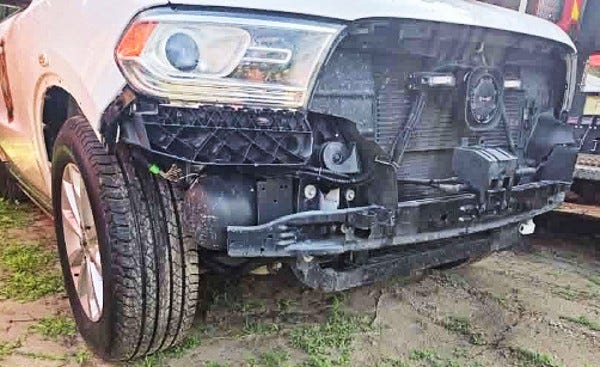
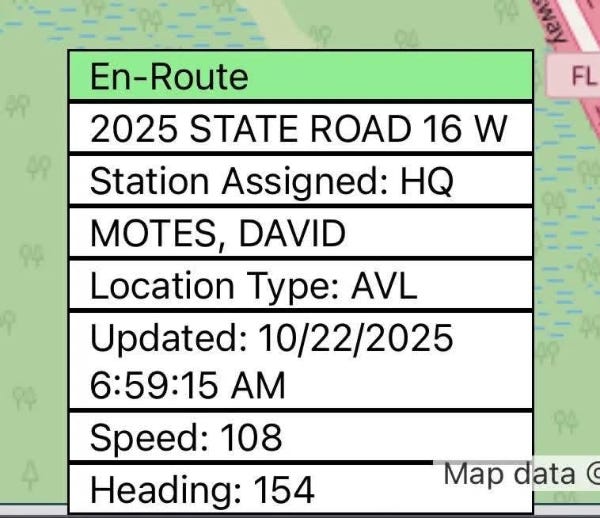
Acting Fire Chief (AFC) David Motes has been recorded driving over 100 mph in his county fire vehicle to calls where his presence was not required.
Motes, who is also one of several assistant county managers, is required to have the county GPS tracker activated at all times. However, he has been known to turn off his vehicle’s GPS to keep his speed and location undercover.
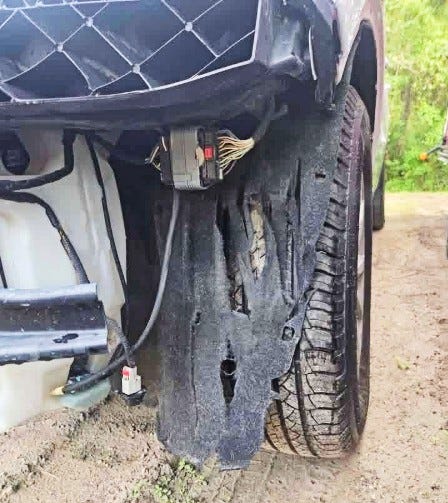
His efforts to be incognito may have gotten a bit more difficult on September 6, when he was involved in a one-car accident that ripped the front of his county SUV clean off. He didn’t do the front tires or wheel wells any favors either.
County policy provides a pretty simple roadmap for what is supposed to happen following an accident involving a county vehicle: Follow the law, follow the procedures and make sure the information gets to where it needs to go quickly. But it seems some of those directions took the scenic route or maybe disappeared completely with Motes’ bumper.
Florida Statute 316.065 (1) says the driver of a vehicle accident that results in injury, death or damage to any vehicle or other property in an apparent amount of at least $2,000 must notify local law enforcement or the nearest Highway Patrol Office and an accident report filed.
According to damage experts, and those in the know, fixing Motes’ county SUV will cost at least, $3,000.
Clay News & Views (CN&V) made a public records requests with law enforcement and learned that Motes didn’t report his accident.
The county’s “Policies and Procedures Manual” requires a county employee involved in a work-related accident to report the accident to their “immediate supervisors” within an hour. Then, both the supervisors and the employee are required to fill out a report and present it to the Risk Management department within 24 hours.
CN&V emailed Motes’ immediate supervisors—County Manager Howard Wanamaker and Fire Chief Lorin Mock.
As previously reported, both Wanamaker and Mock, two of the highest paid employees in the county, had not unraveled the mystery of how to return emails. But, ever hopeful, CN&V emailed the two and asked why a police report was not filed. We also inquired if county insurance could be filed without a police report.
It appears there has been no progress with the two’s email skills. This left Communications Director Laura Christmas, who has identified herself as “lead spokesperson for the county,” to reply on their behalf.
“As this incident was not a vehicle accident, a vehicle accident report from a law enforcement agency is not required.” Christmas said.
Of the insurance coverage, Christmas said, “Vehicle and/or damage is documented and accordingly evaluated for possible insurance claim.”
The county’s policies and procedures’ requirements raise even more questions regarding Motes’ accident. The policies’ manual requires that:
Any employee involved in a work-related accident/injury or there is damage to County or private property, regardless of the severity or significance, the employee(s) involved MUST be drug tested immediately.
Refusal to submit to a drug test must be reported immediately to Risk Management and may lead to disciplinary action, up to and including termination of employment.
Delaying the submission of a drug test will be grounds for disciplinary action or possible termination and may result in the accompanying workers’ compensation claim to be denied.
The same policy states the employee cannot drive a county vehicle until the results of the drug-test are received.
Since apparently, driving a county vehicle and ripping the front off does not meet the county’s definition of a vehicle accident, CN&V asked the county’s lead spokesperson to please define the county’s definition of a vehicle accident.
CN&V also asked Christmas to provide: Vehicle Accident/Incident Reports that Motes and his supervisors were required to submit to Risk Management, results of his drug test and GPS readings showing Motes’ location, time and speed at the time of his accident. We also asked when Motes returned to work after the accident, and if he presently has another county vehicle for his use?
The county’s lead spokesperson replied that she forwarded CN&V’s requests for records and the questions to the county’s public records department. County records charges CN&V $50 an hour to provide records and will, most likely, have to obtain most of the information from the county’s lead spokesperson.
Even though official records may be pending for a while, insiders were none-too-happy about the exceptions made to allow Motes to forgo state and county requirements. They were also all too willing to discuss details about Motes’ accident—both to CN&V and on numerous Facebook posts.
Sources said on September 6, rescuers were dispatched to a residence for help with “health issues.” They had been called to the residence before and were well-acquainted with the patient. Employees said the scene was safe and an engine and rescue were at the residence rendering aid. Crews said the incident did not require or need Motes’ appearance, and that it was not normal for him to appear on such a call.
Fire crews said supervisors were blaming the “conditions of the road” for Motes’ accident, but crews said the large fire engine and the rescue vehicle had “no issues at all” navigating the road.
The GPS readouts, available only if the GPS was actually turned on, have been closely guarded.
Insiders said an insurance claim has not and will not be filed; County taxpayers will be footing the bill for Motes’ SUV accident.
Sources said Motes did not take a drug test. They said when rank-and-file are involved in even a small “fender-bender” the county requires an immediate drug test and a (union-mandated) field sobriety test for alcohol. (Motes is not a union member.)
They also said they were relieved of duty until all results were available.
The first responders of Clay County Fire Rescue are working and sleeping in quarters that has been plagued with rats, mold, and mildew—conditions that cause serious illnesses. Those who have had work-related conditions say they have received little support from upper management.
Rescuers have been tasked to save lives with missing and inadequate equipment. Former and present fire rescuers said at least three in upper management have vigorously taken part in hazing, so they have turned a blind eye to allow a culture of serious and dangerous hazing to persist.
Motes’ preferential treatment has added to the already low moral documented in anonymous county and union surveys in Clay’s Fire service.
Employees believe Acting Chief Motes will outrun the consequences of his accident-that-was-not-an-accident. Rescuers say with 39 years in, Motes also continues outrunning their calls for his retirement.
What a crock! Nice reporting.