


The author covers education for the Florida Phoenix. He previously worked for the Iowa Capital Dispatch and the Iowa State Daily. He grew up in Iowa and is a graduate of Iowa State University. This story first appeared in the Phoenix on January 21, 2026 and is reprinted here with permission.
By JAY WAAGMEESTER
Florida’s education commissioner is not happy with the conduct of some locally elected school board members, and he wants to do something about it.
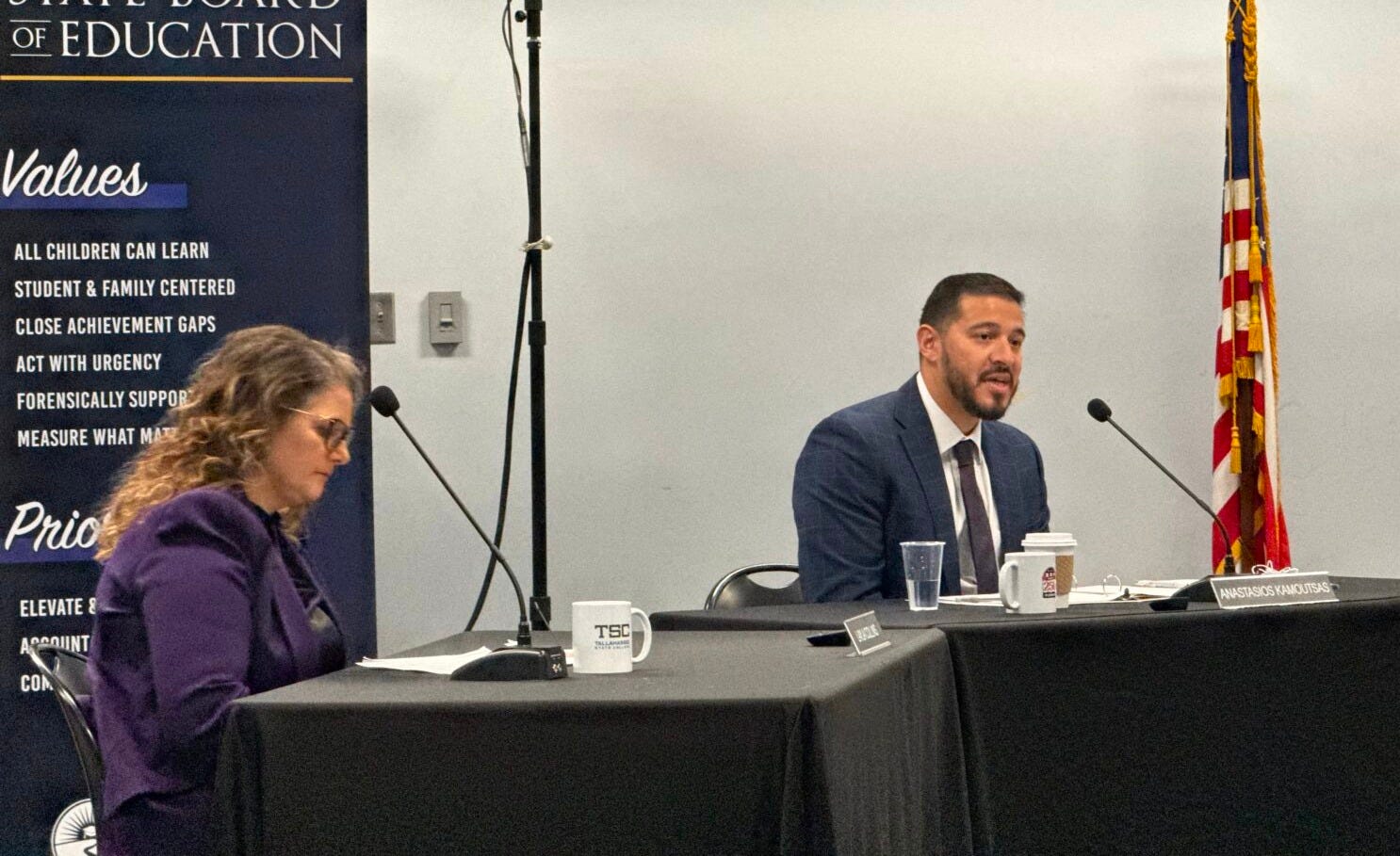
Commissioner Anastasios Kamoutsas made clear Wednesday during a Board of Education meeting in Tallahassee that he wants the Legislature to give his department more authority over school board members seeking to “elevate themselves for political reasons.”
His comments came amid complaints against Clay County School Board member Robert Alvero.
Alvero came under scrutiny last month for comments he made in a social media video, that “I have had 80% more negative experience with the African American community in this country than with white people.”1
Following the comments, Kamoutsas in December said he was “directing” Alvero to come before the state board.
Wednesday, Alvero didn’t show.
“For me, this unfortunate incident is a reminder that the Legislature needs to look at this board’s authority with regard to school board members. Too many have sought to elevate themselves for political reasons, disregarding their duty to educate children, and this board’s unfortunately limited in its ability to demand accountability,” Kamoutsas said.
“Comments that distract from the mission of serving students undermines the confidence of this entire school system,” Kamoutsas said.
The state Board of Education comprises gubernatorial appointees, while local school boards are elected by citizens of their respective counties.
Alvero retained an attorney, former state Rep. Anthony Sabatini, a conservative firebrand.
In an email response to questions from the Phoenix Wednesday, Sabatini replied, in entirety, “The state education board should cease attempting to be the political correctness police” [sic]
In a social media post in December, Sabatini said Alvero is “receiving ridiculous criticism based on so-called ‘racist’ & ‘politically incorrect’ remarks he made.”
“The fake outrage against Alvero is complete & total nonsense,” Sabatini wrote.
“ANY adverse state action taken against Alvero in an attempt to punish him & force him into adopting politically correct viewpoints, will be responded to with a lawsuit for First Amendment Retaliation.”
State board chair Ryan Petty said of Clay County voters, “Hopefully they’ll take action at the next election to remove him from office.”
Republican state Sen. Jennifer Bradley, who represents that region of the state, called upon Alvero to resign last month, as did House Speaker-designate Sam Garrison, like Bradley of Fleming Island.
“We will always protect people’s First Amendment rights to say what they want to say, but we also have to be mindful that our children hear that,” state board member Layla Collins said.
In 2020, critics called for Sabatini to resign from the Florida House over his own inflammatory rhetoric.
Kamoutsas has not replied to an emailed question from the Phoenix asking about what precedent oversight by appointees over elected officials would follow, or set.
Other Counties
Since Gov. Ron DeSantis appointed Kamoutsas last year, he has focused on local school boards, including in Alachua and Leon counties.
In Alachua, a similar situation arose. Kamoutsas called in front of the state board that county’s vice chair, Tina Certain, after comments and actions in the aftermath of the deaths of pro wrestler Hulk Hogan and conservative activist Charlie Kirk.
“This board took a lot of criticism for our attempts to hold the Alachua School Board vice chair Certain accountable for her actions, and we were accused of doing that in a very partisan manner and because of partisanship, and nothing could have been further from the truth,” Petty said.
The Clay County situation shows that accountability comes regardless of political ideology, Petty insisted, although he described Alvero as “a so-called conservative, because I don’t think the views that he expressed were conservative in any nature—not that we’re getting into the politics of it.” Petty added: “But the comments he made were absolutely inexcusable, and should never be uttered by anybody in a position there.”
According to his bio on the Clay County school website, Alvero has served with the Jacksonville Fire and Rescue Department and Florida State Guard.
He’s still active on his campaign Facebook, quoting Martin Luther King Jr. on Sunday.
More of Alvero’s Comment:
“With that being said, doesn’t mean I haven’t had good experiences with African American people. I have met a lot of great African American people, and I am still friends with them because they’re good, decent people. But that’s the 20% of the people I have met. They’re African Americans. The other 80%, they’re being nasty. They’re being rude. They’re being problematic. Always trying to fight. Always disrespecting. So why would I want to be around people like that?”
Sabatini is known to be “way out there”, on the fringe, but strange things sometimes happen.
So what is the Alvero outrage all about? Is the outrage that his negative experiences couldn’t possibly be as high as 80%? Or is the outrage that it couldn’t possibly be that low? Or is it that he dare to state his experience at all?