


The lakes in Keystone Heights are dying. Eight years ago, former State Senator Rob Bradley and the St. Johns River Water Management District (SJRWMD) decided it was time to save the lakes and the value of the properties surrounding them.
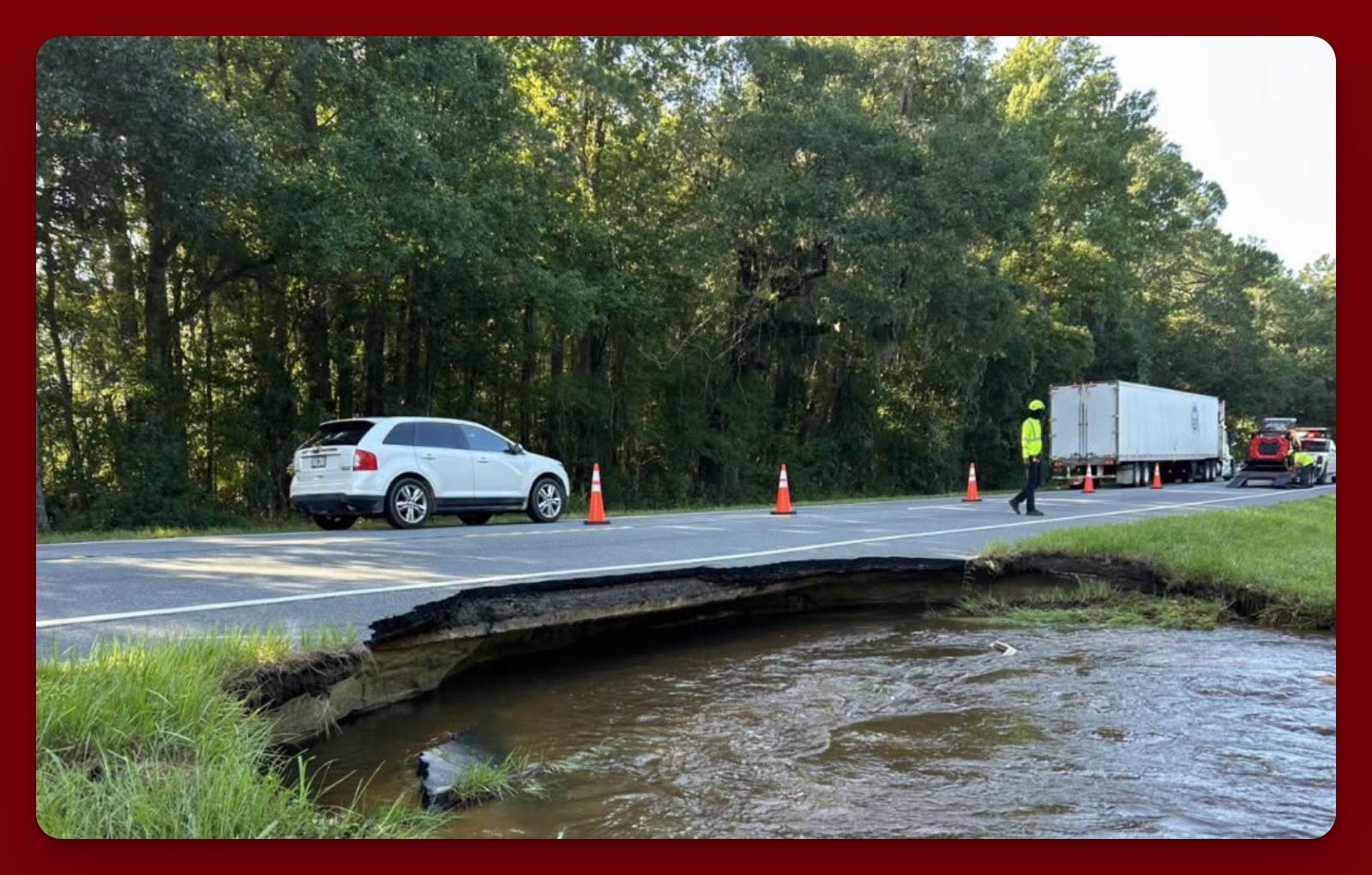
Their solution? Create a pipeline from Black Creek to the lakes in Keystone. On Tuesday, that pipeline burst and washed out part of Blanding Boulevard, which is the main road connecting Keystone to the rest of the county.
The road damage has left it with one usable lane, and the Florida Department of Transportation scrambled to deploy a crew to repair it. The road was repaired and reopened late Tuesday evening.
Residents of the south prong of Black Creek, where the water is pumped from, say the burst pipe isn’t the only issue being caused by the project. For much of the year, northeast Florida has suffered from drought conditions, and despite the recent rain, water levels in Black Creek and other waterways remain below normal.
Despite the low water levels, former State Senator Rob Bradley gushed about the pipeline pulling water from the creek last week.

The comment section was filled with a few local politicians quick to praise Bradley and the project, but most comments questioned why the pump was running while creek water levels were low.
Per Bradley, the pumps are configured to run based on the volume of water flowing through the creek, not the water level. CNV verified that a minimum of 25 cubic feet per second (CFS) is required before the pump is activated to shunt water away from the creek and into the lakes in Keystone.
The United States Geological Survey (USGS) has a measuring station near the pipeline intake, which shows a current flow of 110 CFS and a 10-day average of 58 CFS. These numbers are well above the minimum threshold set for the pipeline to begin to suck, but it is unclear if the measurement is taken before or after the water is diverted.
The pipeline, by definition, removes water from the creek that would have otherwise flown into the south prong, which later merges with the north prong on its way to empty into the St Johns River near Doctor’s Lake.
In practical terms, the pipeline’s design should ensure that during low-flow or drought conditions, no water is taken from the creek.
But residents with property on the creek downstream of the pipeline intake have taken to Facebook to show just how low the water levels are in their sections of the creek and have expressed confusion about why the pipeline is currently pumping water.


The official purpose of the pipeline is to fill the lakes Geneva and Brooklyn in Keystone Heights. These lakes are one of only two major recharge points for the Upper Floridan Aquifer, with the other near Valdosta, Georgia. Water that flows into these lakes eventually reaches the aquifer.
Neither lake is replenished by creeks or streams; instead, they rely on rainfall and aquifer levels to remain full. Years of increased demand on the aquifers have left the lakes looking more like puddles.
Black Creek does not refill the aquifer. This fact, along with the creek’s proximity to Keystone Heights, was the main reason the SJRWMD targeted it for this project.
While the people of Keystone Heights rejoiced over the project, not everyone was sold on it. In fact, the Environmental Protection Agency pushed back hard against SJRWMD’s attempts to simply dump untreated water from the creek into the lakes.
Pushback from the EPA eventually forced SJRWMD to add a filtration system to the pipeline, ensuring any pollutants and contaminants from the creek would not be forced into the lakes and the aquifer.
Environmental and conservationist groups also raised concerns about the project, questioning its environmental impacts and the fact that the SJRWMD board of governors was stacked with developers, construction industry personnel, and businesspeople. Not a single member of the board at the time was an environmentalist or scientist.
Rob Bradley, who joined the SJRWMD board after leaving office, grew increasingly frustrated by the scrutiny and criticism.
While we all lament the suffering politicians endure when they have to answer questions and be held accountable, the residents on Black Creek have real reason to be concerned if this project isn’t managed properly.
Withdrawing water from Black Creek poses several risks, separate from whether the pumps remain within their permitted flow threshold. Even compliant withdrawals change the creek’s natural flow pattern below the intake, which can reduce dilution of nutrients and other pollutants, raise water temperature, and lower dissolved oxygen — all of which affect fish and aquatic invertebrates.
Sustained lower flows can also reduce the water table feeding wetlands and swamp forests along the creek’s banks, echoing what has already happened at Lake Geneva, where a forest grew on what used to be an open lakebed after water levels dropped for years.
The 25 CFS cutoff the district uses to decide when pumping stops is a regulatory line set through modeling and professional judgment during permitting, not a guarantee that withdrawals below that level have zero ecological impact.
Nice article. Thanks, Josh
Additionally, we cannot get any answers on whether or not there is any real time Independent (that is the key) monitoring occurring along the creek especially the south prong. What about water quality studies including looking at salinity, dissolved oxygen, pH studies, anything that would, if altered, impact Black Creeks health and therefore its ecosystem. Someone non affiliated, should be following short and long term effects on the flora and fauna, erosion, the health of banks and wetlands surrounding the creek. Also, a great point brought up in this article is where is the “flow” data the district keeps referring to being taken at? If I’m understanding correctly, the flow of water can be influenced by many artificial factors such a narrowing of an area(such as pipes, ditches or culverts), also slopes or gradients in particular those leading down to a pump, can all artificially increase the flow velocity thus kicking on the pumps during low water levels. There seems to be no transparency when asking questions on what is being done to protect Black creek. I feel a project on this scale needs constant research and monitoring and those running it should also be held at a certain standard. We have a lot to lose if we fail Black creek!