


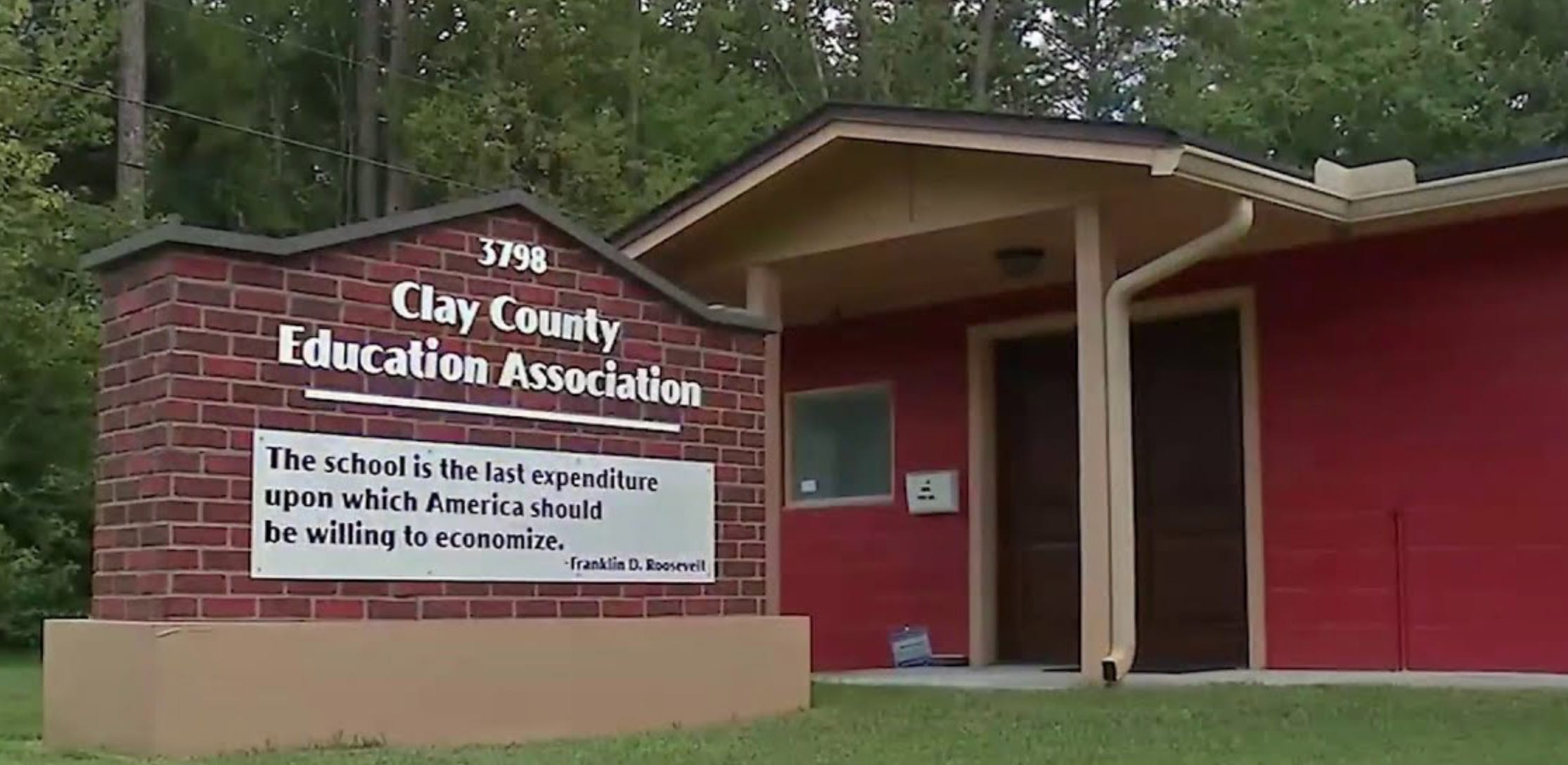
The Clay County Education Association (CCEA) is the local teachers’ union in Clay County. Over the past few weeks, the union’s members have been voting on whether to retain the union.
Per a law signed in 2023 by Governor Ron DeSantis, local teachers’ unions are subject to special regulations that were not applied to other public-sector unions, i.e., police and firefighter unions.
Under the new law, any teacher’s union whose membership falls below 60 percent of teachers in its district must hold a vote to remain in existence. A majority of the union members must vote in favor of retaining the union. If not, the union and any contracts it negotiates cease to exist.
According to the CCEA’s Facebook page, the union will hold an election to recertify and remain in existence. This means that, under the law, the union now represents fewer than 60 percent of the teachers in Clay County.
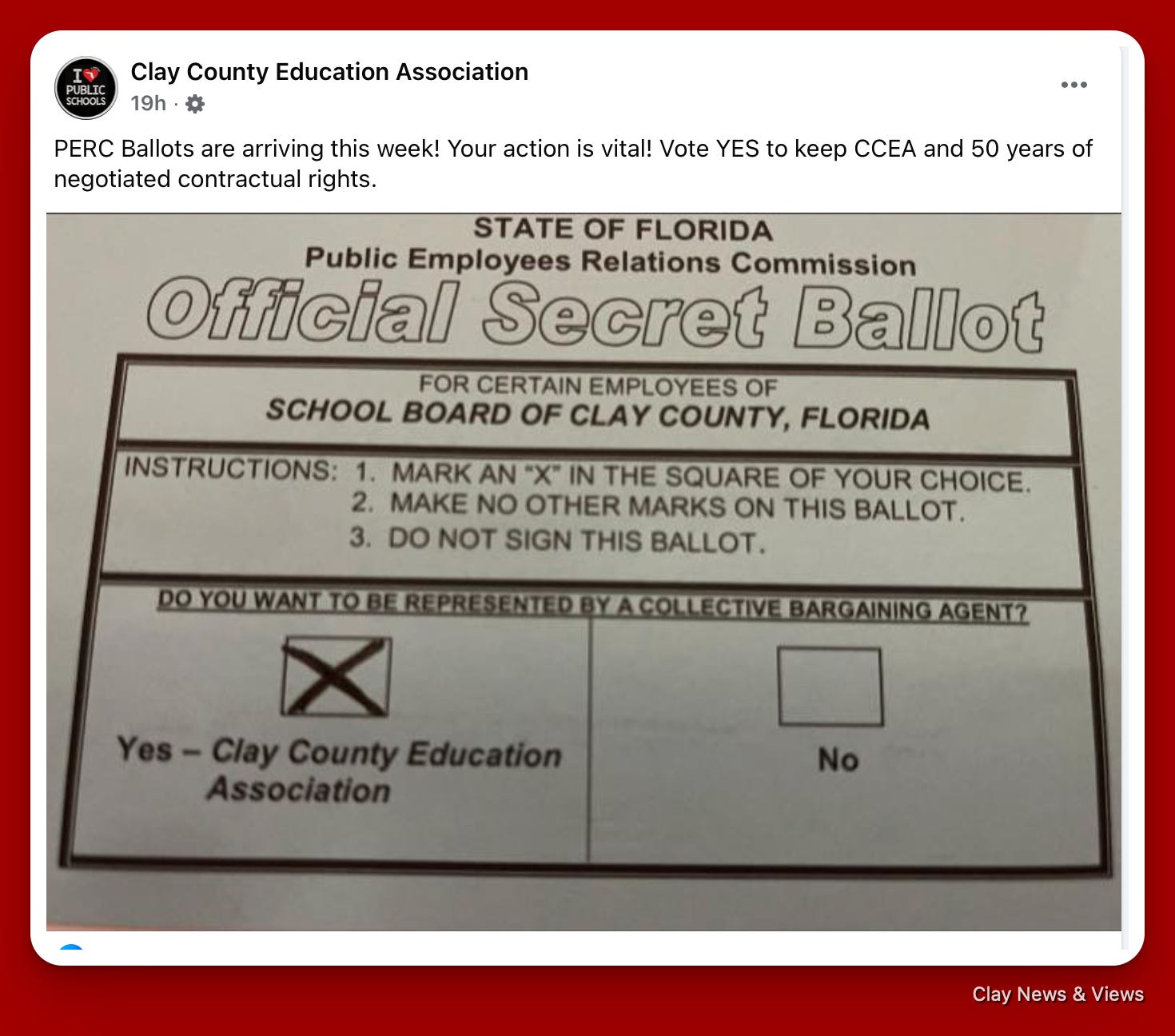
Statewide, over 100 teacher unions have re-certified via a vote, and no major Florida K-12 union has dissolved as a result of a vote.
Here locally, the CCEA is in the midst of a very public and contentious fight with the Clay County School Board and School District over teacher pay. School Board members Erin Skipper and Michele Hanson sparred with public speakers and union president Vicki Kidwell at the board’s December meeting.

CCEA does not publicly publish its membership numbers, but assuming a 59 percent membership rate, approximately 1,600 teachers in Clay County are union members.
These members pay union dues of $792 per year, which means CCEA brings in up to $1.2 million per year. This amount is an estimate, and could be much lower depending on the actual membership level the union has attained.
Much of the money CCEA brings in is sent out of the county to state and national unions. On their website, CCEA lists associations with the following unions:
Florida Education Association
National Education Association
American Federation of Teachers
AFL-CIO
Of the $792 paid by local teachers yearly, somewhere between $300 and $500 is sent to the state and national unions, which amounts to between 37% and 63%.
In 2024, the National Education Association’s budget was $432 million. $167 (39%) of that budget went to political activities via PACs, donations, and lobbying, all of which supported Democrat party causes or organizations.
With Clay County consisting of an overwhelming majority of Republican voters, it is more than likely that a significant portion of local teachers’ union members are Republicans.
Given that a portion of their dues are sent to national and state unions that exclusively support Democrats, what could possibly motivate Republican teachers in Clay County to join the CCEA?
Clay News & Views spoke with some teachers who are also union members and registered Republicans. While each of them had a variety of reasons for joining the union, they all shared one common reason- lack of support from their administrators and the school district.
The teachers recounted multiple stories of out-of-control behavior in schools, a lack of consequences for bad behavior, and retaliation against teachers who push back against problems in their schools.
The value they get from union membership is support and legal protection against false allegations and unsafe classroom conditions, support that they aren’t confident they would receive from the school district.
Teachers continue to pour their hard-earned money into unions—money they often complain isn’t enough to begin with. Don’t get me wrong; I believe every teacher deserves a six-figure salary. But it’s baffling when these unions take that money and funnel it to the Democratic Party, which, in my view, pushes policies that undermine child protection. The whole thing feels utterly oxymoronic. It reminds me of that classic Janet Jackson song: “What Have You Done for Me Lately?”
The author was so close, but failed to take it a step further due to his own bias. The motivation for Republican voters to pay into a union that overwhelmingly supports Democratic candidates is because the Republican platform is unilaterally anti-union and anti-workers' rights. People join unions after failing to convince their employers to treat and pay them fairly. Nobody wants to pay nearly $800 a year of their meager salary just to say they're part of a union. It's because if they get wrongfully terminated, they know they'll have support. They also know that without the union, their chances for increased pay and better benefits are grim. Unfortunately, oftentimes union battles are won at the state and national level, which is why a large portion of the dues goes to those entities. If you don't have collective bargaining power (money and numbers), then you cannot take on massive entities like school boards and the FL Department of Education. It's the sad reality of litigation in our society.