


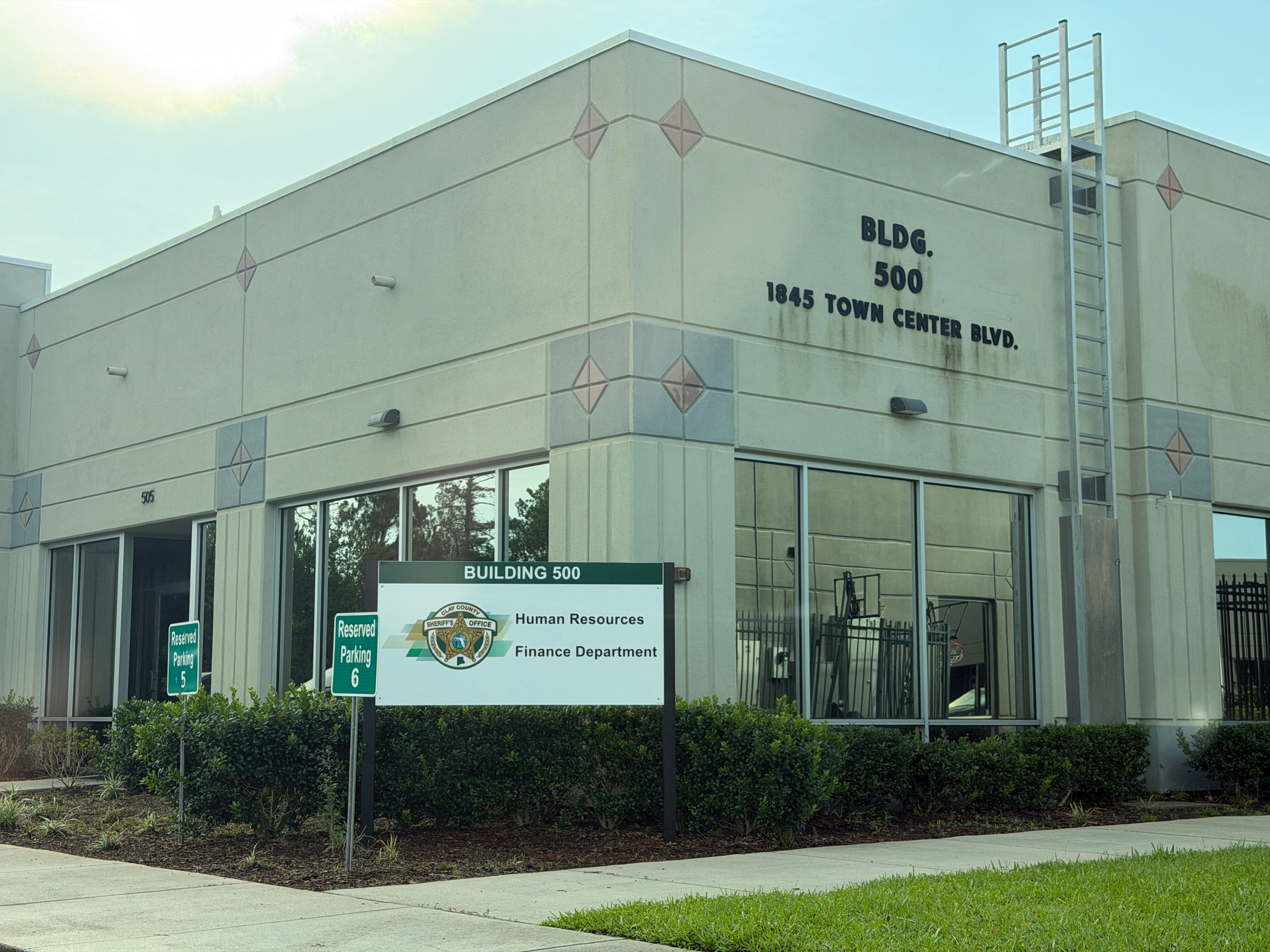
Clay County finalized a $1.6 million CCSO renovation contract in May 2026, three weeks before disclosing a projected $44.5 million General Fund deficit. But county records show officials were already using the word “shortfall” — and naming public safety funding specifically — as far back as July 2025, when commissioners voted down a tax increase meant to address it.
In May of this year, the County agreed to pay $1.5 million to renovate an office in Fleming Island being used by the Clay County Sheriff’s Office.
Per the contract, Brogdon Builders, LLC manager Clayton Brogdon was contracted to complete a $1,604,255.50 renovation of Building 500 at the Fleming Island Business Park.
The building houses the agency's Human Resources and Finance divisions, as well as some training facilities.
Three weeks later, at a June 9, 2026 budget workshop, county staff told commissioners they were facing a projected General Fund deficit of more than $44.5 million heading into the next fiscal year, driven largely by a sharp slowdown in the development activity that has fueled county revenue growth in recent years.
Framed on its own, that timeline might suggest the county signed a significant capital contract just before an unexpected fiscal shock became known.
A review of county records and prior local reporting complicates that reading: Clay County had already been publicly describing its finances in terms of a “shortfall” — and naming Sheriff’s Office funding specifically — nearly a year earlier, in the summer of 2025.
What The County Bought
The Building 500 project renovates existing interior space at 1845 Town Center Boulevard. Per the bid documents and signed agreement, the scope includes two new training rooms (the Base Bid, priced at $1,493,255.50), a new conference room (Alternate Bid No. 1, $31,000), and new cubicle and private office space (Alternate Bid No. 2, $80,000).
The Board of County Commissioners awarded all three components on April 28, 2026, selecting Brogdon Builders as the lowest responsive and responsible bidder for Invitation for Bid No. 25/26-061.
The stated purpose, per the agreement, is to “consolidate training functions into a centralized location” and improve workspace configurations for CCSO’s current and future operational needs.
The largest single line items in Brogdon’s price breakdown are mechanical/HVAC work ($366,850) and audiovisual equipment ($229,905.50), together more than a third of the Base Bid, followed by electrical work ($168,300) and interior doors and frames ($116,600).
The contract sets a 345-calendar-day window from Notice to Proceed to Substantial Completion, with liquidated damages of $500 for every day the project runs past that deadline.
Fiscal Cracks Begin To Show
Clay County’s fiscal strain did not begin in June 2026. In late June 2025, the county proposed raising its Public Service Utility Tax — a charge on electric and gas bills for unincorporated county residents, including Clay Electric customers — from 4% to 10%, the maximum rate allowed under Section 166.231(1)(a), Florida Statutes, and the first change to that tax since 2004.
The county’s own Business Impact Estimate, published July 3, 2025, stated plainly that the increase was intended “to fund shortfalls in the County’s budget such as for essential Public Safety services” — explicitly naming the kind of funding category CCSO falls under. At the maximum rate, the tax was projected to generate about $7.4 million a year; Clay Electric estimated it would add roughly $72 a year to the average member’s bill.
The Board rejected the increase 4-1 on July 8, 2025. Commissioner Alexandra Compere called it a short-term fix: “I’m very uncomfortable with making a decision that only addresses today... these are short-term solutions, and as the years continue, those figures get exponentially higher.”
She favored a broader revenue mechanism, like a sales tax, instead. Board Chair Betsy Condon, describing herself as a fiscal conservative, proposed a county-level spending review before considering new revenue, saying, “I don’t think we’ve looked under every rock, and our constituents demand it of us.” Both commissioners suggested revisiting the question later in the year after the county looked for savings elsewhere.
Two months later, at the September 9, 2025 first public hearing on the FY2025-2026 budget, Assistant County Manager Troy Nagle told commissioners the county’s general fund reserves stood at $22,350,733 — about $1.5 million less than the year before — and that the county’s cash carry-forward was down roughly $83 million year over year.
The overall budget remained balanced as required by Florida statute, and Nagle noted that the county still met the Government Finance Officers Association's reserve recommendations. But the reserve decline was flagged to commissioners as “a point” even then, a full nine months before the $44.5 million figure became public.
What Changed Between 2025 and 2026
Part of the answer traces to Tallahassee. Throughout 2025, Governor Ron DeSantis pushed to eliminate property taxes on homesteaded properties statewide, calling them “basically paying rent to the government to live on your own property.”
House Speaker Daniel Perez favored a different approach and, in September 2025, rolled out a slate of seven competing House proposals ranging from a 10-year phase-out to targeted exemptions. None of those proposals passed before the 2026 regular session ended.
Rather than let the debate die, DeSantis called a special session, and on June 1-3, 2026, the Legislature passed HJR 1-F — now known as Amendment 3 — placing a constitutional amendment on the November 3, 2026 ballot that would raise the homestead exemption to $150,000 in 2027 and $250,000 in 2028, and cut the assessment cap on non-homestead property from 10% to 5%. It requires 60% voter approval to take effect.
The Legislature’s own Revenue Estimating Conference has projected Amendment 3 would cost local governments and school districts roughly $12 billion a year on a recurring basis if approved — on top of, and separate from, the $44.5 million General Fund deficit Clay County disclosed in June, which county officials have said does not yet factor in any Amendment 3 impact.
Polk County Sheriff Grady Judd, an outspoken critic, has called the amendment “a train wreck” that would hit public safety funding and response times statewide.
That two-year run-up — a governor publicly campaigning to zero out property taxes, a House speaker countering with his own slate of cuts, and a special session that finally put a specific, costed amendment on the ballot — is the backdrop Clay County commissioners were watching when they rejected the 2025 utility tax increase and again when they confronted the 2026 deficit.
What’s not yet clear from the public record is how directly that statewide fight shaped the county’s own budget planning in the interim, or whether the $170 million year-over-year drop in new taxable value that Property Appraiser Tracy Drake cited in June 2026 was itself anticipated back in mid-2025, when commissioners chose to defer a revenue fix rather than adopt one.
It is also unclear whether the county pursued any of the “cuts in other places” that Compere and Condon both said they wanted to see before revisiting a tax increase — and if so, what those cuts were and whether they materialized before the FY2025-2026 budget was finalized.
Where Did The Money Come From?
Nothing in the Building 500 agreement, the bid documents, or the attachments identifies the specific fund behind the $1.6 million contract price. Clay County maintains separate capital improvement and enterprise funds for some infrastructure work, so it is not automatic that this project draws on the same General Fund now facing the deficit — but the contract itself is silent on the question.
CN&V has not yet identified a budget line item that confirms the funding source. That distinction matters for how the project should be read against both the 2025 warnings and the 2026 deficit: a project funded from capital dollars set aside before the revenue decline sits differently than one drawn from the same pool commissioners are now trying to shore up.
Budgets Growing Faster Than Inflation
This is not the first time Clay County’s overall spending trajectory has come under scrutiny. CN&V has previously reported that the county’s total budget rose from $399 million in 2022 to an estimated $571 million in 2026 — a 43 percent increase over five years, more than triple the roughly 12 percent inflation seen over the same period. County officials have pushed back on an earlier, larger growth figure that included cash reserves alongside the operating budget, but did not dispute the 43 percent figure for the budget itself.
What’s Not Public
Under Section 119.071(3)(b), Florida Statutes, the building plans, schematics, and security-related specifications for the Building 500 project are exempt from public disclosure, meaning the detailed design behind the $1.6 million price tag cannot be independently reviewed by the public.
The bid documents also required the awarded contractor to self-perform at least 40 percent of the work with its own workforce, a standard county requirement intended to limit reliance on subcontractors.
What’s Next
CN&V has asked the county whether the Building 500 contract is funded through the General Fund, whether it was budgeted in the adopted FY2025-2026 budget or added later, whether commissioners were shown any shortfall projections before the April 28 award, and whether the county considered scaling back the two alternates given its fiscal picture.
CN&V has also asked the county to detail what, if any, budget cuts were identified or implemented following the July 2025 vote to reject the utility tax increase, and whether county staff anticipated the scale of the FY2026-2027 deficit at that time.

Geez, maybe they can start auctioning off the flock cameras and equipment to make up some funds...
First, I'm in the wrong line of work clearly. Second, maybe the CCSO can now put the Flock Contract to good use since they won't be spying on us anymore. And thirdly, bring on Amendment 3 BABY! DeSantis is exactly correct, if we pay property taxes, we are paying rent to the government for our own property. Clay has not pitched in for any of my mortgage payments. Find another way to fund the government. This county spends way too much money for what it has to show. They can't even get kids reliably back to their homes from public schools without doing double bus trips. Think about that. We can't fund enough school bus drivers to get all the kids home in one trip, but we can afford Flock cameras, pricey renos and even the school board has way more cars than it needs but can't perform the very basic operations. Crazy!