


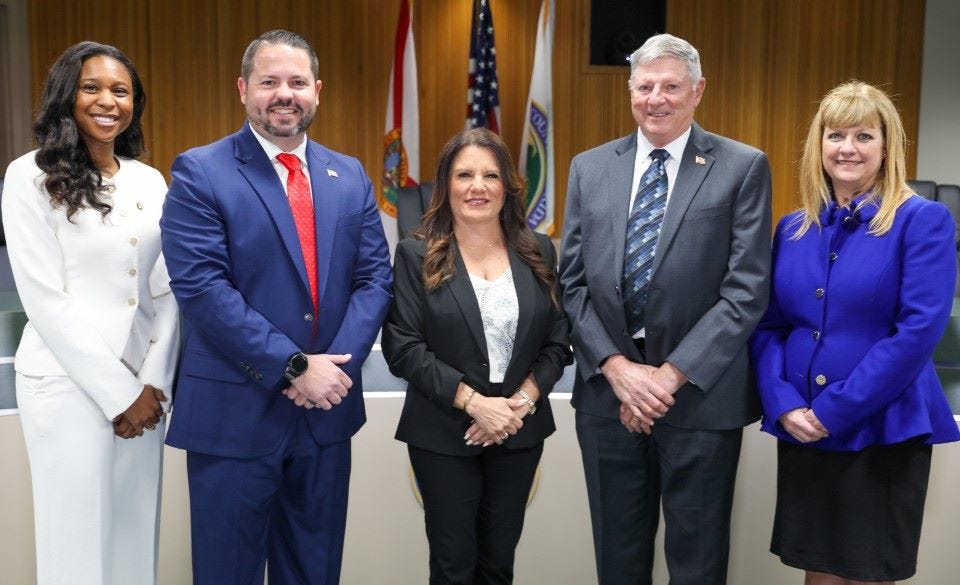
Colin Groff may well be Clay County’s foremost expert on our controversy du jour—stormwater. Over his 40 years as a civil engineer he has set up “seven or eight” municipal stormwater utilities. His company is Black Creek Engineering.
Most recently, he was the key figure in forcing Green Cove Springs to reimburse a commercial landowner after it unlawfully screwed him out of $187,000 in stormwater fees. Compared to that the Clay County proposes to assess homeowners between $51 and $162 a year, depending on “impervious surface area.”
What the city was doing to that one landowner was transparently unlawful, Groff said.

Although this may disappoint residents up in arms about a newly instituted stormwater fee for homeowners in Clay’s unincorporated areas, Groff believes that the county’s plans comply with state laws regarding stormwater.
However, having spent much of his career working as a goverment water boss—he mentioned St. Johns and Nassau counties—he said our county commissioners have failed miserably at communication with the public regarding the fee.
Groff also believes there should be a reduction in property taxes to offset at least some of the fee revenue.
Under the weight of federal law, the very rainy State of Florida issues “MS 4” permits to munipalities requiring that they control stormwater and any resulting pollution. In a classic example of an “unfunded mandate,” there’s a list of things a city or country must do to comply, including installation and maintenance of ditches, water pipes and retention ponds.
The state allows a two-pronged approach to pay for all this.
So far, Clay has collected part one—the base fee—as a tax collected from businesses and homeowners and paid from the general fund. Everybody in the county is going to have to pay it because everybody enjoys the benefits of it,” Groff said. “So they did all that correctly.”
The second revenue stream, so to speak, is a users fee, and today the commissioners are supposed to decided how much it’s going to cost.

“It’s considered an assessment in the state of Florida. And you can only assess people’s property for a direct benefit,” Groff said.
The uproar comes from a distinction between what many citizens see as “direct benefit” and how the state defines that term. As long as the projects funded by the users fee do not, for example, solely benefit a particular development, they can be considered “a general benefit.”
Groff himself owns 55 acres unconnected to any county drainage infrastructure. “None of my water goes off my property. But I do drive on the roads,” he said. “And all of that general maintenance of making sure stormwater is being handled properly benefits everybody in the county.”
Groff has examined the legal language that establishes the fee. “Their ordinance is written well within state statutes. There’s no issue in the ordinance. The only mistake they could make is if they had a project that has a direct benefit to somebody,” he said.
A quick examination of the list of projects raised no red flags for Groff, but maybe a couple gray areas. Opponents could question decisionmakers, forcing them to explain why specific projects benefit everybody.

Groff mentioned one of the projects specifically, the one regarding the Dudley Branch Creek. “Their going to upgrade the culverts on some roads. “Does it directly benefit people that drive on those roads? Yeah. But if people cannot drive on those roads, they’re going to have to maybe drive on your roads.”
To the extent that some of these project had been paid for from the general fund up until now, Groff said county commissioners should pledge to offset the shift to a fee-based system by a proportional reduction in the “millage rate,” the number upon which property taxes are determined.
In fact, the elephant that will be somewhere in room with commissioners later today, is Amendment 3 on the November ballot. If passed, Amendment 3 would cut property taxes by a whole lot and force heavier reliance on fees to pay for goods and services.
Which is fine by Groff. He believes government should be funded through fees, not taxes on land and homes. That way every department head would have to justify the fee amount to the public, rather than drawing from an amorphous general fund that defies scrutiny.

Good article, touched quite a few things I was not aware of.