Dancing With the One That Brung Ya
Did the ‘Paper of Record’ Fib or Was Its Bogus Election Coverage an Honest Mistake?

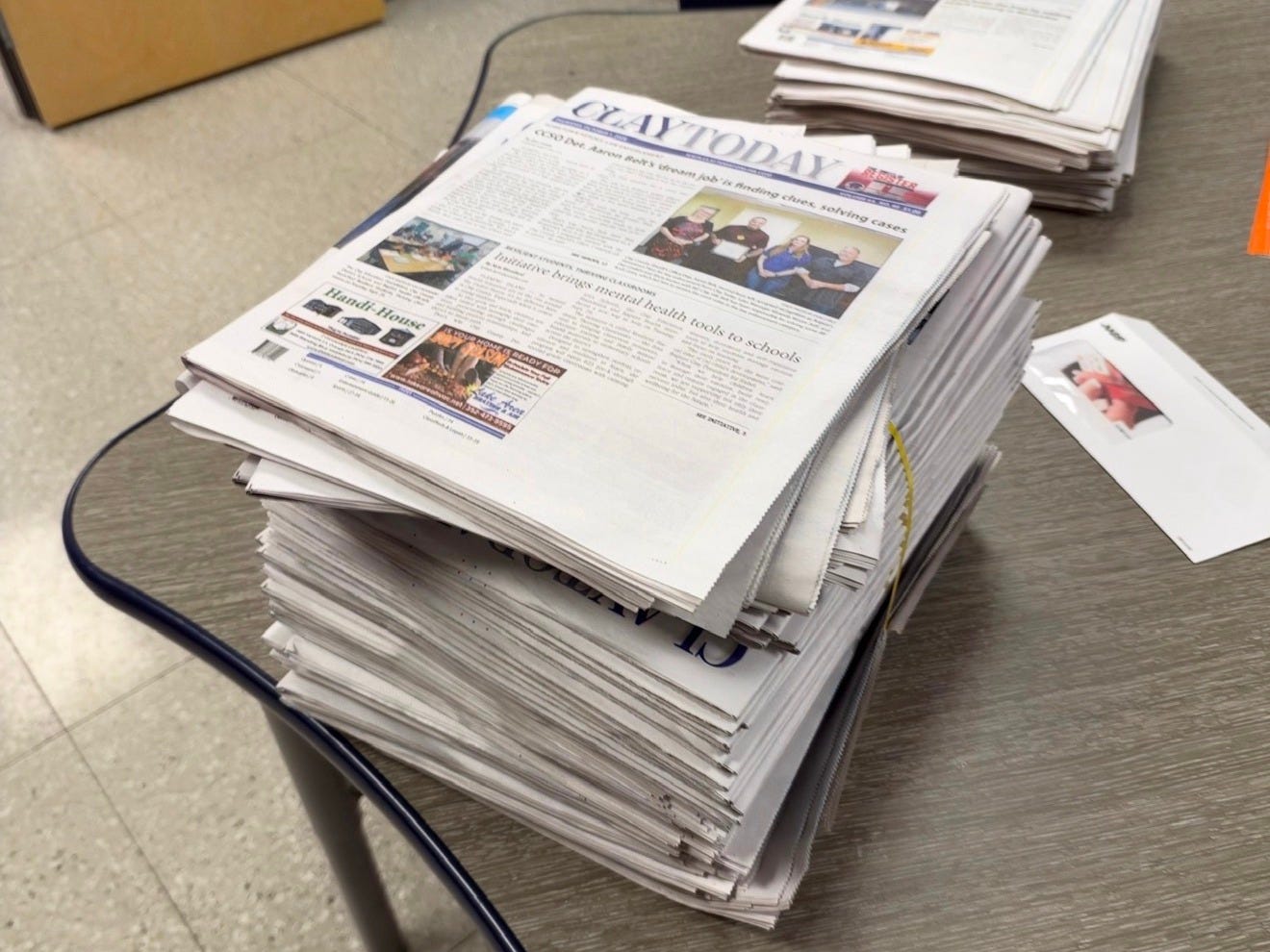
It was Election Day, and I was scrolling through an online Jacksonville newspaper when I ran across a snippet about the amendment to revise Clay County Commissioners’ salaries. I practically choked on my own spit.
The snippet was quoted from, and linked to, our local newspaper, Clay Today.
I clicked on Clay Today’s link and, sure enough, on October 15, over two weeks before the election, there had been a headline that read, “Election Guide 2026-Voting information ballot amendments explained.” The guide was written by former editor and now reporter Don Coble.
The language of each of the amendments was listed, followed by “the skinny,” that is, Coble’s interpretation of each. Here’s what he said about the salary amendment:
The skinny: If passed, salaries for County Commissioners, which is currently $37,000 a year, would be based on a formula in Florida Statute 145.031, which calculates salaries based on population. Based on that formula, salaries would be about $18,000 a year.
I don’t subscribe to Clay Today, so I guess I missed their through-the-looking-glass portrayal of the amendments.
Although that “skinny” was about as accurate as a world-wide weather forecast based on your great uncle’s arthritic knee, it could have changed the course of the election in Clay County. Probably, the reason it didn’t is because our electorate was pretty well educated on this amendment.
The salary revision amendment had been placed on the ballot by Clay County’s Charter Review Commission, which is supposed to be independent, but its members are in fact chosen by the County Commission. The charter review people were actually caught on video discussing how to use “creative wording” to sell voters on the amendment.
The Real Skinny
I was surprised that Clay Today printed such false information when there was plenty of contradictory data available. One readily available source was the Florida Office of Economic and Demographic Research. Its research showed that if our ballot initiative passed, the commissioners' salaries would be tied to the state formula of $96,993 per year, with regular raises.
Most surprising: The “yes” vote being promoted by Clay Today would have done more than give the commissioners a 162 percent raise. It would have forever stripped Clay County voters of an important safeguard in our “Home Rule Charter”—the right to have the final say on changes to commissioners’ salaries.
Our charter is like our county constitution and ensures that changes are decided by the voters. In other words, the proposed amendment wasn’t just about giving commissioners a bigger paycheck; it was also about taking the decision out of the hands of the very people who pay their salaries.
According to state regulations, our commissioners “control the county finances, growth, infrastructure, public service and quality of life.” But their primary duties are to represent the best interests of their constituents.
Our commissioners have recently given us a civics lesson on home rule that we shouldn’t soon forget. They called the stormwater tax, which appears on our tax bill and will not benefit most of the county, a “fee.”
Had they called it a “tax,” the principle of home rule would have required commissioners to ask the voters for permission to levy it. The stormwater tax debate suggested that either some of them can’t read, or they’re not taking to heart the part about representing the people.
But we county voters gave the commission a civic lesson of our own. Despite the erroneous information from the county’s surrogate, we said “no” to their raise by a margin of 69 to 31 percent.
To be fair, reporters sometimes get information from people who sound completely credible and speak with confidence. A source may even produce supporting documentation. Unfortunately, sometimes a source gets it wrong, the information got twisted along the way, or little did you know, the source wears a tin-foil hat and gets his information from Ozzy Osbourne via the Ouija Board.
Clay News &Views asked Coble and his boss Hugh Osteen via email for an explanation, but we haven’t received a response.
The Dance
Although surprised by Clay Today’s betrayal…I got it. We don’t need to start searching for a Ouija Board at Clay Today to figure out why they might have released that whopper about our commissioners’ salaries.
A few analogies that my daddy regularly expressed may help to explain Clay Today’s dilemma:
“You gotta dance with the one that brung ya.” “He who pays the piper, calls the tune.” “When somebody else owns the gravy train, you ride where they tell you.”
In case daddy’s analogies haven’t sunk in, here’s that skinny. A very big bundle of Clay Today’s income comes from county legal ads controlled by county leaders.
As Clay News & Views has mentioned before, state rules and regulations allow counties to put all county ads online—which everyone could read for free. According to a local official, who has no Ouija Board contacts, some of our elected and appointed officials had gotten together and decided to help bankroll Clay Today, with our money—maybe so they could keep their own mouthpiece.
Given the power of our commissioners and the fact that most of the county’s elected officials favored the commissioners’ raise—especially since their own salaries and compensation packages are already grazing in the land of excess—just maybe Clay Today wasn’t going to bite the hand that feeds them.
Another of my daddy’s favorite sayings was, “You can have principles or a paycheck, but you can’t have both.” And that probably hits home with the folks at Clay Today every pay period.
According to the publication Close Up Washington, there are 6,000 newspapers in the U.S., and about two a day go out of business. A Pew Research survey showed only nine percent of adults get their news from print publications, compared to 56 percent who get theirs via online. The surveys said one-third of young Americans get their news from TikTok.
Who knows? Clay Today might not exist without the money Clay County takes from us and gives to them.
Dropping Drawers
While Clay Today was riding the charter-amendment gravy train, it was also helping local officials amplify negatives of Amendment 3, which lowers property taxes by increasing the homestead exemption.
Our officials had been spreading the news far and wide that Amendment 3 would “defund” fire and rescue and law enforcement.
As Clay News & Views has previously reported, the defunding spin was a scare tactic. The language in Amendment 3 prohibits that kind of cutting, and House Bill-1329, which debuts on New Year’s Day, will require that first responders and essential services be funded before any other governmental daydreams or wishlists.
(Additionally, some Clay County fire and rescuers informed folks that their fire chief visited some fire houses days before the elections and said the defunding rumor was “just political.” )
Here’s the skinny from Tallahassee on HB-1329:
Our governor, House Speaker, and other lawmakers verified Florida’s local governments were spending our money like it was growing on trees. So, they passed the bill, also called Local Government Financial Transparency and Accountability Act, and it goes into effect on January 1, 2027.
The bill requires counties and municipalities to figuratively drop their financial drawers so that taxpayers can finally see what’s lurking inside.
All counties and municipalities will have to post online in clear concise language: how much money they are receiving from all the many taxes we’re paying, all expenditures including departmental spending, employee salaries and travel expenses.
Any budget spending, which officials are thinking of passing, will have to be posted at least 14 days before a public hearing and stay online for at least 45 days. Final budgets have to be posted online and stay there for at least 5 years.
The kicker, causing the most heartburn for our officials, is contained in the bill and just might provide some entertainment for county taxpayers is as follows:
The county shall hold a budget workshop at which the board shall perform a budget reduction exercise, identifying strategies to potentially reduce the ensuing fiscal year budget by 10 percent in comparison to the current year budget without compromising essential public services, such as law enforcement, fire services or legal obligations.
The legislature said HB-1329 tells local governments that “we posted the budget” is no longer a defense to keeping financial records and taxpayers in the dark. Members also say the bill will finally force officials to be more transparent and accountable so that taxpayers can finally get a clear picture of how their hard-earned money is spent.
Some folks in Tallahassee also say local officials will be whining that they will have to spend more money to hire employees and modernize equipment to gather and post all the financial information. But some legislators replied that plenty of employees have both access to the top-secret financial data and the talent to post it online.
Come January or February, Amendment 3 and HB-1329 may put a big dent in those wishlists and daydreams of our elected spenders. Some officials may even be glad that voters ignored Clay Today’s “skinny” and said “no” to the commissioners’ fat raise.
Daddy had a simple solution that might help the county get its spending under control.
“If the well is running dry, stop watering the weeds.”
Incredibly written and informative as usual!
Will the town managers and or department heads have to post their town/city paid credit card statements as well in the new laws starting 2027? Again your daddy is a wise man…