



A judge in Broward County has ruled red light cameras unconstitutional. Green Cove Springs and Orange Park rely heavily on the cameras for revenue, and the ruling has cast doubt on their future.
The ruling has also created confusion for people who have recently received red light tickets. There is no clear direction in the judge’s ruling to state or local governments on whether tickets must be paid.
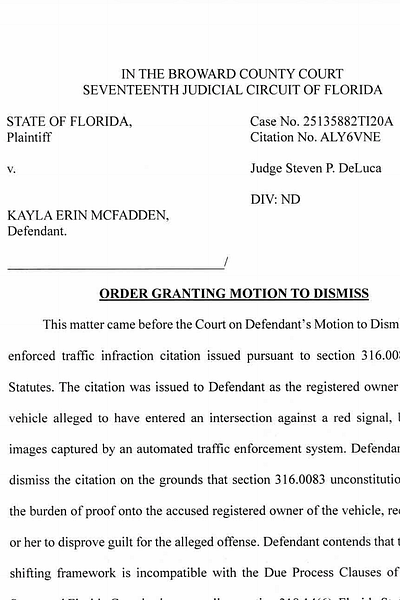
While Judge Steven P DeLuca’s ruling specifically voids the red light camera ticket of the driver who challenged it, it provides no further instructions for anyone else who receives a ticket. Nor does it provide any specific instructions to municipalities currently using red-light cameras.
Since their inception in 2010, red light camera infractions have resulted in over $1.2 billion in fines, with the proceeds split mostly between the state of Florida and the municipalities that have the cameras installed.
Given the substantial amount of money coming from the cameras, it is almost certain the ruling will be challenged by the state. Additionally, the ruling exposes flaws in how traffic infractions are handled in Florida.
Judge DeLuca highlights that though traffic infractions are considered civil, they are adjudicated in a “quasi-criminal” manner. The cases are labeled as “State of Florida v. Defendant” and end with a finding of guilty or not guilty. A determination of guilt requires proof beyond a “reasonable doubt.”
Guilty verdicts are permanently part of the driver’s record, and unpaid fines lead to suspension of driving privileges. All of these are hallmarks of criminal cases, not civil infractions, per Judge Deluca.
Popular legal YouTuber Steve Lehto covered the verdict and its implications in a recent video:
Lehto suggests that motorists in Florida who are facing a red-light camera fine might have luck defending themselves by presenting Judge DeLuca’s ruling to the court adjudicating their case. But as a single ruling on one district of the state is not binding statewide, there are no guarantees.
In Florida, traffic citations are administered to the person driving the vehicle. In comparison, red-light camera citations are issued to the vehicle owner, who must either admit they were driving or submit an affidavit to the court naming the driver. Per the judge, this constitutes an illegal attempt by the state to force an accused person to prove their innocence.
DeLuca also called out the fact that a person could conceivably incur an infinite amount of red-light infractions with no consequence other than the monetary fines. No matter how many times a person runs a red light, no points are assessed to their license, and their driving privileges are never suspended.
Ultimately, it will take further clarification through the appellate courts and additional legal challenges to determine what the future holds for red-light cameras in Florida.

Also, as you have reported the Clay school board verbalized they want them in school zones to get more money.
Agree. A money-making scam. These cameras are even worse all over Europe. Everywhere on the roads taking paictures for even mild speeding. $$$$$ Nothing but for money.