


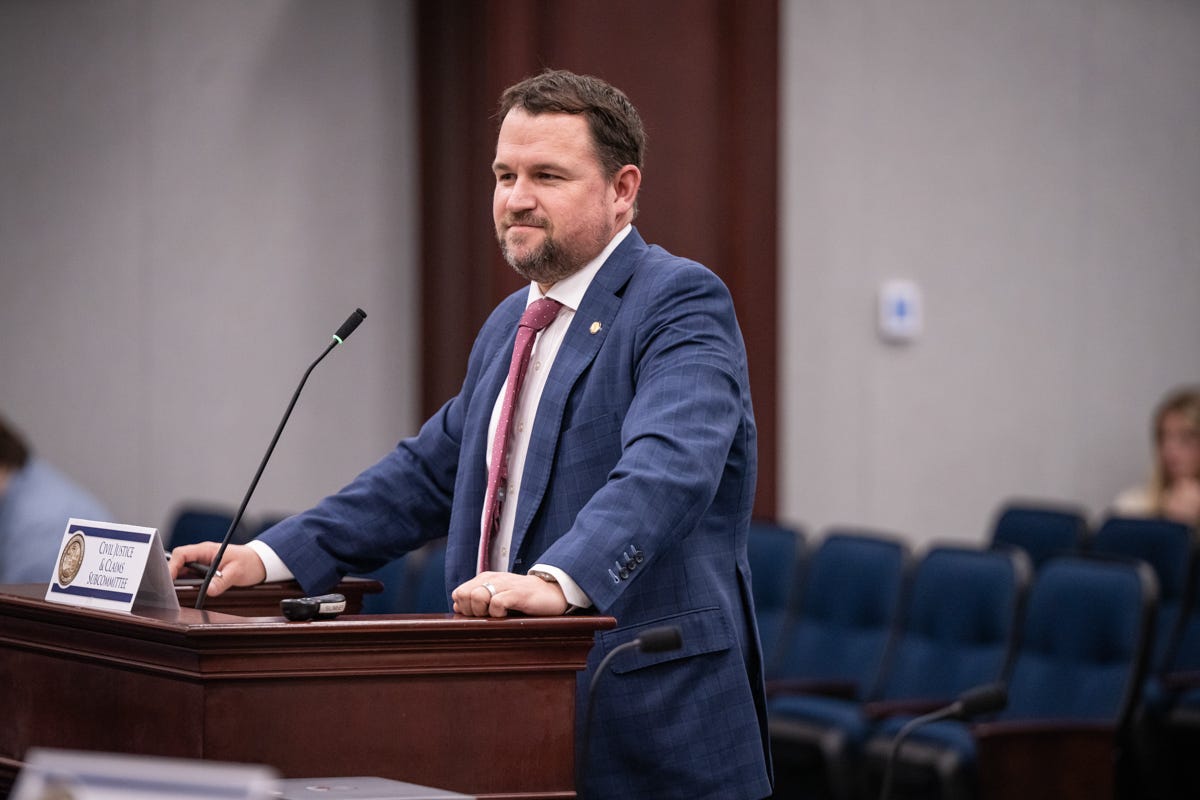
State Rep. Judson Sapp says Republicans who oppose Amendment 3 have strayed from the party’s conservative roots. He made the comments during a Sept. 29 interview on Florida’s Voice radio with host Drew Steele.
Sapp represents House District 20. He described it as covering parts of Clay, Putnam, St. Johns and Marion counties.
Sapp said he “got a little feisty” about Amendment 3 at the Clay County Republican Executive Committee meeting the night before. He said many Republicans thanked him afterward for speaking out.
What Amendment 3 Does
Amendment 3 comes from CS/HJR 1F, a joint resolution the Florida State Legislature passed in a 2026 special session. It would take effect Jan. 1, 2027, if voters approve it. Like all constitutional amendments in Florida, it needs 60% of the vote to pass.
The amendment raises the homestead exemption for all taxes except school taxes. The exemption would rise from $50,000 to $150,000 in 2027. It would rise to $250,000 in 2028. Starting in 2029, it would grow with inflation each year.
The school tax exemption stays at $25,000.
New residents would get a smaller break at first. People who did not live in Florida as of Dec. 31, 2026, would get a $50,000 exemption on non-school taxes. They would receive the full exemption starting in their fifth year.
The amendment also tightens the cap on yearly assessment increases for non-homestead property. That includes businesses, rental homes, and second homes. The cap would drop from 10% to 5% starting in 2027. School taxes are again left out.
The amendment adds a list of approved uses for county and city property taxes. The list includes public safety, schools, roads, stormwater, natural resources, debt payments, and employee retirement costs.
Sapp’s Case
Sapp called property tax one of the most unfair taxes in America. He said Amendment 3 aims to reduce it and could eventually eliminate it.
He said local governments across the state have told him they cannot function with any budget cut. He dismissed those warnings as scare tactics.
“When did the Republican Party become the party of big government?” Sapp asked.
He said some Republicans he respects are taking the same position as Jacksonville Democrat Angie Nixon. “That is shameful,” he said.
Sapp said he understands that local officials are trying to protect their budgets. But he said they are using tactics he once associated with Democrats.
“Many Republicans have become the pigs in ‘Animal Farm’,” he said.
He urged voters to question Republicans who oppose the amendment. If voters do not like the answers, Sapp said, they should “hold them accountable” in future primaries.
Steele told listeners that losing police or fire departments is “not gonna happen.” Sapp agreed. “It’s not going to happen,” he said.
Sapp also criticized local governments for spending on lobbyists to fight the amendment. “People who claim they have no money to run budgets, sure are spending a lot of money to stop this on lobbyists,” he said.
He closed with a broader argument. He said the state should not “force people to pay rent for the government, ‘cause that’s what every tyrant in human history has done.”
Sapp ended the interview by urging support for Republican Byron Donalds for governor. He criticized Democrat David Jolly.
What The Text Says About Fixes
Sapp said the amendment lets lawmakers “fix things as it goes along” without another constitutional amendment. He said local governments would get “a seat at the table” when lawmakers write implementing laws.
The amendment does give the Legislature several roles. Lawmakers must create a procedure that lets counties and cities raise the exemption further, up to the full value of a home.
State law may allow them to ban certain local spending. They must define key terms, such as what counts as a “qualifying improvement.” They may decide whether non-homestead property returns to full value after a sale.
The constitution sets the exemption amounts, the 5% cap, and the start dates. The Legislature cannot lower the exemption by passing a law. Any money to replace lost local revenue would have to come from outside property taxes. That could include state funding or new local taxes approved by lawmakers.
Sapp suggested the state could ease costly mandates on local governments. The first budgets affected would be those adopted in fall 2027. The Legislature’s 2027 regular session comes before then.
The Ballot Summary And The Text
Voters will see a short summary on the ballot. Parts of it differ from the full text.
The summary says the amendment “requires, through general law, a schedule for full elimination” of homestead property taxes. The full text requires the Legislature to create a procedure for counties and cities to raise their own exemptions. The text contains no schedule. It leaves any further increase to local governments.
The summary says local governments must use remaining property taxes “solely for core public needs.” The text’s list also covers general county operations and spending approved by local officials.
The summary says new residents must wait five years for the larger exemption. Under the text, they receive it starting in their fifth year.
The Republican Record On Taxes And Spending
Sapp’s appeal to conservative principles draws on the party's long history.
In his 1981 inaugural address, President Ronald Reagan said government “is the problem.” That year he signed the Economic Recovery Tax Act.
It cut the top income tax rate from 70% to 50%. The record was mixed. Reagan also signed tax increases in 1982. Federal debt nearly tripled during his two terms.
In 1994, House Republicans campaigned on the “Contract with America”. It promised a balanced budget amendment. The amendment passed the House in 1995. It fell one vote short in the Senate.
Working with President Bill Clinton, the Republican Congress oversaw federal budget surpluses from 1998 through 2001.
The Tea Party movement grew in 2009. Supporters often said its name stood for “Taxed Enough Already,” a phrase Sapp referenced in the interview.
In the 2010 midterms, Republicans gained 63 House seats.
Florida Republicans have pushed property tax relief before. In 2008, voters approved an amendment backed by Gov. Charlie Crist, then a Republican. It doubled the homestead exemption to $50,000 for non-school taxes.
It let homeowners carry Save Our Homes savings to a new home. It also capped yearly assessment increases on non-homestead property at 10%.
In 2018, the Republican-led Legislature asked voters to raise the exemption to $75,000. The measure got about 58% of the vote. It failed because it fell short of 60%.
What Voters Decide
Amendment 3 is on the Nov. 3 general election ballot. It needs 60% approval to pass.
He is correct. It’s a bipartisan issue because everyone is squeezed out. I’ve seen both sides aiming for this because salaries doubled since Covid. Budgets doubled since Covid. We never have had our incomes doubled, but our tax burdens have.