


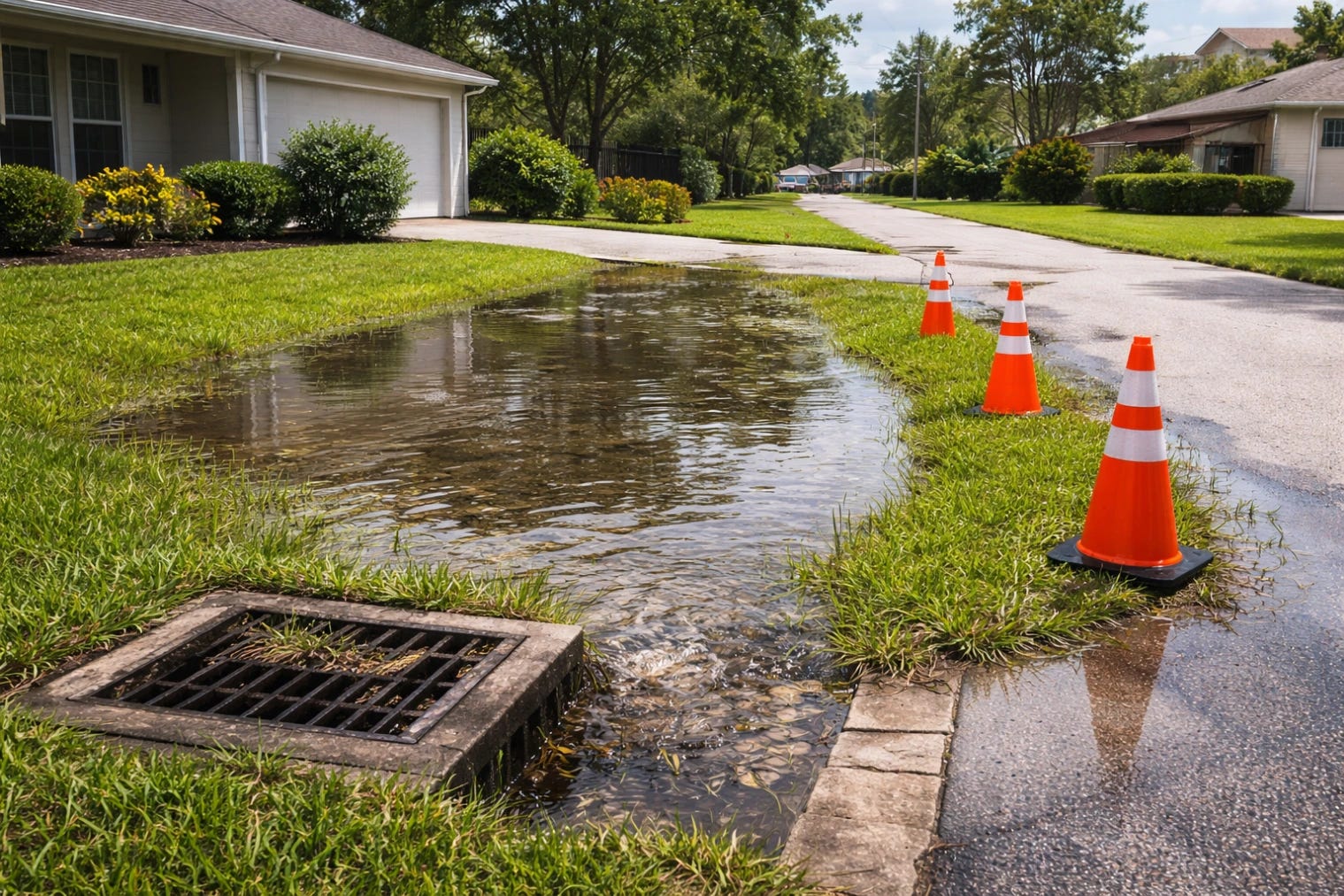
The Board of County Commissioners has already adopted the ordinance creating the fee. What's left to decide on August 25 is how much it will cost — and county records suggest the true price tag may be larger and less settled than officials have said publicly.
Clay County property owners outside the county’s four incorporated cities will soon see a new line item on their tax bill: a stormwater assessment intended to pay for drainage repairs, flood control and water-quality upgrades across unincorporated Clay County.
The Board of County Commissioners voted July 28 to create the stormwater utility, formally adopting Ordinance No. 2026-33 and an accompanying resolution that sets an initial rate.
A final public hearing on that rate is scheduled for 5 p.m. Tuesday, August 25, in the Board’s meeting room on the fourth floor of the County Administration Building, 477 Houston Street. Barring a change at that hearing, the fee takes effect October 1 and will first appear on tax bills mailed in November.
County officials have framed the fee as a modest, equitable fix for aging infrastructure. A review of the underlying rate study, ordinance, resolution, and the county’s own project list shows a more complicated picture.
A regulatory compliance problem behind the timing, a public cost estimate that appears to omit tens of millions of dollars in already identified work, and a rate structure that allows the fee to rise 41 percent above its starting point without the same public notice process required to establish it.
The fee applies only to developed property in unincorporated Clay County — Orange Park, Green Cove Springs, Keystone Heights and Penney Farms are excluded because they run their own stormwater programs.
It is based on a property’s impervious surface — roofs, driveways, patios, parking lots — rather than its assessed value, using a standard unit called an Equivalent Residential Unit, or ERU. One ERU equals 3,780 square feet of hard surface, roughly the median for a single-family home in the county.
For most homeowners, the bill will fall into one of three tiers:
Tier 1 (400–2,825 sq. ft. of impervious surface): $51 a year
Tier 2 (2,826–5,400 sq. ft.): $85 a year
Tier 3 (more than 5,400 sq. ft.): $161.50 a year
Commercial and other non-residential properties are billed per ERU using the same $85 rate. Vacant land isn’t charged. Owners of multiple parcels pay separately for each.
Properties with a permitted private stormwater system can get a 25 percent reduction; residential parcels of five acres or more qualify for a 50 percent reduction; bona fide farm operations can be fully exempted.
Notably absent from that list: veterans and financial hardship cases. The county’s prior stormwater assessment program — a Municipal Service Benefit Unit created in 2003 — included exemptions for both. The new ordinance explicitly repeals those provisions.
It is not yet clear from public records whether the 2003 MSBU is being replaced outright by the new utility or will continue to operate alongside it, a distinction that matters for any property owner trying to figure out whether they’ve already been paying a version of this fee.
Increased Tax Rate Baked In
The Board’s initial resolution sets the rate at $85 per ERU for the coming fiscal year — but it also establishes a ceiling of $120 per ERU that the Board can move to in future years.
That’s a 41 percent increase already written into county policy. Under the ordinance, a future increase up to that pre-approved ceiling does not appear to trigger the same individualized mailed notice and public hearing process that applies to the initial assessment. Only increases beyond $120 would require restarting the notice process.
Residents budgeting for $51 to $161.50 a year should understand that figure is a starting point, not a guarantee.
Consultants hired by the county, Jones Edmunds & Associates and Raftelis, modeled three funding paths before the county settled on its current approach. A faster, five-year capital investment plan would have meant a flat $135 per ERU.
A ten-year plan would have meant $105. The county chose the slowest option: a “10-year build-up” starting at $85 and climbing to $100 by 2031. That decision buys residents a lower bill now, but it also means the infrastructure work the fee is meant to fund will take longer to complete.
Compliance Issues
County officials have generally described the new fee as a proactive response to aging infrastructure. The consultants’ rate study tells a more specific story: the Florida Department of Environmental Protection issued the county a Notice of Non-Compliance in November 2024, following an audit of its stormwater program.
That finding is what led directly to the recommendation that the county create a dedicated stormwater utility — and to plans to hire a stormwater inspector specifically to address inspection gaps the state flagged.
The contents of that Notice of Non-Compliance have not been made public, and the county has not said whether it has since resolved the violation or whether compliance depends on the adoption of this fee.
Is It $30 million — Or Closer To $50 million?
The county has consistently cited “more than $30 million in needed capital improvements” as the justification for the fee. That figure traces to a 2025 Stormwater Master Plan prepared by Jones Edmunds, which priced out 12 projects at a planning level — from a $6.35 million overhaul of Gano Avenue to a $450,000 drainage fix in the Shannon Lake neighborhood.
Five additional projects on the list, including regional stormwater storage between County Road 220 and State Road 21, have no cost estimate at all yet, marked simply “TBD.” The county’s own rate study concedes it does not currently have a Commission-approved capital improvement plan; the $30 million figure is described as “the best available data,” not a final number.
A county list titled “General Repair and Maintenance” complicates the picture further. It itemizes 88 specific drainage repairs by street address, from underdrain replacement on Carter Spencer Road (over $2.5 million alone) to smaller cross-drain fixes throughout the county, for a total of roughly $21.2 million.
That list does not appear anywhere in the consultants’ rate study and is not reflected in the public $30 million figure. Whether it represents an additional, unfunded backlog on top of the $30 million capital plan — pushing the county’s total documented stormwater need closer to $50 million — or whether it’s meant to be absorbed into the utility’s annual operating budget is a question the county has not yet answered publicly.
That operating budget, for comparison, covers only about $1.6 million to $2.3 million a year for all “other services and charges” — a pace that would take roughly a decade to clear the maintenance list alone, even if none of that money were needed for anything else.
Fuzzy Numbers
The resolution formally adopted July 28 states the county expects to collect $9,244,095 in the fee’s first year. That figure is broken into three components — a management and improvement cost of $8,280,252, a collection cost of $362,358, and a statutory discount of $262,013 — that add up to $8,904,623, about $339,000 less than the total cited in the resolution. No explanation has been publicly offered for the gap in the projected numbers.
There’s also an open question about how many property owners will ultimately qualify for the reduced rates. The consultants estimate that nearly 42,000 parcels — about 45 percent of all assessed properties in the county — may be eligible for the 25 percent stormwater-treatment credit alone, largely homes inside HOAs and planned communities with private drainage systems.
How many of those owners will actually claim the credit, and how that would affect the county’s ability to hit its $9.24 million revenue target, isn’t addressed in the public materials.
The billing itself will lean on impervious-surface data that is, in places, several years old. For any property built in 2020 or earlier, the county is using federal aerial imagery captured in 2020 and 2021.
In 2023, the county conducted its own aerial survey, which the rate study says won’t be incorporated into the stormwater billing system until at least 2027, after the fee has already been in effect for a year.
Property owners who believe their impervious-area figure is wrong have 30 days from the date of their notice to appeal, first to the Public Works Director and, if unresolved, up the chain to the County Manager and ultimately to the Board.
Clay News & Views has submitted a detailed list of questions to the County, and we will publish a follow-up article once we receive their response.
Looking forward to the follow-up article.
Our private property has being used for years without our consent, by the county, to dump storm water drainage thru it, even though drain easement was GIVEN along the roadway. An Environmental engineer confirmed the low section of our property was a localized divot and not a natural drain for the area ... we are FAR from the only ones who have been abused in this way. Now they want us to PAY THEM on land we are taxed on and can no longer reliably use ???
This last minute move to slide this in is highly disrespectful to all impacted citizens. And it looks "odd" .... like the salesmen who is rushing to get a customer's signature before the product sells out. Think the internet has word for it.