


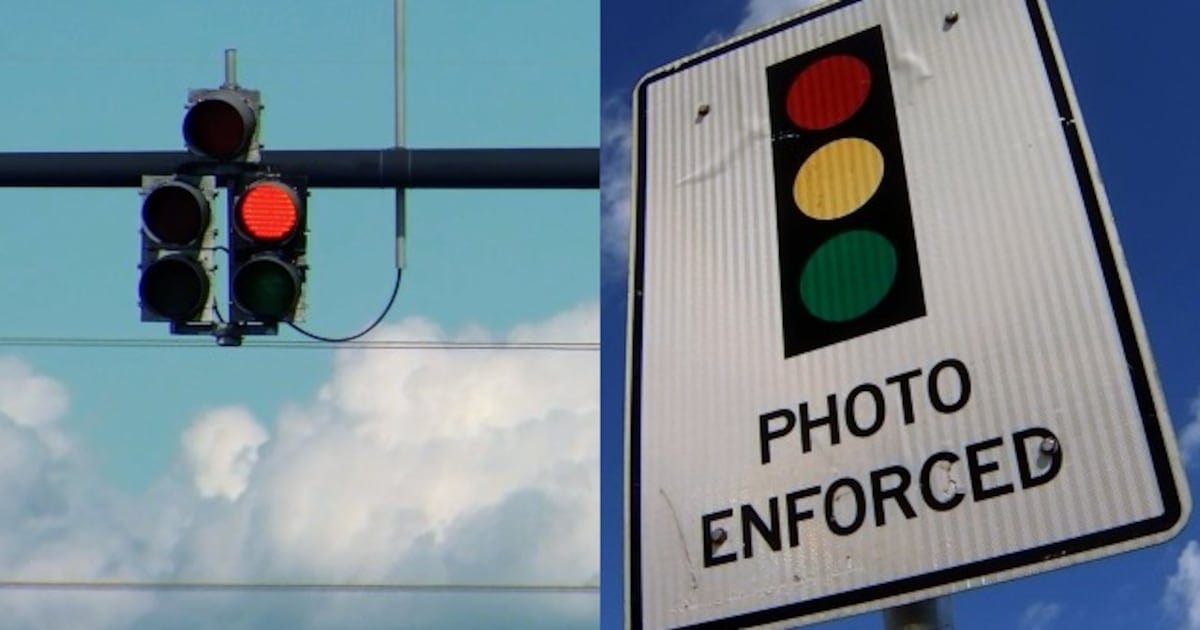
At a January 28 meeting of the Town of Orange Park's Public Safety Public Works Committee, members grappled with a familiar question: whether to expand the town's red-light camera program to one of its most crash-prone intersections.
The discussion centered on the Wells Road and Park Avenue intersection, where Police Chief Randy Case presented data showing 138 crashes from 2022–2024, including eight confirmed red-light violations.
While the chief described the site as the town's highest-crash location—surpassing even recently re-engineered nearby intersections—committee members and a resident in the audience expressed measured caution about introducing more automated enforcement.
The proposal from Verra Mobility, the town's current camera vendor, called for installing four new cameras at the large, complex intersection. The company offered a discounted rate of $3,500 per camera per month if the town extended its contract by three years, down from the existing $4,250 per camera. This would increase the town's monthly camera expenditure from about $29,750 to $38,500.
The increased cameras would amount to a windfall of $315,000 for Verra Mobility over the life of the contract.
Verra Mobility has sway with the powers that be in town, as former Orange Park Police Chief Gary Goble is now a “Senior Account Manager” for the company, according to his LinkedIn profile.

Last year, Goble published an article on Officer.com arguing that technology in policing should be fully trusted to “help keep the public safe.”
Chief Case made the same argument during the meeting, stressing that the primary goal was public safety, not revenue generation. He noted that cameras at the town's three existing intersections (eight cameras total) have contributed to behavioral changes and a reduction in violations over time. GPS apps now warn drivers of camera locations, and required signage further alerts motorists.
Case made several references to the risk of drivers being killed at the intersections where the new cameras would be placed. But none of the 138 accidents at Wells Rd and Park Ave involved a fatality. And only 8 of the accidents involved a driver running a red light, which is just under 6%.
Neither the Town of Orange Park nor Verra Mobility has ever provided data showing definitive decreases in dangerous driving at the intersections currently covered by the red light cameras.
One intersection in particular, Debarry Ave and Kingsley Ave, had single-digit accident numbers before the red-light camera and has not seen a decrease since installation.
Yet the financial picture drew scrutiny. The town nets roughly $78 per citation after state-mandated shares are taken for funds such as spinal injury research and medical programs.
With about 19,000 tickets issued annually town-wide (averaging 52 per day), the program generates significant revenue—over $2 million gross in recent reporting periods, with the state claiming a substantial portion.
Critics have long questioned whether such systems prioritize safety or municipal budgets, especially in a small town where cameras already cover key thoroughfares along high-traffic corridors like U.S. 17 (Park Avenue).
Resident Pete Johnston, attending the meeting, voiced concerns about the optics of adding more cameras. "I don't want the town of Orange Park labeled as a problem like Waldo was," he said, referencing the infamous Florida speed-trap town.
He questioned how many tickets would be needed just to cover the new cameras' costs and suggested exploring percentage-based contracts instead of fixed monthly fees.
Committee members, including Chairman Glenn Taylor and Mayor Randy Anderson, appeared reluctant to rush into expansion. They favored starting with simpler, less controversial measures: additional "High Crash Area – Use Caution" signage coordinated through the Florida Department of Transportation (FDOT), which oversees the state road.
The committee unanimously approved a motion to pursue signage and update crash data through mid-2025, with plans to monitor results for a year before revisiting cameras.
FDOT has previously resisted changes like protected left-turn arrows at the intersection, citing potential backups. Easement issues for camera placement also remain unresolved, tied to property line discrepancies.
The debate reflects broader ambivalence in Orange Park, where red light cameras have operated for over a decade and generated millions in fines.
While proponents point to deterrence and crash reduction at monitored sites, skeptics—including some residents and past media reports—wonder if the systems function more as reliable revenue streams than pure safety tools.
With traffic volumes exceeding 88,000 vehicles daily on Park Avenue and ongoing regional growth, the committee's preference for signage-first signals a preference for low-cost, non-punitive steps before committing to further surveillance.
No final decision on cameras has been made; the issue remains deferred pending the impacts of new signage and new data. The full Town Council would ultimately vote on any expansion.
If a red light camera was only about safety, not revenue, then all fines generated would be given to local charities, not to government. If it was about safety and deterrence, then infractions would be treated the same as if an officer issued a ticket for running the red light. In each case the act of the red light runner is the same.
Red light cameras, in some instances, can cause accidents rather than prevent them as drivers slam on their brakes in fear of getting a ticket at a yellow light and end up inadvertently causing a rear-end collision. This is clearly just a money grab.