


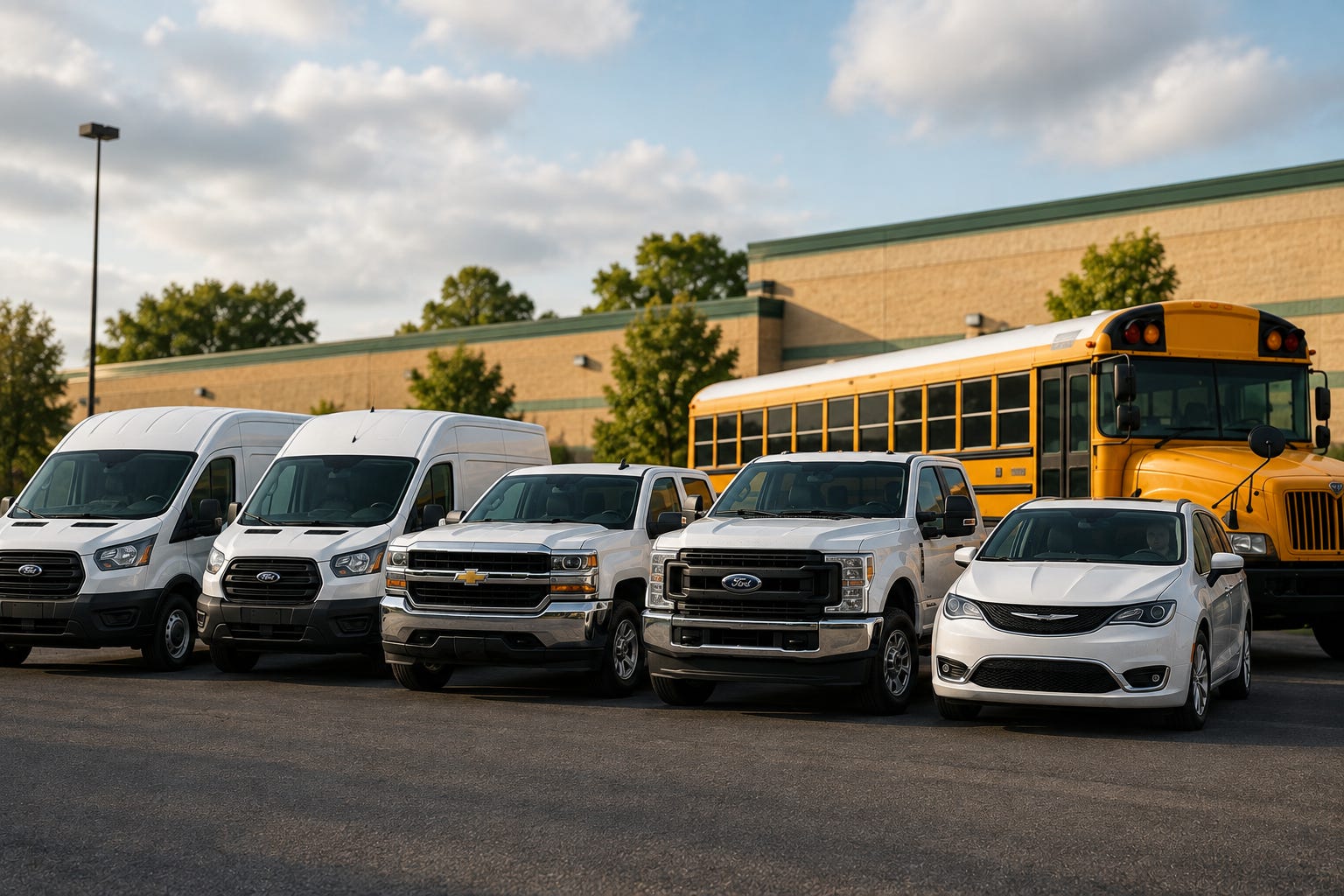
The Clay County School Board is set to approve a new five-year contract that will put dozens of Ford, Chevrolet and Chrysler vehicles into the district’s transportation fleet, at an estimated cost of roughly $600,000 a year, a figure that, according to the vendor’s own financial projections, could rise substantially over the life of the deal.
The contract, with St. Louis-based Enterprise Fleet Management, covers 50 new vehicles under five-year leases, plus ongoing maintenance and tracking services for 100 vehicles still in the district’s existing “white fleet.” It is scheduled to go before the School Board today.
The order calls for 10 each of five vehicle types:
Ford Transit 350 cargo van — $954.66 per month lease, $73.15 per month for maintenance and GPS, or $12,333.72 per vehicle annually
Ford Transit 250 cargo van — $932.35 per month lease, $68.88 per month maintenance and GPS, or $12,014.76 per vehicle annually
Chevrolet Silverado 1500 work truck — $771.76 per month lease, $66.50 per month maintenance and GPS, or $10,059.12 per vehicle annually
Ford F-250 pickup — $990.64 per month lease, $71.97 per month maintenance and GPS, or $12,751.32 per vehicle annually
Chrysler Pacifica passenger van — $801.64 per month lease, $64.45 per month maintenance and GPS, or $10,393.08 per vehicle annually
Combined, the 50 leased vehicles will cost the district roughly $575,520 a year in lease payments and full maintenance coverage, according to figures in the contract.
An additional $31,380 a year covers maintenance management and GPS telematics on 100 vehicles the district has not yet replaced, bringing the total to just under $607,000 annually, in line with the district’s own $600,000 estimate.
A Price Tag That Could Grow
That figure covers only this initial 50-vehicle order. The district’s total fleet numbers 228 vehicles, and Enterprise’s own long-range planning documents, included in the contract package, model what happens if the district continues replacing vehicles at a similar pace in the years ahead.
Those projections show lease costs climbing sharply: from about $814,000 in the program’s first year to nearly $986,000 in year two, more than $1.15 million in year three, and roughly $1.33 million by year four, as more of the district’s vehicles shift from ownership to leasing.
The same projections show the district’s net cash position — factoring in lease costs, maintenance, fuel and other fleet expenses against savings — turning negative in years two through four, with shortfalls estimated at roughly $31,000, $87,000 and $201,000 in those years, respectively, before an anticipated rebound tied to a later round of vehicle sales.
The Surplus Vehicle Credit
A significant part of the district’s near-term math hinges on the sale of 141 surplus vehicles. These older units are being phased out as new leases take effect. Enterprise’s contract materials estimate those vehicles will fetch about $884,477.50 at consignment auction, an amount the company nets against roughly $431,640 in lease payments due in the program’s first partial year.
On paper, that yields a net negative cost, with projected auction proceeds from the surplus vehicles exceeding what the district would owe in new lease payments during that stretch.
But that estimate comes with an explicit caveat buried in Enterprise’s own planning documents: the surplus fleet’s value was calculated “sight unseen,” and the company warns the figures “can be adjusted after physical inspection and may change based on market factors” — meaning the actual proceeds, and therefore the size of any offset, are not guaranteed and could come in lower once the vehicles are appraised and sold.
Unlike the annual lease and maintenance costs, which recur over the life of the contract, the surplus-vehicle credit is a one-time event tied to a fixed pool of aging vehicles. Once those 141 units are sold, that source of savings does not recur, meaning the recurring cost of roughly $600,000 a year is likely to determine the district’s ongoing budget obligation once the initial surplus sales are complete.

Clay School District 'White Fleet' Too Big, Too Old

The data provided in this article is from the presentation deck supplied to the School Board by Enterprise Fleet Management. The full presentation can be found here.