‘Start With the Top and Work Downward’: CN&V Readers Chime In on County Budget
After Amendment 3, Survey Respondents Favor Cuts at the Top and Reject New Fees


Florida voters approved Amendment 3 on Nov. 3rd. The measure raises the homestead exemption on non-school property taxes from $50,000 to $150,000 in 2027, then to $250,000 in 2028. It takes effect Jan. 1st, 2027.
That means less property tax money for Clay County government. Commissioners and constitutional officers will have to decide what to trim.
Clay News & Views asked readers for their ideas. We ran a survey on Substack and a separate anonymous version that we shared on social media. In all, 208 people responded.
Their message was consistent. Start at the top.
The Results
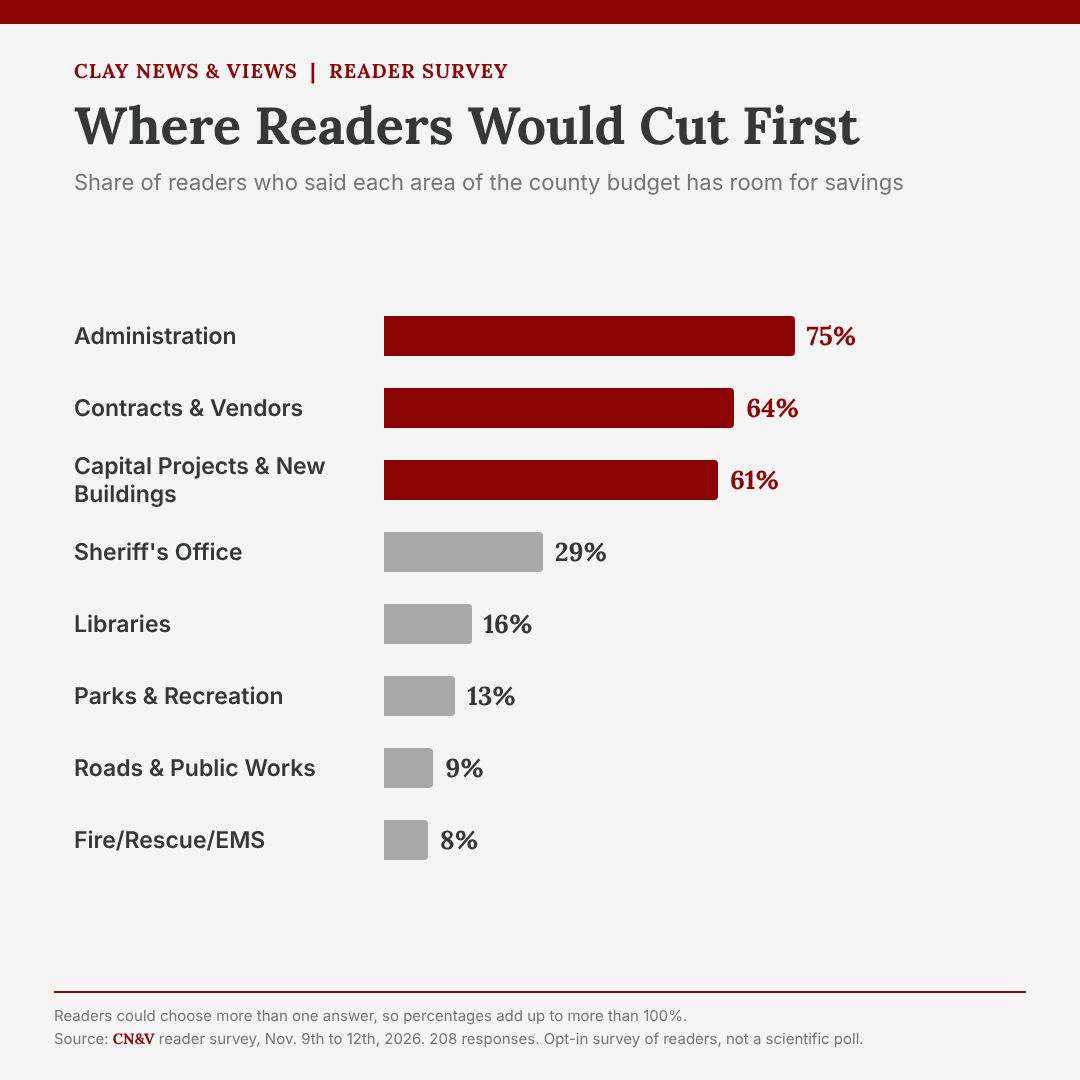
We asked readers to pick the areas of the county budget with the most room for savings. They could choose more than one.
We also asked which services matter most and should be protected.
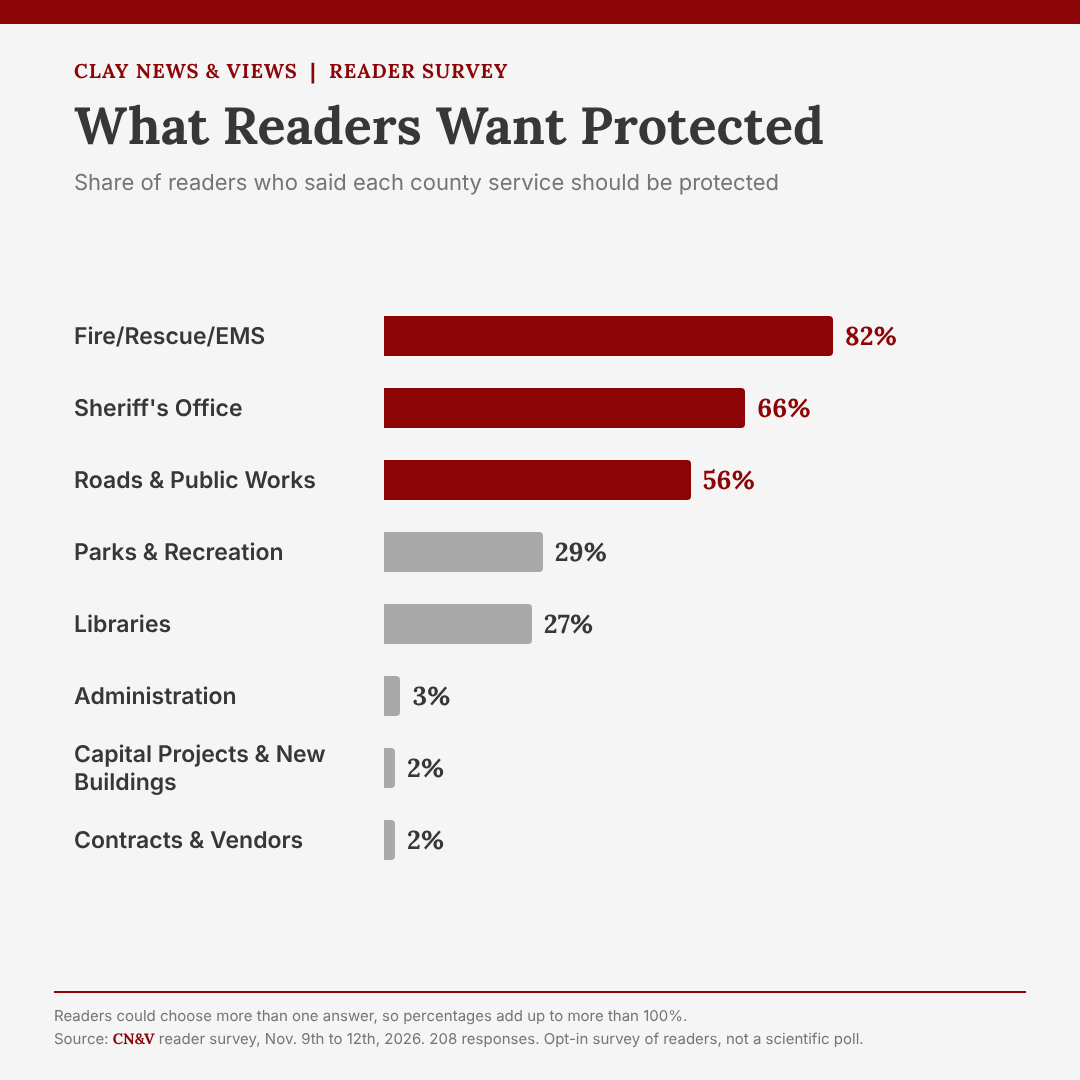
The two lists are close to mirror images. Readers want to protect first responders and roads. They see administration, contracts, and new buildings as the first place to look for cuts.
Both versions of the survey produced nearly the same rankings. Substack subscribers and social media users reached the same conclusions.
Trim the Top
Readers wrote more about leadership pay and administrative layers than any other topic. Many questioned how many assistant county managers there are. Others pointed to salaries for top officials across county government.
“Start with the top and work downward,” one reader wrote.
“Cut the bloat at the top. Too many admin roles that are not necessary,” wrote another.
A third reader put it this way: “The county needs employees that do the work, not so many managers supervising it.”
The view was shared by people who work inside county government. Twenty-six respondents said they are current or former county employees. Twenty of them, or 77%, picked Administration as a place to cut. That matches the rest of the survey.
Protect Deputies, Review the Rest
The Sheriff’s Office landed on both lists. Two out of three readers want it protected. Nearly three in ten see room for savings. Eighteen people checked it on both lists.
The written comments explain the split. Readers want patrol and emergency response protected. Their suggested cuts focused on command staff, take-home vehicles, the cost of new patrol vehicles, Flock license plate cameras and new facilities.
“Determine what is essential (police/fire/rescue, etc.) and non-essential (admin/other). Then cut or reduce only non-essential projects and services,” one reader wrote.
Take-home vehicles came up for county employees in general.
“Letting people drive county vehicles home, why can’t they drive their personal vehicles to work?” one reader asked.
Flock cameras drew pointed comments. “Bye bye Flock cameras and similar warrantless surveillance devices,” one reader wrote.
Buildings and Contracts
Six in ten readers picked capital projects and new buildings. Several mentioned the proposed Public Safety Complex. Others asked why the county keeps building new facilities.
“Stop funding large projects that don’t actually bring value to everyday people,” one reader wrote.
“Why can’t the older buildings be used? It’s wasteful to build new ones,” wrote another.
On contracts, readers asked for wider competitive bidding and fewer consultants. Several said projects take too long, driving up costs.
“Look at all outside purchases and bid them out. Reward departments that come up with cuts that don’t hamper services,” one reader suggested.
Growth Should Pay Its Way
Many readers connected the budget to growth. They want new development to cover more of the cost of the roads, sewer lines and services it requires.
“New development needs to pay for itself,” one reader wrote. “No infrastructure handouts to developers.”
No to New Fees
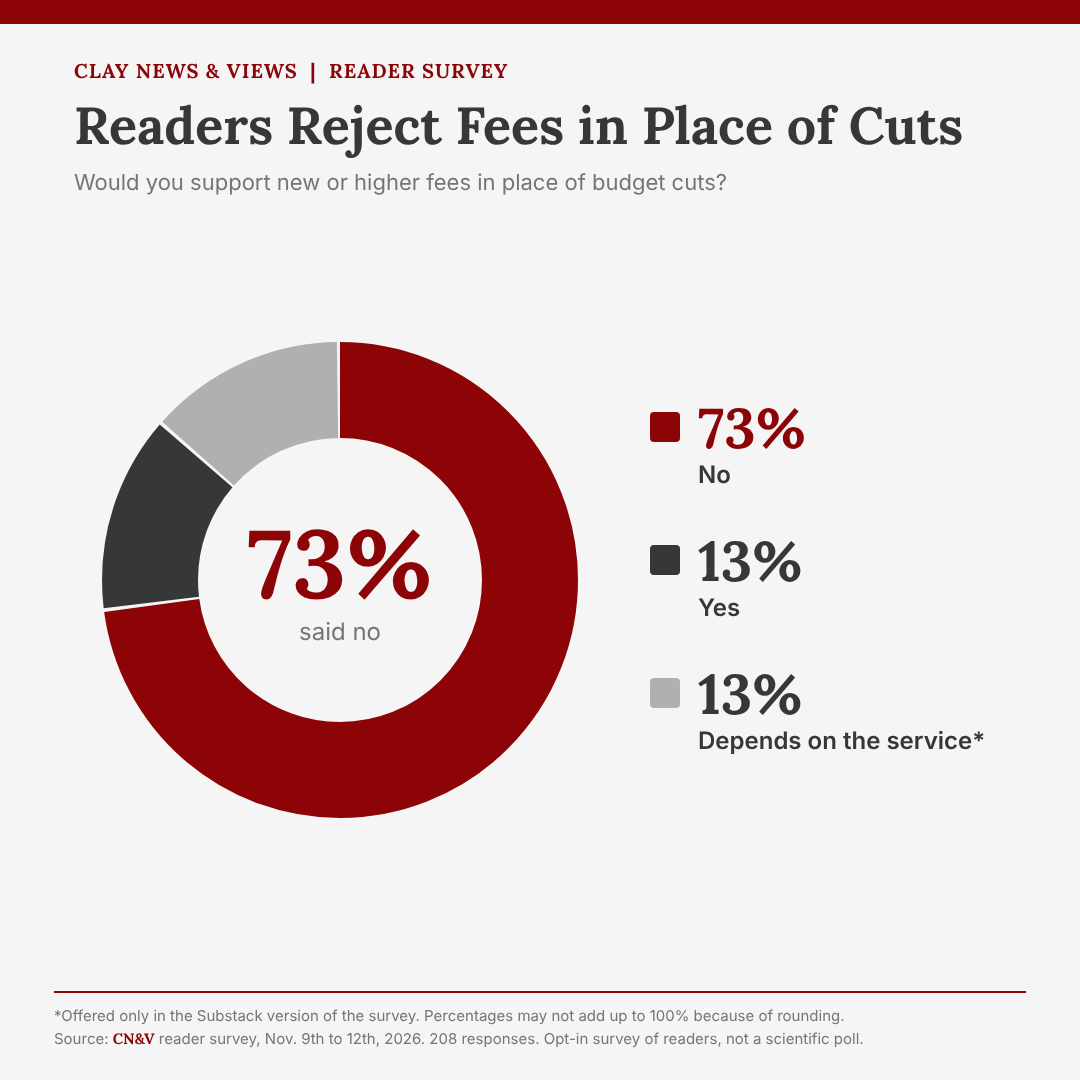
We asked whether readers would support new or higher fees in place of cuts. Nearly three in four said no. About 13% said yes.
The Substack version also offered “Depends on the service.” Twenty-eight readers chose that answer.
One reader linked the question to the vote itself. “Wouldn’t higher fees in place of cuts be the exact reason why there was opposition to this amendment?”
Another reader was open to fees with conditions. “I’m fine paying fees if they are proposed and properly accounted for.”
Other Voices
Readers did not all agree.
Some suggested shorter library hours or fewer branches. Others listed libraries among the services to protect. One frequent library user suggested trimming hours when branches are quiet. “That is not me advocating to end them,” the reader wrote, “but to reduce resources to when they are most utilized.”
Another reader noted that waste depends on who is looking. “I think waste is in the eye of the beholder and what services you actually use in the county.”
Some readers worried about the cuts themselves. “I’m truly concerned that the long-term health of our county will be sacrificed for short-term tax relief,” one wrote. “Only time will tell.”
Another reader pointed to the employees who will absorb the changes. “The hardest part is that individuals have to take on more workload and stress because of these cuts that everyday citizens don’t see.”
One reader questioned the survey itself. “You think you can look at a budget and understand every aspect of running a government when you’re only getting a portion of the picture.”
Readers Want to See the Numbers
That last point came up often, from the other direction. Many readers said they want to help but need better information first.
“Show us a line-by-line list of spending if you want us to help you figure this out,” one reader wrote.
“It is impossible for us to know this answer as citizens,” wrote another. “We need to rely on audits.”
Readers asked for independent audits, zero-based budgeting, and clearer explanations of what each department does with its money.
“Could the leaders share more transparency about what each of these departments of our community do and spend their funds on?” one reader asked.
What Comes Next
Several readers also sent specific tips about county spending. We are reviewing those and will report on anything we can confirm.
Have a tip or a document you’d like to share privately? Email us at info@clayviews.com.
About This Survey
CN&V ran two versions of this survey beginning Nov. 9th. One was open to Substack subscribers. The other was an anonymous version shared on social media. The results here combine 208 responses collected through Nov. 12th. We removed one apparent duplicate and one response from a CN&V staff member.
Readers chose to take part. The results reflect the views of those who responded, and they are not a scientific poll of Clay County residents. Percentages are rounded. Quotes were lightly edited for spelling and punctuation. We have withheld all names and identifying details.
Discussion about this post