


Part 1 of this series broke down the six contracts between Clay County and Flock Safety, who signed them, the equipment, and what they cost. This piece examines the patents, software, and the county’s largest, least-understood purchase: a system built to absorb thousands of camera feeds and track everyone in the county.
Flock Safety’s own FAQ page states plainly that its technology is “not a live-tracking system” and that “each image is a standalone vehicle event.” Law enforcement officials across the country, including here in Florida, have repeated some version of that same claim for years. It is not true, and the company’s own patents and product catalog prove it.
A single license plate photo is a standalone event. A year’s worth of photos of the same vehicle, cross-referenced against every other vehicle it was ever near, searchable by plain language, viewable across county and state lines, is not a standalone event.
It is the ability to answer where this car has been, who it has been near, and how often, going back twelve months. That capability, not the plate photo itself, is the product Flock is actually selling, and it is the product Clay County paid extra to keep for a full year instead of 30 days.
This piece lays out exactly how that tracking works, using Flock’s own patents, software, and marketing materials as the evidence.
The Patent: Flock’s Own Blueprint for Tracking People
In 2018, Flock Group Inc. filed for a patent covering the core system behind its entire product line. The patent was issued in 2022 as US Patent 11,416,545. Its two named inventors are Garrett Langley, Flock’s CEO, and Matt Feury, Flock’s co-founder.

The patent describes what it calls a “Dynamic Surveillance and Object-Based Query” system. In plain language, it is a method for pulling video from many separate camera sources that have nothing to do with each other, and combining them into one searchable network.
The patent lists the kinds of cameras this system is built to absorb. Neighborhood watch cameras. Home security systems. Commercial security cameras. Traffic monitoring cameras. Even a bystander’s smartphone.
This is the same idea now running in Clay County as the Wing Gateway system and the Camera Registry, described five years before either contract was signed.
One example in the patent is worth quoting directly, because it removes any doubt about what this system is designed to do. The patent describes a feature that can recognize when a person seen by any camera in the network matches a specific individual the system has been told to watch for.
For example, the patent describes the system identifying a subscriber’s teenage daughter and then automatically sending an alert to the subscriber’s phone.
Here’s the exact language from the patent:
"For example, alert triggering module 158 may recognize that a person detected in a video segment by object detection module 154 to be at a certain location at a certain time is statistically similar to the teenage daughter of a subscriber to the DSOQ system and, in response, may cause an alert signal (e.g., an SMS communication) to be transmitted over network 130 to a smartphone associated with the subscriber."
Flock patented a system built to track a named person, in real time, wherever the network’s cameras happen to see them.
The patent also describes using “face recognition data points” to search for a specific person’s face across multiple, unrelated camera networks at once.
Flock has said in other contexts that its products do not use facial recognition. Whatever the current state of any specific camera on the market, the patent shows the system was designed with that exact capability in mind from the start.
The patent’s central walkthrough example makes the scope plain. A car is spotted near a crime scene. Investigators use the system to trace that same car through a completely unrelated traffic camera, then a convenience store’s private security footage, then use a face captured in that footage to search a third, separate network of home security cameras entirely.
Three independently owned camera systems, never built to talk to each other, stitched into one timeline by Flock’s software and fed into a neural network (AI).
This is the same company, the same founder, and largely the same idea now installed across Clay County. The patent is simply the moment Flock put it in writing.
What FlockOS Actually Does With the Data
It is easy to think of Flock as a company that takes pictures of license plates. That undersells what the software is built to do once it collects those pictures and everything else feeding into it.
FlockOS does not store isolated snapshots. It builds a searchable record of vehicle movement over time. Every camera event, meaning every time a vehicle passes a Flock device or a device feeding into FlockOS, includes not just the plate but the vehicle’s make, model, color, and identifying features like bumper stickers, roof racks, and dents.
Flock calls this a “Vehicle Fingerprint.” The system identifies and tracks a vehicle even when its plate is not fully visible or has been swapped.
Retention length determines how far back that search can reach. Flock’s standard default is 30 days. Clay County did not stop there. Contract C23-0007, covering the 95-camera roadway network, includes a paid add-on described as “Extended data retention (Up to 1 Year),” at a cost of $142,500.
Clay County Sheriff Michelle Cook paid extra, on top of everything else, specifically so that a full year of vehicle movement data would remain searchable rather than aging out after 30 days.
A year of retention means a year of patterns. It means anyone with Flock system access can look back and see not just where a specific car was on a specific day, but where it has been, how often, and alongside which other vehicles, across twelve months.
FlockOS uses the data to predict, in real time, where a car is traveling. Flock shows off this capability via their YouTube channel:
These built in features of FlockOS include tools explicitly designed to find relationships between vehicles, not just locate one. Multi-jurisdiction search lets an investigator follow a vehicle’s activity across county lines.
A feature Flock calls “Convoy” search is designed to identify vehicles that repeatedly travel together, surfacing what the company describes as “organized activity, accomplices, and patterns.”
None of that requires a crime to have occurred. It requires only that a vehicle, and whoever is driving it, passed enough cameras enough times.
Despite repeated denials by Flock, law enforcement agencies, and politicians, Flock’s system is not simply a tool for looking up a single plate after a single crime.
It is architecture built to track patterns of association, movement, and behavior across an entire community, over whatever time window an agency is willing to pay for.
Clay County paid for the longest window Flock offers.
All tools and data provided by Flock can be accessed without a warrant or even suspicion that a crime has been committed. Coupled with a lack of oversight from Flock and the agencies using its services, the system is ripe for abuse, which we’ll exmaine in part three of this series.
LPR Pro: Flock’s Own Marketing Proves the Point
Flock’s newest camera line, called LPR Pro, makes this explicit. It is marketed directly to law enforcement agencies as an upgrade from Flock’s standard cameras, and its features describe exactly the kind of tracking system this article has been describing, not as a side effect, but as the sales pitch.
Detailing it as the “single greatest change since DNA”, Flock’s own product page outlines the new LPR Pro’s enhanced capabilities.
Freeform Search allows an investigator to search using plain-language descriptions instead of an exact plate number. A partial plate, a vehicle description, or a few remembered details are enough to generate leads.
Multi-GEO Insights is built to “uncover vehicle activity across jurisdictions,” letting an agency follow a vehicle’s movement as it crosses from one jurisdiction into another.
Convoy Search is designed to “identify vehicles traveling together,” explicitly marketed as a way to uncover “organized activity, accomplices, and patterns that traditional plate searches may never reveal.”
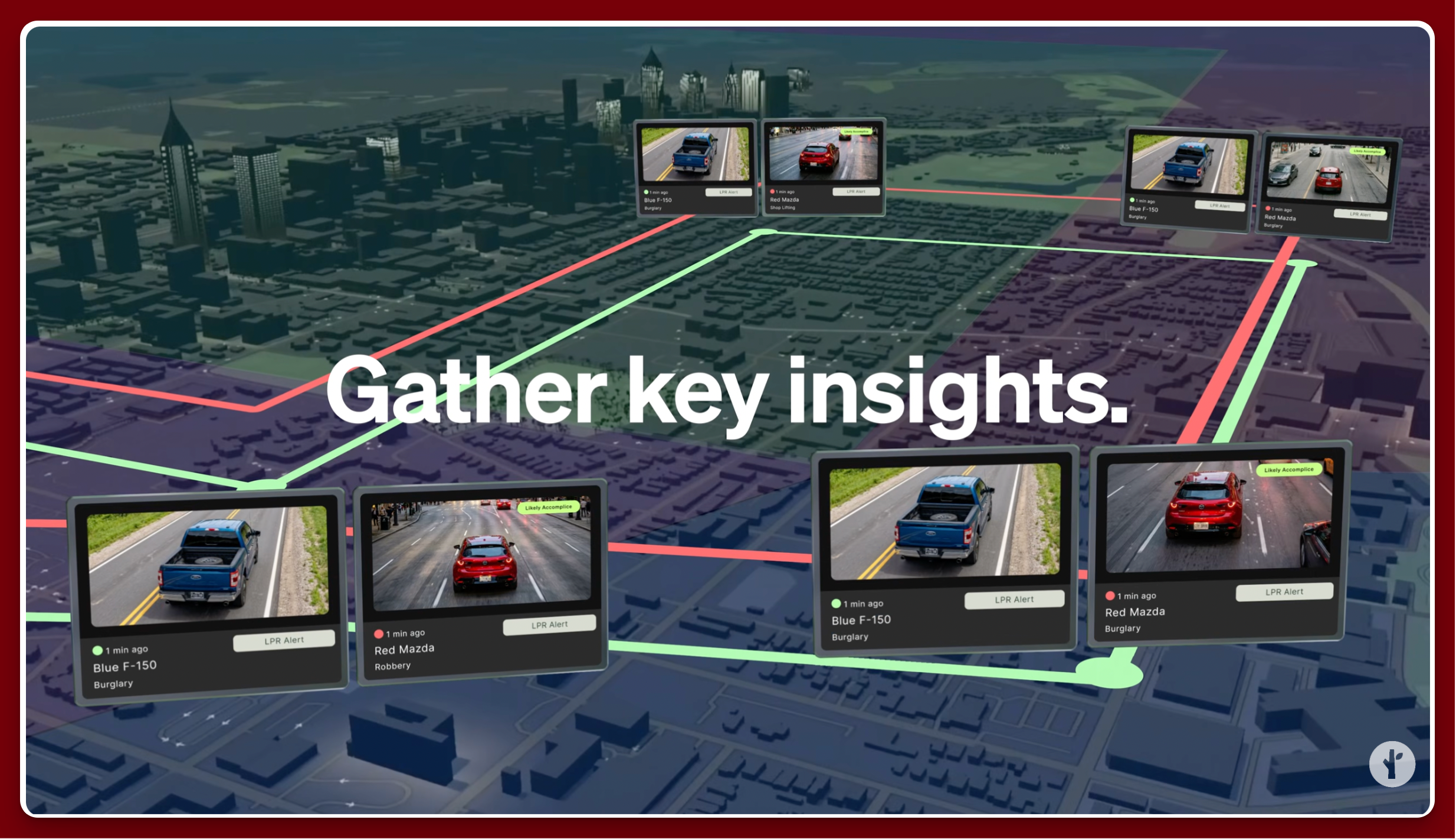
Advanced NightVision improves image capture in low light, extending reliable tracking into nighttime hours.
Visual Search lets an investigator upload an image and search using vehicle characteristics alone, without needing a plate number.
Read together, these are relationship-mapping tools, a far cry from the simple APLR camera advertised by Flock. Convoy Search in particular has nothing to do with reading a single license plate.
Its entire purpose is identifying who travels with whom, how often, and where. Multi-GEO Insights exists to erase jurisdictional boundaries as a limit on tracking. Visual Search exists so a plate isn't even required to start building a profile of a vehicle’s movements.
As of this writing, Flock lists LPR Pro as available on its website, following a waitlist rollout. Clay County has not indicated whether any of its contracts include or will be upgraded to LPR Pro.
That is a direct, answerable question to put to CCSO, since the county’s existing Falcon cameras and its extended one-year retention purchase make it a natural next customer for this upgrade.
The Wing Gateway: How Outside Cameras Get Pulled Into FlockOS
Flock’s network extends beyond its own Falcon and Condor cameras. Flock designed and built a device that can pull in any camera a law enforcement agency has access to, called the Wing Gateway.
CCSO’s Wing Gateway contract, covered in Part 1, installs 104 network devices across the county. Their job is simple. They plug into cameras CCSO does not own and pull that video into FlockOS.
Clay County’s contract documents state the cameras were already “being ingested into FUSUS via FUSUS core.” FUSUS is a separate real-time crime center platform, now owned by Axon, the Taser and body-camera company.
FUSUS connects to existing security and traffic cameras, regardless of brand, and streams their footage into one dashboard that law enforcement can search and monitor live. Before the Wing Gateway contract, many of Clay County’s outside camera feeds reached the sheriff’s office this way.
The Wing Gateway devices serve the same role, but for Flock. Each gateway plugs directly into a group of existing IP cameras, from 8 to 128 at a time depending on the model, and routes their feeds into FlockOS instead of, or alongside, FUSUS.
The effect is that cameras never manufactured or sold by Flock, cameras owned by businesses, HOAs, or other government buildings, become searchable inside Flock’s own platform once connected through a gateway.
Together, the 104 Wing Gateway devices purchased can pull in 1,520 camera streams, though the statement of work configures only up to 100 to start. That leaves substantial room to grow the network without buying more hardware.
Clay County’s Flock contracts were framed, publicly, around license plate readers on roadways. The patents, underlying software, and the company’s newest product reveal a system built for something larger: continuous tracking of vehicles, their associations, their movement patterns, and eventually people.
Part three series examines the vulnerabilities in Flock’s network and the cases of abuse of the system by law enforcement officers across the country
